
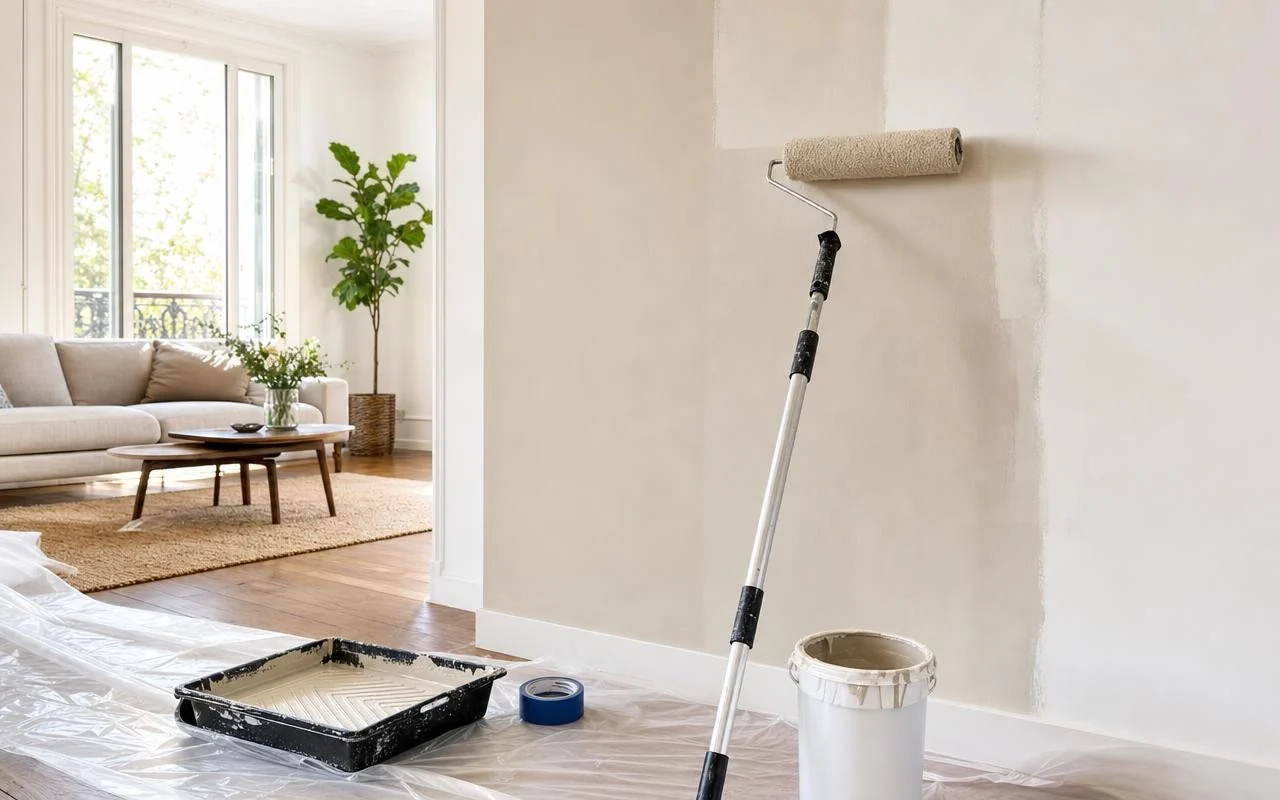
When you watch a building painter at work, one detail stands out quickly: his roller seems gigantic. Nothing to do with the small sleeve you find in most DIY kits. This roller is often 18 inches wide, a size that can surprise those accustomed to the standard 9 inches used by homeowners. If he has adopted this bulky tool, it’s not only because he’s in a hurry to finish the job.
In reality, an 18-inch paint roller spans about 46 cm in width, almost double that of a standard model. DIY enthusiasts often shun it, unaware that it was designed for the pace of professional sites: large surfaces, high ceilings, floors to repaint. Behind this unusual width lies a precise logic of speed, comfort and finish quality. And a few highly targeted uses that speak especially to professionals.
An 18-inch paint roller to speed up painting large surfaces
On a living room wall, a long corridor or an workshop ceiling, the strength of the 18-inch paint roller is simply the surface covered with each pass. Manufacturers remind that the standard 9-inch format remains versatile, but widths of 14 and 18 inches substantially boost productivity on large areas. A 14-inch model can already save more than half the time compared to a 9-inch; with 18 inches, the gains become striking as soon as you have space ahead of you.
With this width almost always comes a telescopic pole screwed into the frame. The painter stays on the ground, avoids climbs up and down ladders, and maintains a continuous motion, which further speeds up the pace. The 18-inch frame, U-shaped and held at both ends, supports the heavy weight of the paint-loaded sleeve. At first, the setup feels heavy and unstable, but professionals quickly learn to modulate pressure and keep the roller flat.
Fewer touch-up marks and a more even finish with an 18-inch roller
Speed isn’t the only challenge. Each time a roller returns to an area where the paint has started to dry, it can leave “lap marks,” a darker or shinier band visible under grazing light. Manufacturers like Sherwin-Williams describe this phenomenon as one of the most common defects on interior walls. With a wide roller, the number of overlaps decreases and the wall more easily preserves a wet edge, the famous wet edge, which greatly limits these marks.
Painters also use the 18-inch for back rolling after airless spraying. The machine lays down the paint very quickly, but sometimes unevenly: too much on ridges, not enough in micro-crevices. By immediately going back over with a wide dry roller or slightly loaded, they flatten the film, push out the excess and fill the gaps. Since the product is already on the surface, they don’t have to reload, and the broad width makes this smoothing step much faster on ceilings and large walls.
When to choose the 18-inch roller rather than a 9-inch
An 18-inch isn’t suitable everywhere. Its weight tires you out quickly, and it becomes awkward in small or very furnished rooms. It also requires dedicated equipment: a large frame, an appropriate tray or a specific bucket, items that not all DIYers have at hand.
Painters mainly use it on large, unobstructed walls, ceilings or floors. To start, a 9-inch roller is more than sufficient; the 18-inch format becomes interesting when you have mastered the gesture and you really have a lot of surface to cover in a minimum number of passes.
