
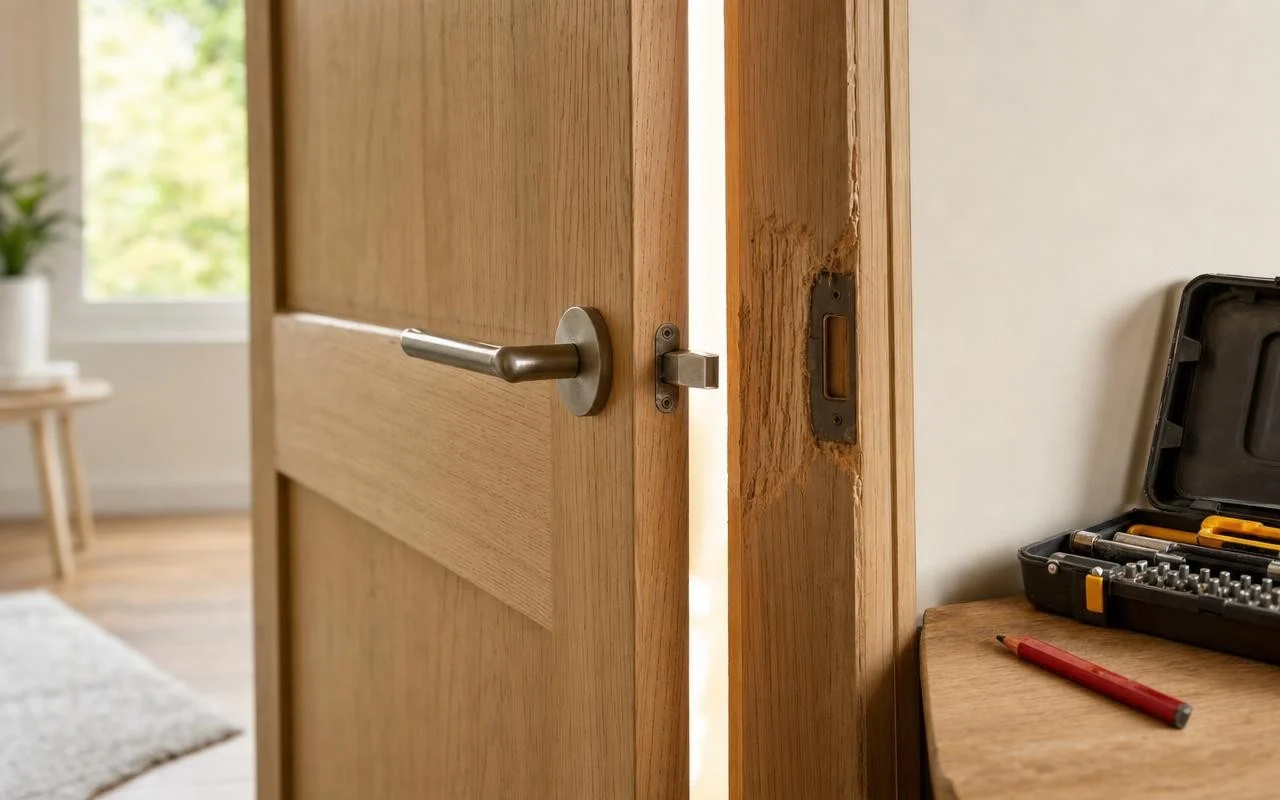
When the heat arrives, many interior doors suddenly start rubbing, sticking, or getting jammed halfway. We push harder, get annoyed, then often grab the blue-and-yellow spray you see in every garage. A dash of WD-40 on the hinges and you hope the door will slide back to a smooth, easy close.
This instinct may seem logical, but for a sticking door, it rarely targets the real issue. Wood swells with moisture, the frame shifts a little, the door is no longer perfectly aligned with its original position. And no matter how much spray you apply on the hinges, the door still scrapes: the true solution lies elsewhere.
Why a door that sticks has nothing to do with a lack of lubrication
Wood is hygroscopic: it absorbs moisture from the air and swells when the air is humid and heavy, then contracts when the air dries out again. A door sits very close to its frame; if the panel swells by a few millimeters in summer, it starts rubbing on the top, bottom, or sides of the frame, or even on the floor.
Many people also notice that the door opens and closes without issue in winter, then gets stuck at the first heat waves. In that case, the noise doesn’t come from the hinges but from the wood pushing against the frame. WD-40 may quiet a creak, but this product is mainly a solvent that lifts oils already present on the hinges. The effect on a sticking door remains modest and doesn’t last beyond a few weeks.
What to use instead of WD-40 for a sticking door
Before bringing out the sander, a quick check of the hinges is essential. A door can sag a bit over time: tighten all the screws, replace those that turn in the hole with screws that are slightly longer, and if necessary add thin washers behind a hinge to straighten the angle. After each adjustment, open and close to see if the rubbing has disappeared.
If the door still rubs, the long-term solution is to remove a little wood where it catches. Identify the area by slowly opening and closing, then mark the edge with a pencil. Once the door is off, sand gradually with an electric sander or a simple block.
- Clean the door to remove dust and dirt.
- Sand the marked area, removing only a tiny amount of material with each pass.
- Put the door back in place and test several times.
- If rubbing is significant, finish with a rabot (hand plane) for a precise adjustment.
Finish the job properly to prevent the door from sticking again
DIY guides emphasize one key point: don’t remove too much wood. If you plane too much during a humid summer, you risk ending up with a door that “floats” and allows air to pass when the wood contracts in winter. It is better to proceed in small steps, consistently testing the opening and closing.
After planing, the door edge is often bare. To limit moisture absorption and prevent the problem from returning, apply a coat of paint, varnish, or a protective finish to the exposed wood. In very humid rooms, a budget dehumidifier, available for around 50 dollars (approximately 46 €), also helps stabilize the air. With these targeted actions, the door regains smooth operation, without relying on a can of WD-40.
