
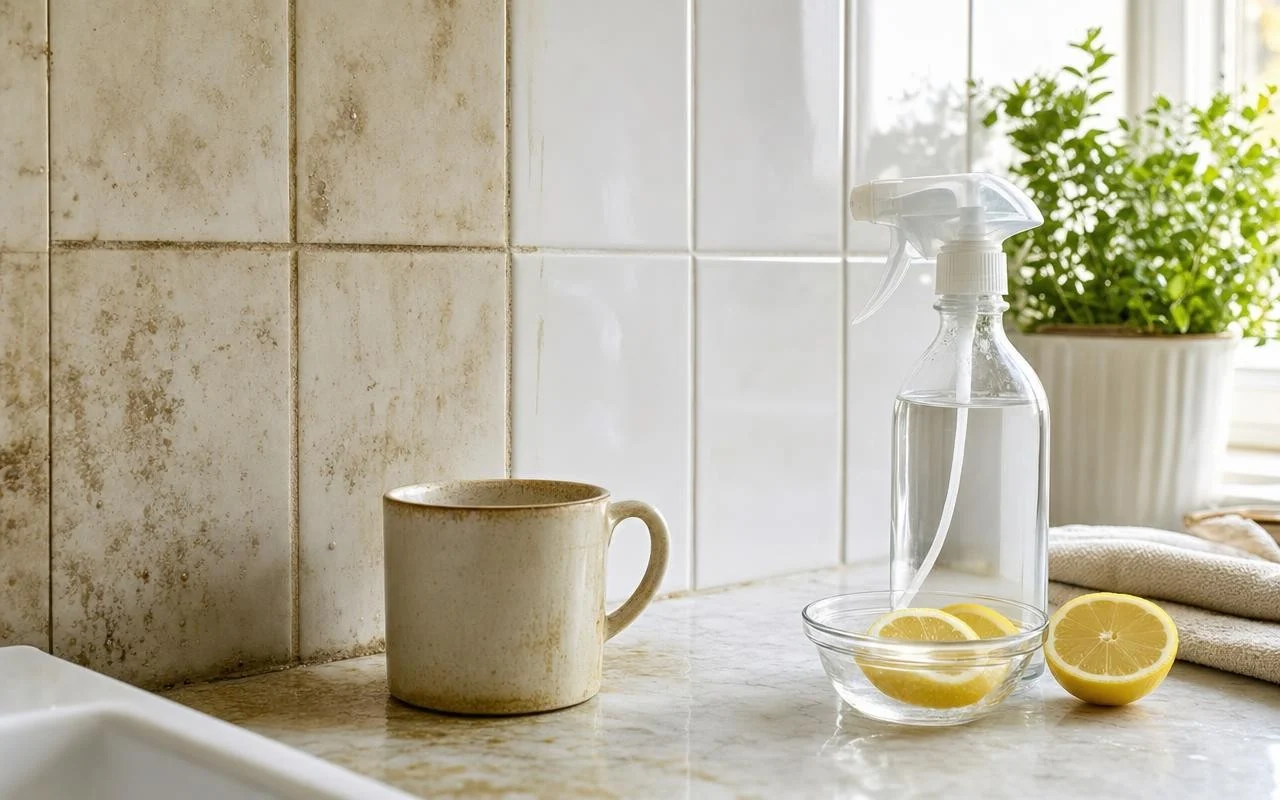
A porcelain mug yellowed by tea, a ceramic sink marred with marks or a white haze: many immediately reach for the duo of white vinegar and citric acid, touted as the miracle combo. On delicate surfaces, the idea of combining two acidic products reassures some, unsettles others. Is this really the best way to lift stains without harming the enamel?
Many tutorials rely on these so‑called natural ingredients, while brands such as Briochin highlight a citric acid that is 100% naturally sourced, ECOCERT-certified, paired with household vinegar. By contrast, chemistry sites judge this mix as of limited use, at best redundant. Between promises of a “second life” for your earthenware and doubts about the cocktail’s value, the question remains open.
Citric acid and vinegar recipe for earthenware: what the method promises
The Briochin site proposes a simple recipe for stained earthenware or porcelain. It advises to pour “one part citric acid and one part household vinegar, all mixed with hot water,” to let it sit for 30 minutes, then rinse while rubbing lightly. “And there you go, the result will surprise you. A simple trick that gives a second life to your earthenware and porcelains,” promises the brand.
This protocol works mainly because it combines three levers: an acidic solution, heat, and a sufficient dwell time. L’Atelier du Bricolage notes that when faced with limescale, the acid reacts with calcium carbonate and that effectiveness depends mostly on concentration and temperature. An enameled earthenware generally tolerates these solutions if you scrub with the soft side of the sponge and rinse well.
Mixing citric acid and vinegar: real gain or simply a duplicate on earthenware?
When reading chemists’ opinions, the picture is not so spectacular. For the site Chimie-Experts, pairing white vinegar and citric acid does not create a dangerous reaction, but only a slightly more acidic solution; the authors recommend choosing one or the other depending on the use. The site EtiketBio goes further, labeling this mixture as “rarely useful” and “not more effective than a well‑dosed citric acid” for descaling.
Applied to the kitchen or bathroom, this finding is clear: on earthenware or porcelain, the duo offers no better results than a single well‑measured acid left to act for 30 minutes. The Centre Services site suggests filling tea‑ or coffee‑stained porcelain cups with heated vinegar and letting it work for 30 minutes before scrubbing. In practice, patience, water warmth, and occasional repetition count more than the cocktail.
Choosing between vinegar and citric acid depending on the stain on porcelain
Behind a “stained earthenware,” several problems can hide. A white haze, droplets that have dried, or halos after drying indicate calcium carbonate deposits from hard water. L’Atelier du Bricolage reminds us that citric acid dissolved in hot water reacts with these deposits and helps loosen them from the glaze. For a ceramic dish or a sink bottom, a 30‑minute soak in this solution followed by a clear rinse often suffices, without adding vinegar.
If the stain is brownish and concentrated where liquid pools—such as the bottom of a mug or the rim of a basin—it mainly stems from tea or coffee pigments, sometimes fixed by a bit of limescale. In this case, warmed white vinegar or a citric acid solution work if the area is well covered, left for half an hour, then scrubbed with the soft side of a sponge. On a earthenware or porcelain piece in good condition, the choice of product, its dosage, and respecting the contact time matter far more than the idea of mixing them.
