
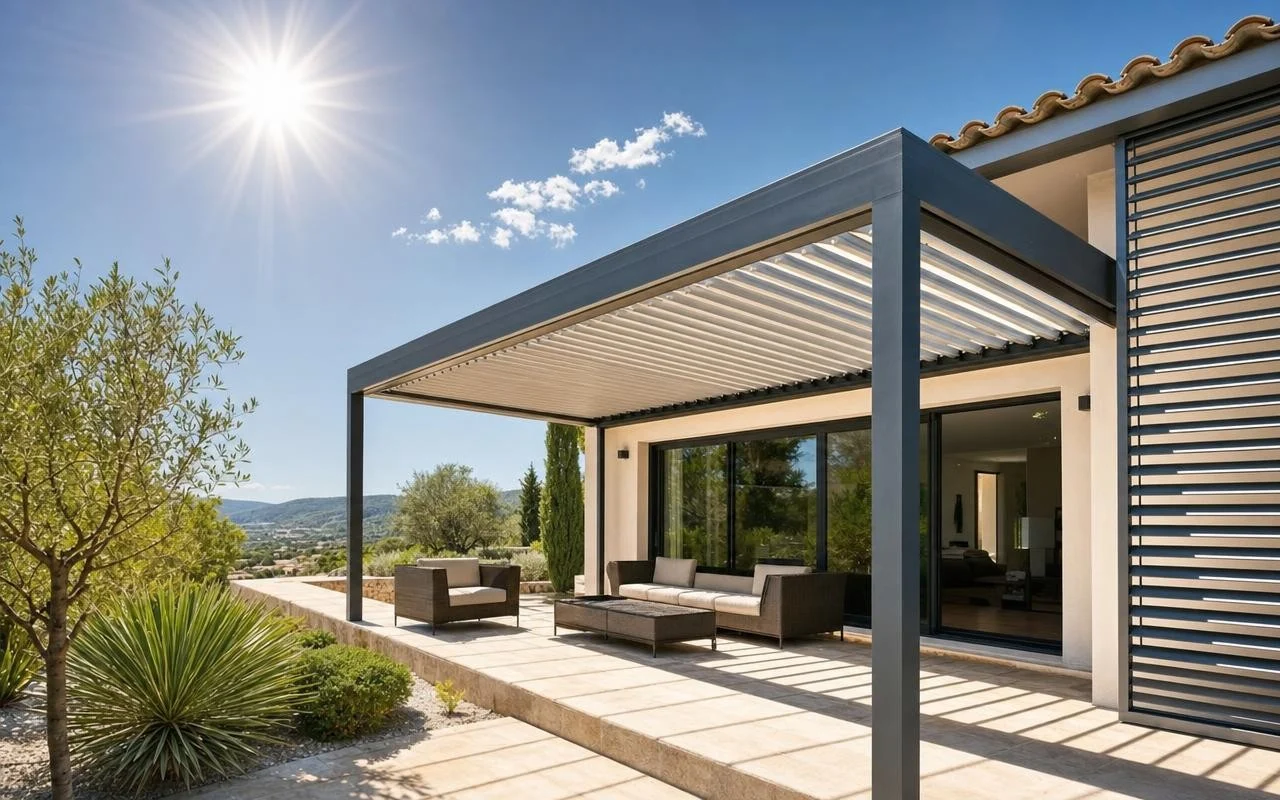
When I had my south-facing bioclimatic pergola installed, I pictured myself dining in soft light all summer long. South orientation, a large tiled terrace, a state-of-the-art aluminum frame: on paper, everything promised a life outdoors from morning to night. The installer spoke of thermal comfort and natural ventilation, magazines showcased dream terraces. Then the first heatwave arrived, and my beautiful pergola turned into a blazing oven.
I hadn’t considered the sun’s path or how my house would store heat. Like many, I mainly wanted to capture as much light as possible and enjoy a fully south-facing exterior touted as ideal. In reality, a terrace exposed directly to the sun becomes suffocating very quickly if the depth, blade angle, and side protections aren’t designed together. That’s what I realized that day, as I watched the thermometer climb and the terrace empty out.
South-facing bioclimatic pergola: when the sun-drenched dream turns into a furnace
In the height of summer, the sun hits my façade almost vertically for several hours. The gray slab and the aluminum posts absorb this energy, then radiate it back like a giant heater beneath the pergola. Without adequate air movement, the temperature climbs to the point where any activity becomes impossible, exactly what specialists describe when they speak of a space turning into a real furnace. Shade alone isn’t enough if the air remains stagnant and the ground continues to radiate.
Experts remind us that this type of exposure is bearable only if the overhang of the structure and the angle of the adjustable blades cut off the radiation just before the sun reaches its zenith. If the pergola is too shallow or poorly positioned, the blades let through the zenith rays that strike the terrace directly. Heat then accumulates on the paving and rises into the air instead of being vented outward. It is precisely this sizing error that ruined my first summer lunches.
Correcting a south-facing bioclimatic pergola: side screens, adjustments and plants
Once the heatwave has settled in, it’s hard to redo everything. The solutions then rely on side protections capable of blocking the scorching afternoon rays, those that come from the side and further heat walls and the ground. Professionals often recommend side screens specifically designed for pergolas, complemented by more decorative elements. Three options regularly appear on quotes.
- Micro-perforated vertical fabrics that filter ultraviolet rays while allowing air to pass.
- Sliding shutters made of certified wood, in an eco-friendly design.
- Long planters planted with sturdy climbers that naturally shade the structure.
Next comes the adjustment of the blades. Manufacturer guides explain that, on a south-facing façade, the blades are best kept parallel to the wall, with an opening of about 90 degrees during the hottest hours to block direct radiation while letting hot air rise. Some pergolas allow a rotation up to around 145 degrees to reintroduce light in the morning or evening.
Well preparing your bioclimatic pergola project in the face of heatwaves
For those who haven’t started construction yet, garden specialists remind us that a southeast or southwest exposure often provides a better refuge during the hottest hours. In some cases, even a west-facing façade proves effective. In Corps-Nuds, near Rennes, Laurence noticed this after installing her pergola: “We are located to the west, with the afternoon and setting sun, but it no longer hits the wall, which heats the house, and we can now achieve interior temperatures of 25-26 degrees, which wasn’t the case during the last heatwave,” she explains.
In Ille-et-Vilaine, during the summer of 2026, Alu Bertron has been installing “2 to 3 per week since June,” says Jérémy Havez. A bioclimatic pergola costs “on average around €20,000” and lead times are lengthening, with installations now pushed to mid-October.
