
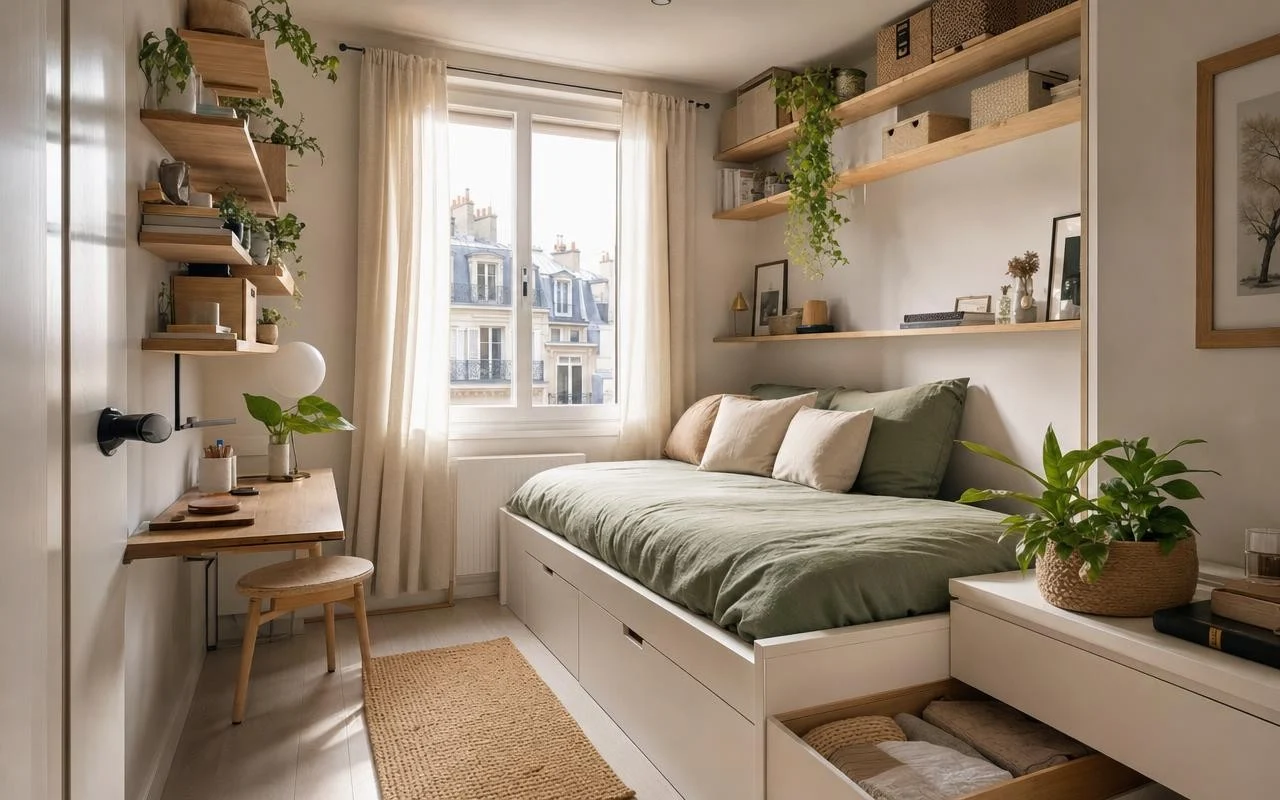
Your bedroom measures 9 m², the bed almost hugs the walls and, once the door is closed, you feel more like you’re camping than actually living. The bedside table overflows, the chair doubles as a coat rack, the wardrobe refuses to close, and every inch counts. This constant sense of saturation isn’t a foregone conclusion.
In a room under 10 m², the bed often takes up 40 to 50% of the floor space, and design specialists advise keeping 50 to 60 cm of clearance around it to move around comfortably. In other words, without a proper small bedroom under 10 m² organization, the space can quickly feel blocked and unlivable. Five very concrete tips can nonetheless make it much more functional.
Small Bedroom Organization: Sort First
There’s no room for adding furniture until the space has been lightened. The simplest method remains the four-bin approach: one box for what you keep, one for discard, one for recycle, and one for donate. Empty the wardrobe, the bedside table, the under-bed bins, then sort item by item, asking whether you truly need it or if it could be of use elsewhere.
The guidance from home organizers is clear: as soon as the bags are full, everything must leave the room, otherwise the chaos will hide in a corner again. To keep it up over time, many also apply the rule one in, one out, and keep a small “maybe” box to revisit after a month. Sophie Bertel, a home organizer, reminds us that “clutter is visual pollution” that overloads the brain and makes you feel stifled; a small, uncluttered bedroom immediately looks larger.
Make the Bed a Central Storage Hub
In a space under 10 m², the bed becomes your best ally for storage. Since it often accounts for nearly half of the floor area, it makes sense to convert it into a bed with storage: a drawer unit, a lift-top trunk, or simply flat containers with vacuum bags slid underneath. Bedding, towels, out-of-season clothes, soft suitcases, or sports bags find a fixed place there, freeing up the top of the wardrobe right away.
Around the bed, the objective isn’t to add several pieces of furniture, but to choose one highly efficient block: a narrow chest of drawers or a large nightstand with drawers, sometimes tucked into the closet with the doors replaced by a curtain. Vertical folding, popularized by Marie Kondo, allows you to fit many more T-shirts in the drawers while seeing them at a glance, especially if you group by category in shallow boxes.
Utilizing Height, Doors and Light
The next step is to make the most of the full height of the small bedroom. Shelves mounted above the headboard, a slim column extending to the ceiling, or a bed bridge can reclaim easily 40 to 60 cm of space that is often left empty. You can store books, memory boxes, bags, or extra linens there—anything that doesn’t need to be within immediate reach.
Corners also count: behind the door, a few hooks welcome the bathrobe, the daily bag, and tomorrow’s outfit, while a valet stand or a simple hanger prevents stacks from piling up on the chair. In the wardrobe, motion-activated LED strips light up the depths as soon as you open it, which avoids rummaging everything to find a sweater and greatly reduces clutter.
