
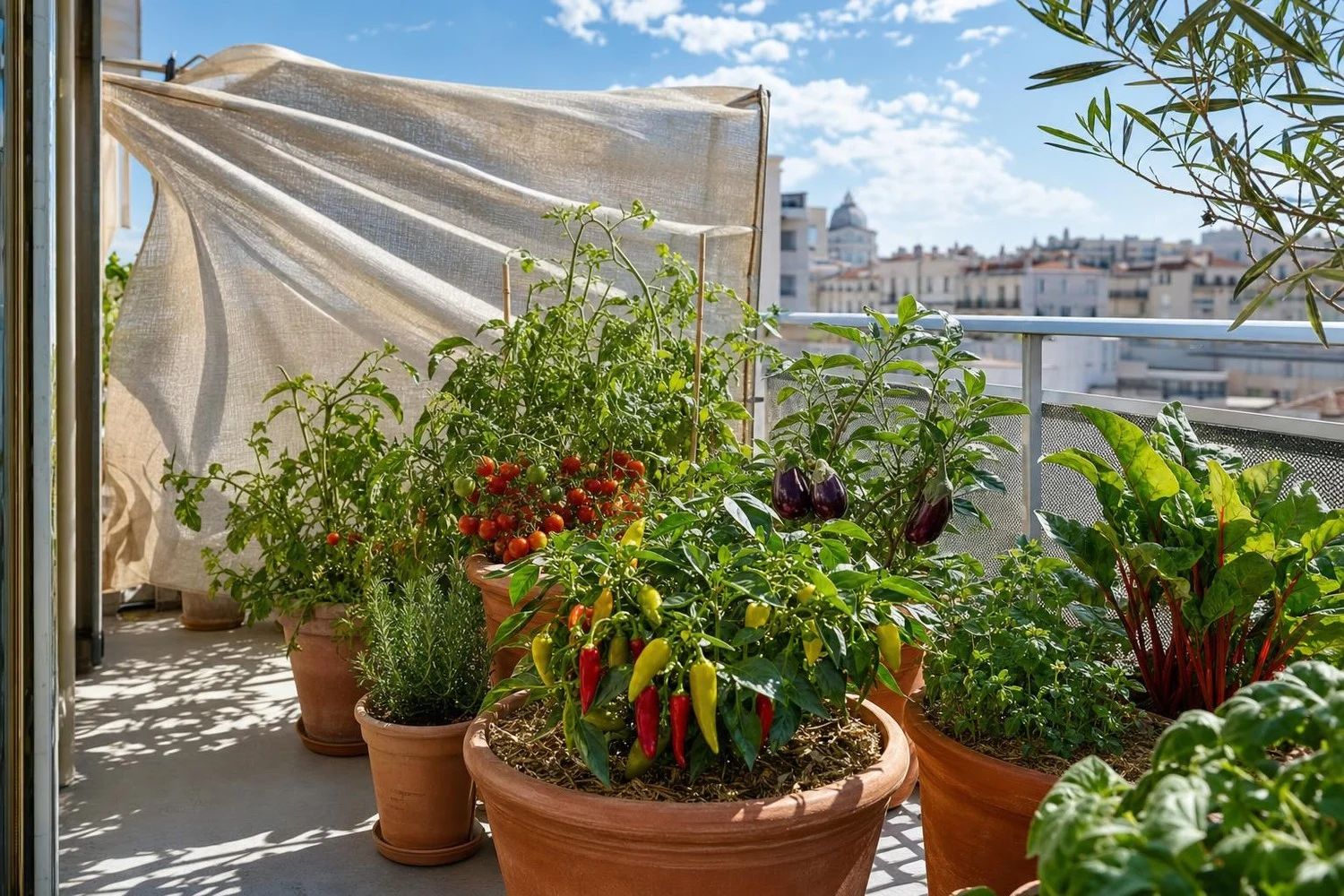
Gusts that topple the stems, pots drying in just a few hours, leaves scorched by the reflection of concrete: many city dwellers give up on a container garden after a single summer on an exposed balcony. The combination of wind and heat quickly turns a sunny corner into a furnace where fragile plants wither.
When the sun beats down for more than six hours a day and the edges behave like radiators, the containers heat up, water evaporates, and the roots cook. Yet by relying on some heat-tolerant plants and wind resistance, a difficult balcony can become highly productive. Some crops even thrive there better than in the ground.
Understanding Your Windy Balcony and Hot Patio
On a balcony, the wind amplifies the drying of foliage and potting soil, while shaking the stems until they break. Heat adds to it, especially if the ground is concrete or tile, which stores the rays. Most vegetables need at least 4 to 6 hours of direct sun, tomatoes and peppers preferably 6 to 8, but with the roots kept cool.
Thus identify the most hostile zones and the calmer corners. Near the railing, the wind often behaves like in a corridor, whereas an angle of wall offers welcome shelter. Many guides suggest clustering the troughs to create a more humid and stable microclimate, and adding a light windbreak – reed screen, screen, or trellis – that filters gusts without blocking light.
Top edible crops for windy balconies and hot patios
For this type of exposure, it’s better to forget delicate salads and aim for vegetables that truly enjoy heat. Peppers, chilies, compact eggplants, cherry tomatoes, and determinate patio varieties perform well in deep pots. Dwarf beans stay low and less exposed to gusts. For leafy greens, Swiss chard handles summer much better than spinach or romaine lettuce.
To cut to the chase, here are a few reliable choices to prioritize on a windy balcony or a hot patio:
- Fruit vegetables: peppers, chilies, cherry tomatoes, compact eggplants, small cucumbers in pots at least 30 to 40 cm deep.
- Low-growing vegetables: dwarf beans, dwarf sugar snap peas, which cover the soil of the trough well without catching the wind like tall climbers.
- Leafy greens: colored Swiss chard, young leaves of arugula or Asian mustard, to place if possible under a light shade in the afternoon.
- Herbs and small fruits: rosemary, thyme, oregano, sage, lavender, basil in a large well-watered pot, plus remontant strawberries in a planter or hanging basket protected from gusts.
Settings and mistakes to avoid for a hot but productive balcony
On an exposed balcony, the container plays a key role. Heavy terracotta or wooden pots, with a broad base and several drainage holes, limit tipping and retain moisture better than a jumble of small plastic pots. For tomatoes, eggplants or peppers, aim for at least 30 to 40 cm of depth filled with lightweight, rich potting soil.
Heat and wind drain pots very quickly; a mulch layer of 3 to 5 cm slows evaporation and keeps the roots cool. Water when the top few centimeters of soil are dry, preferably in the morning or late afternoon, sometimes twice daily during a heat wave. Watch the foliage: curling leaves, soil pulling away from the pot rim, or flowers drying signal stress. By promptly adjusting watering, placement, or a light shade that filters 30 to 40% of the sun during the hottest hours, a highly exposed balcony stays surprisingly productive.
