
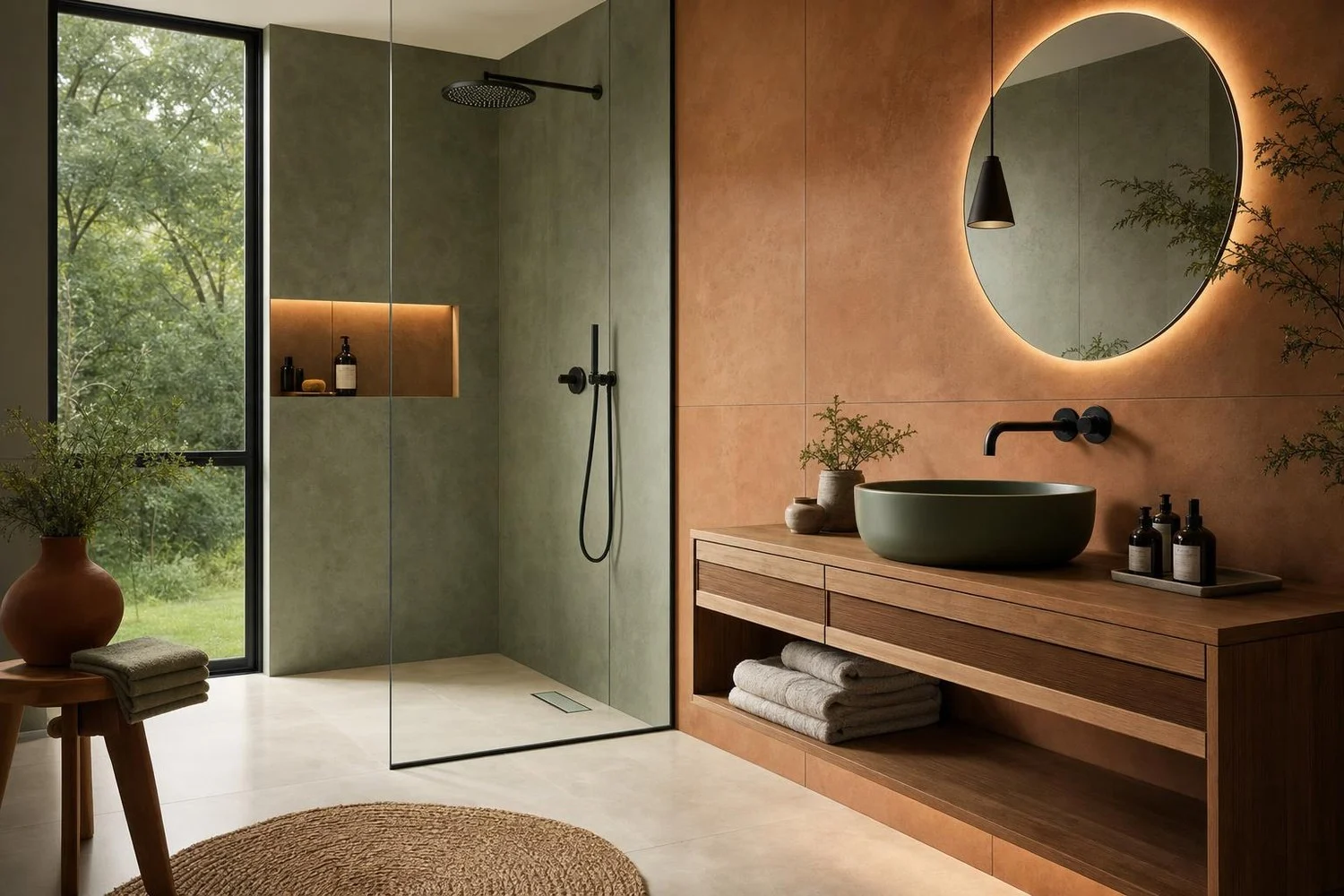
For years, the ideal bathroom was often reduced to a white 10 x 10 tile laid from floor to ceiling, with joints that were clearly visible. Plausible on paper, this grid gradually turned into a nightmare to scrub, between mold, mineral scale traces and the impression of a clinical space. By 2026, tastes have changed: warmth in ambiance, materials that feel reassuring, and walls with virtually seamless joints.
Architects and craftsmen all describe the same evolution: homeowners no longer want to spend their weekends scrubbing grout or feel like they are showering in a bland hotel cabin. They are looking for a durable alternative to traditional tiling, capable of creating a cocoon-like atmosphere, reducing maintenance, and visually enlarging the room, even when it is tiny. A solution clearly stands out on renovation sites.
XXL bathroom tiling: why white is losing its edge
This shift is driven by XXL bathroom tiling, with slabs that can reach up to 120×240 cm, roughly the size of an interior door. Four or five slabs are enough to clad a walk-in shower from floor to ceiling, almost without grout lines. The brain reads a continuous surface, which visually expands the space, even in a small bathroom. And since the room has 60 to 70% fewer meters of joints, maintenance follows suit.
Another major breakthrough concerns color. Earthy tones inspired by terracotta, from terracotta to sandy beiges, replace clinical white. Soft greens, such as sage green or eucalyptus, evoke vegetation and pair naturally with wood and linen. For a more theatrical touch, some dare a forest green, midnight blue, or anthracite around the shower area, while the rest of the room stays light to keep the space bright.
Formats, materials and colors: choosing XXL tiles for the bathroom
In the market, formats 60×120 cm and 120×120 cm often serve as a bridge to these very large slabs of 120×240 cm. The reigning material remains porcelain stoneware, robust, low-porosity, and offered in finishes that mimic stone, marble, or polished concrete. In a small bathroom, a floor in a light-concrete-look large format paired with brighter walls creates a spa-like ambiance without weighing down the space. An accent wall in a color inside the shower is enough to give it character.
To reinforce this continuous-surface effect, the trend moves toward tone-on-tone joints. A beige grout on a beige slab nearly disappears, while a white grout on an anthracite tile instantly re-creates a grid. This attention is felt in daily life: water- and vegetation-inspired tones, like glacier blue or celadon, better hide mineral deposits than pure white, which emphasizes every drop that dries on the shower walls.
Installation, safety and maintenance: the points to check before moving to XXL
These large formats require real expertise. The substrate must be very flat, checked with a two-meter straightedge, otherwise the slightest bump becomes visible on the slab. Tilers use a double adhesive application and handling suction cups, which explains higher quotes than for 30×30 cm formats.
On safety, floors must remain slip-resistant: some professional guides advise a slip class of R10 according to DIN 51130 for a bathroom. With fewer joints, there are also fewer areas that darken, fewer cleaning products, and faster cleaning.
