
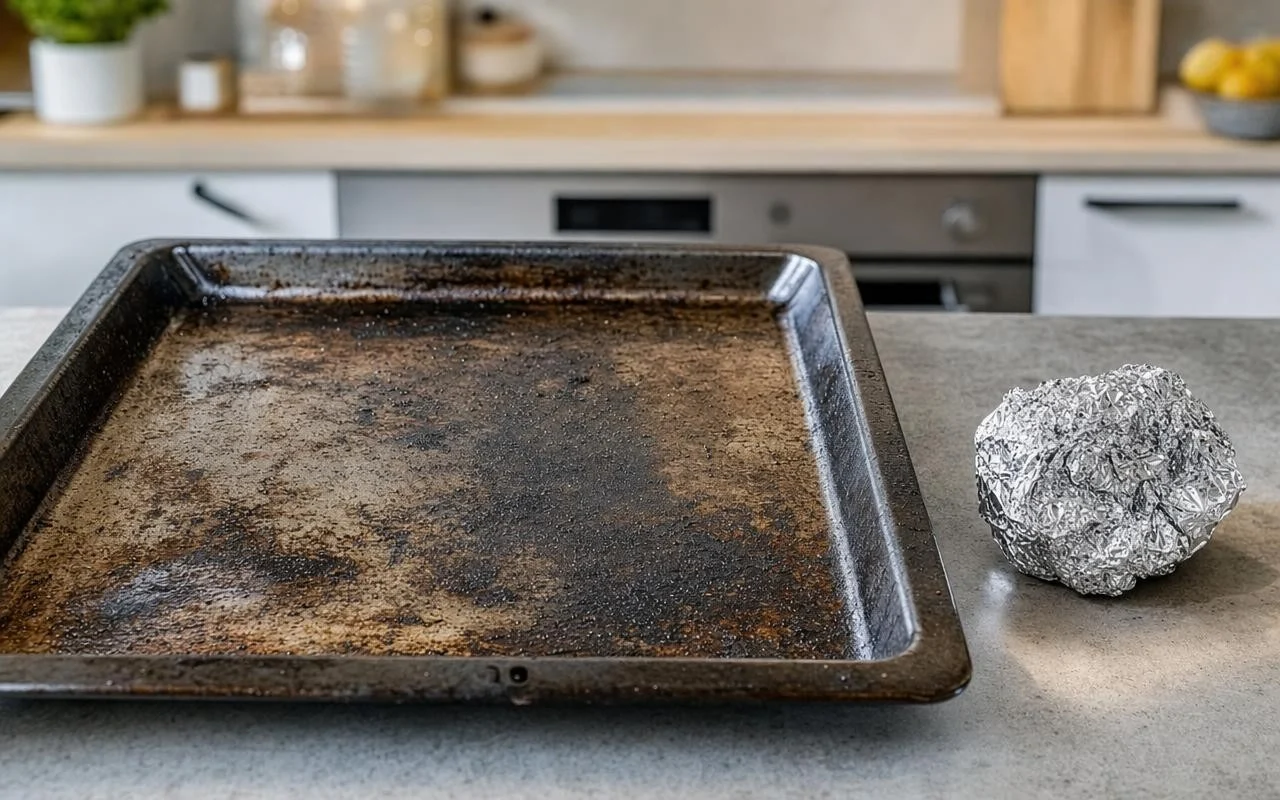
Your oven tray is black, sticky, and you’re torn between stashing it at the back of a cabinet or buying a new one. For some time now, a trick has been circulating: crumple a sheet of aluminum foil into a ball and rub the tray until it shines. A simple gesture, using an object already in the drawer.
On specialist sites like Maison & Travaux, Marmiton, or Martha Stewart, this idea keeps popping up to remove baked-on grease from metal trays. But not everyone emphasizes as strongly that it isn’t compatible with all materials, nor without a test on a small area first. That is where the difference lies.
Why the Aluminum Ball Cleans Oven Trays So Well
In reality, the aluminum ball acts like a makeshift scrubbing pad. When it comes into contact with the metal, it exerts micro-scratching that lifts carbonized grease and brown stains, especially when you add dish soap or baking soda. The mechanical action does most of the work; the dish soap helps dissolve the grease softened by the very hot water.
In an article published on July 10, 2026, experts interviewed by Martha Stewart’s site remind us that aluminum works as one abrasive material among others. Alicia Sokolowski explains: “Abrasive materials like aluminum foil or copper sponges can remove stubborn grime from cooking surfaces, but this method should not be used on non-stick surfaces, as it can damage the coating,” notes Alicia Sokolowski, president of AspenClean. Hence the importance of correctly identifying your tray.
The Right Method for Scrubbing an Oven Tray with an Aluminum Ball
Recommendations converge: we’re talking here about a removable oven tray, made of stainless steel or untreated aluminum, not a glass-ceramic cooking surface nor a delicate coating. Maison & Travaux advises starting with a soak in very hot water with dish soap for 10 to 20 minutes, to soften the residues. Then comes the famous aluminum ball, used without force.
Based on this, the classic step-by-step usually looks like this:
- Let the tray cool, then soak it for 10 to 20 minutes in very hot water with dish soap.
- Form a relatively loose aluminum ball.
- Pour a little dish soap directly onto the wet tray.
- Rub the dirty areas in circular motions, without pressing too hard.
- For very stubborn stains, sprinkle a little baking soda on the surface while it’s still wet, and resume gentler scrubbing.
- Rinse thoroughly with hot water, then dry with a microfiber cloth.
Why you should always test the aluminum ball on the tray first
If this trick is so criticized, it’s because the same micro-abrasion that removes grease can also scratch the metal or damage a non-stick coating. Martha Stewart as well as Maison & Travaux emphasize that the aluminum ball should not be used on coated trays. On these surfaces, every scratch weakens the coating and makes it less effective over time.
The right reflex is to perform a discreet test. On a metal tray whose material you’re unsure of, choose a barely visible, clean, dry corner. Lightly dampen, place a drop of dish soap, then pass the aluminum ball with light pressure, back and forth a few times. If you see dull marks, lines, or a change in the metal’s appearance, it’s best to stop and switch to a gentler method. If the surface remains smooth and uniformly feelable to the touch and visually, you can extend the technique to the rest of the tray. For non-stick trays, however, experts recommend alternatives that avoid abrasive scrubbing: Marla Mock notes that “vinegar is an acidic ingredient that can dissolve grease and lift stains,” particularly when combined with baking soda, and Alicia Sokolowski adds that “the combination of baking soda and hydrogen peroxide helps break down grease and grime and lift baked-on residues from trays.” This allows for a deep clean without risking scratches.
