
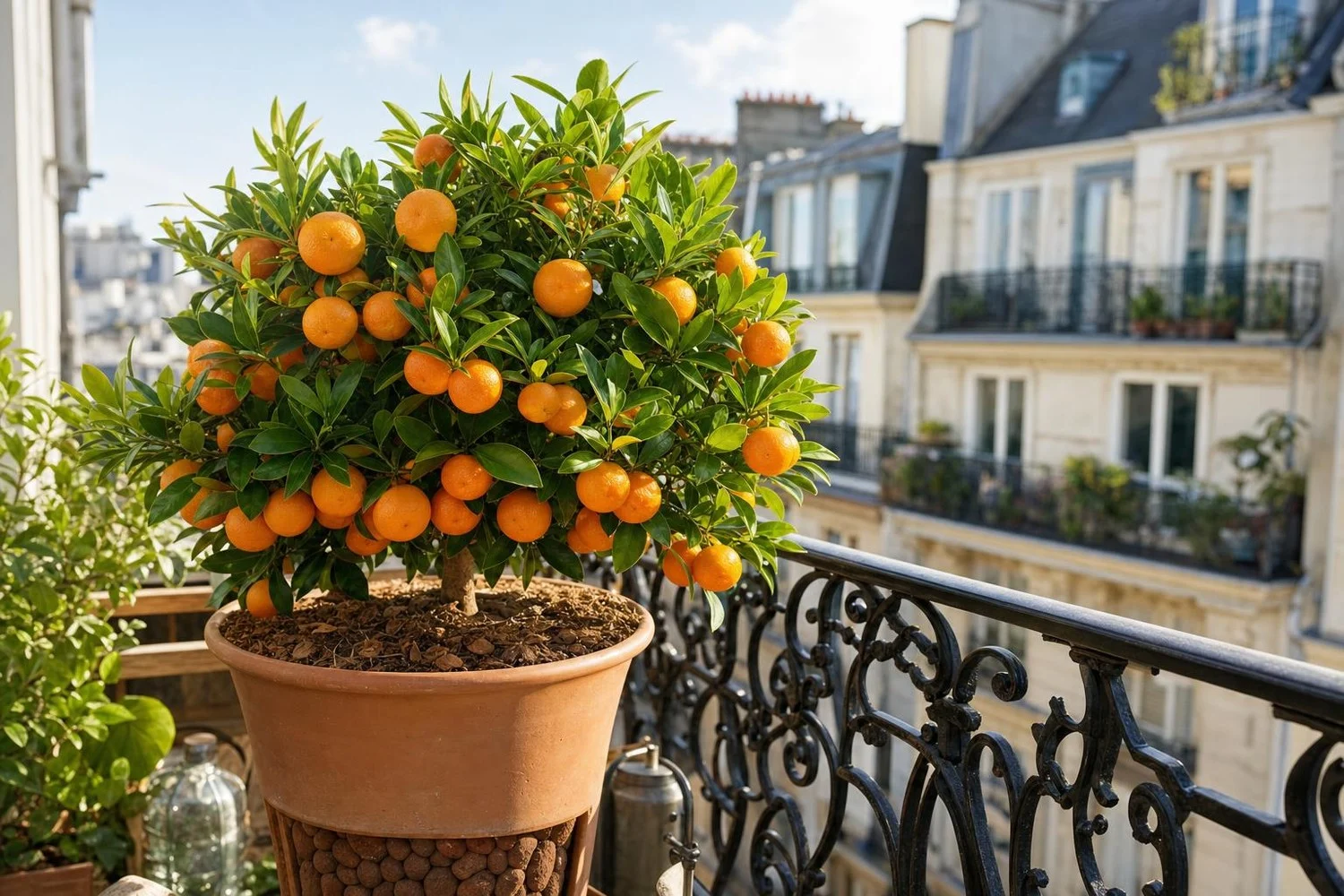
On a balcony that scorches in summer and then frosts over in winter, installing a fruit tree often seems almost impossible. The pots heat up, the wind dehydrates everything, and the first frosts worry you. Yet, some fruit trees tolerate these climate roller coasters and continue to bear. One such tree, compact and fragrant, fits into a planter to provide fruit within reach, even in the heart of the city.
In recent years, growing fruit trees in pots has made its way onto balconies and terraces, with fig trees, lemon trees, or dwarf apple trees. One citrus in particular ticks an extra box: it endures moderate cold, withstands heat waves, and remains productive in a container. Its orange fruits fill the stalls from autumn to early winter, and many people taste them without imagining they could grow on their own balcony.
Why the potted mandarin tree tolerates cold and heat on a balcony
This all-terrain tree is the potted mandarin, Citrus reticulata. In the ground, it can reach between two and four meters tall, but in a tub it stays compact and is easy to manage on a terrace. It offers dark green, fragrant leaves, white blossoms in spring, and small thin-skinned citrus fruits that are easy to peel. According to the site OkDiario, it tolerates temperatures around −3 to −4 °C and resists summer heat up to 50 °C if the substrate stays moist.
This combination of hardiness and heat resistance makes it a credible choice for many balconies, provided you give it a little protection during extreme episodes. Container cultivation gives a decisive advantage: you can move the pot near a sheltered wall in winter, and bring it out to the sun in spring. As Futura notes, the gardener controls the substrate, watering, and nutrient inputs, which promotes harvests.
Choosing the pot, exposure, and the Satsuma mandarin variety
For a cold-hardy mandarin to thrive in a pot, the container matters as much as the tree. A plant about one meter tall needs a planter with a diameter of 50 centimeters; beyond 1.5 meters, you move to 60 centimeters. Terracotta pots allow air to circulate within the substrate and limit root asphyxiation. The bottom should be perforated, with a layer of clay balls or pozzolana for drainage.
Exposure plays a key role. This fruit tree needs about six hours of direct sun per day, ideally on a south or southwest-facing balcony, sheltered from strong winds that dry the leaves. For cooler areas, experts often cite the Satsuma mandarin, more hardy and seedless. Varieties like Clemenules yield sweet, easy-to-peel fruit. Planting is preferably done between April and June so the tree can root before winter.
Watering, fertilization, and schedule for a productive potted mandarin
In a pot, the success of this heat-tolerant mandarin depends greatly on watering. The substrate dries quickly on an exposed balcony, especially in summer. The touch test remains the safest: if the soil is dry a few centimeters down, water; if it is still damp, wait. OkDiario recommends two to three waterings per week in spring and summer, then only one in autumn and winter. A light mulch reduces evaporation and protects the roots.
From March to September, a citrus-specific fertilizer added to every fourth watering covers the nutritional needs. The mandarin flowers in spring, some Clementines as early as mid-April, and the fruits mature from October to December. Repotting every two to three years and a light pruning at the end of winter are sufficient to keep a compact and generous tree on the balcony.
