
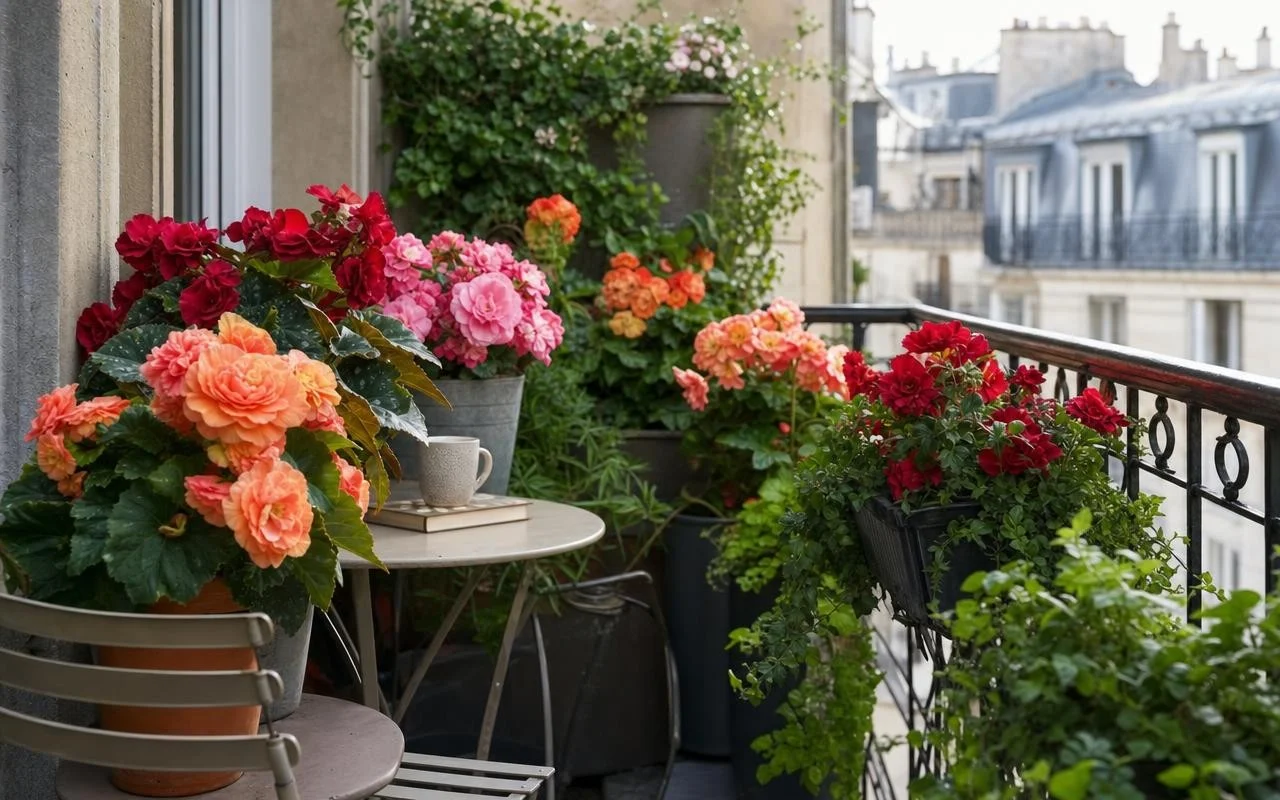
Shaded balcony, a north-facing loggia, a bright interior but without direct sun: many people think they must give up flowering balconies. Yet a compact plant, generous with blossoms and very comfortable in a pot, loves precisely these calm conditions, far from the scorching sun. It accepts the subdued light from a window or a gallery, while turning the space into a true colorful corner.
The calendar also plays a key role. Starting from September 21, a date marking the return of good days in the Southern Hemisphere, gardeners begin to sow or install this plant to enjoy a long flowering season. For a reader in France, the date has another meaning, but the logic remains the same: take advantage of the revival of vegetation.
Begonia in a Pot: The Flowering Plant That Loves Semi-Shade
This plant, discreet in size but spectacular in effect, is the begonia in a pot. The Argentinian gardening article that brought it back to the forefront explains that this species “adapts perfectly to pots and brings intense-colored flowers, even in small spaces.” Its compact habit makes it ideal for a windowsill, a small terrace, or a corner of a balcony squeezed between two walls.
Regarding the palette, begonia varieties offer flowers in pink, red, white, orange, or yellow. One can thus compose monochrome troughs or, on the contrary, mix several hues for a very graphic effect. As this same article summarizes, “the begonia can grow in a pot and takes up little space,” which is why it is often recommended for small urban dwellings.
From September 21: Understanding the Right Moment to Sow or Install
In the Southern Hemisphere, September 21 corresponds to the beginning of spring, with rising temperatures and more hours of light. This is where begonias start best, whether from seeds, small plants bought at a garden center, or tubers awakened after winter. This window of mild weather allows them to establish roots quickly before the first intense heat waves.
For a French gardener, the logic is identical, but translated to the local spring: install a begonia in a pot when nights warm up and the risk of frost has passed. One can sow under a heated sheltered area, or more simply buy young plants already well formed. The essential remains to combine sufficient light with stable temperatures.
Location, Watering and Mistakes to Avoid for a Begonia in a Pot That Keeps Blooming
The begonia needs a lot of light, but it does not tolerate direct sun during the hottest hours. A balcony with filtered light, a bright gallery, or a clear room near a shaded window suits it very well. The pot must imperatively provide good drainage: holes at the bottom, a layer of clay balls or gravel, then fertile and light potting mix to avoid water stagnation that rots the roots.
As for watering, the experts’ advice can be summarized in one sentence: “You should wait until the top layer of the substrate is dry before watering again.” In practice, check with your finger, water deeply, then let it drain, never leaving water in the saucer. A specific fertilizer for “flowering plants,” used during the growth and flowering period, helps maintain a continuous cloud of flowers. To secure cultivation, a small checklist is useful:
- Choose a bright exposure without direct sun at the central hours;
- Provide a pot with a diameter of at least about twenty centimeters for a single plant;
- Use a rich and well-draining potting soil rather than heavy garden soil;
- Regularly remove faded flowers to encourage new buds.
Sources
- Marie France
“Grilled tomato seedlings in April? This potted plant protects them without shade cloth or an expensive greenhouse”
