
Small living room, a bedroom that doubles as an office, a dining corner squeezed between two walls… Many French interiors look like this, and square meters do not multiply. In 2026, interior design shifts course: people seek clever furniture rather than yet another bulky sideboard, able to keep up with daily life without crowding the space.
The Argentinian media TN sums up this new star of layout in a memorable phrase: “it takes up little space, serves multiple rooms, and helps keep everything organized—the multifunctional furniture that is trending in 2026”, referring to the modular multifunction furniture. Designed for small apartments but useful anywhere, it plays at once the role of bookshelf, storage unit, TV stand, or room divider. The question remains: how does it actually work to adopt it without making mistakes.
Meuble modulaire multifonction : ce qui le rend différent
A modular multifunction furniture is not just another shelf. Articles from TN and design magazines like ¡Hola! describe a system of modules that you assemble and reorganize: open niches, closed cabinets, columns that can be moved or evolved. Unlike a fixed piece, it can be dismantled, flipped, completed, in step with the changes of the home.
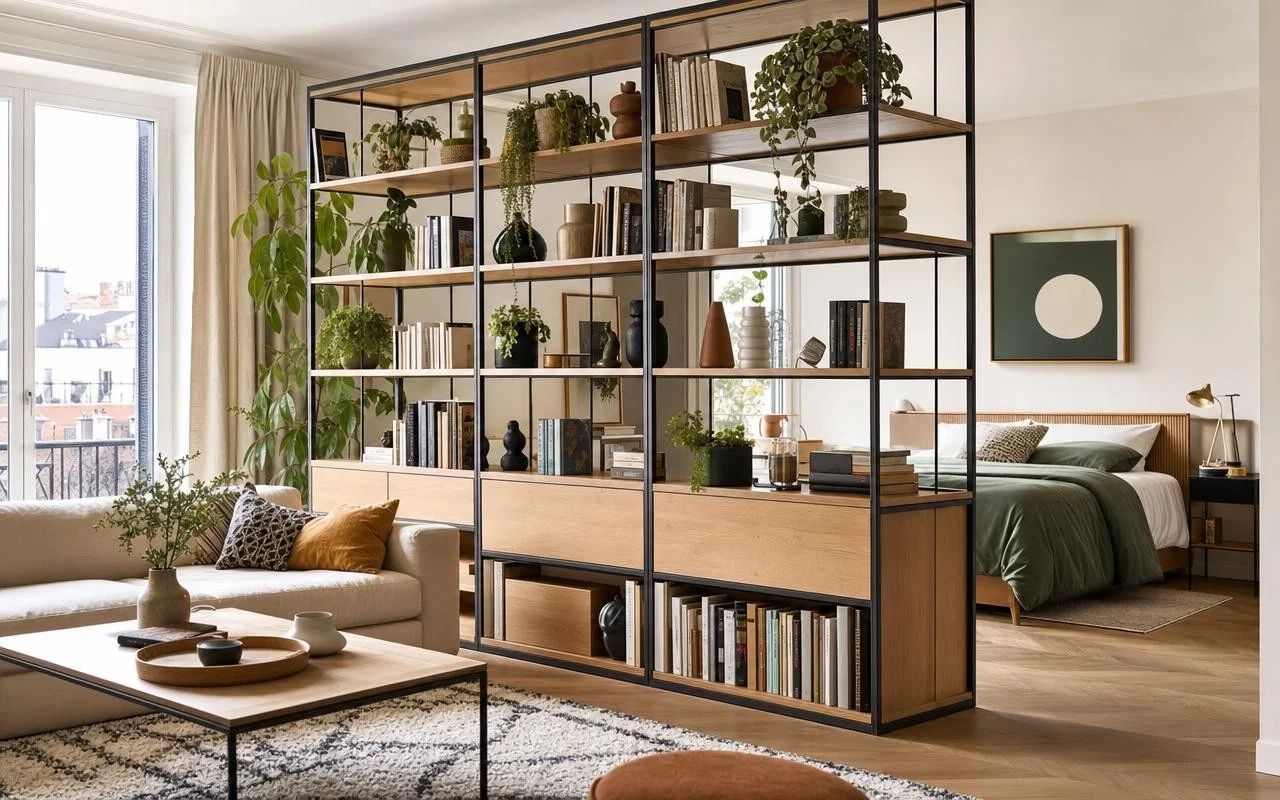
On June 5, 2026, TN highlights the “open divider module” which, according to the media, “allows you to organize, decorate and divide without losing visual amplitude.” No solid back, often accessible from both sides, it lets light pass through and avoids the wall effect. The trend models showcased in 2026 feature simple lines, neutral colors, and a light structure, which eases their integration into minimalist, Nordic, or industrial styles.
Pourquoi ce meuble gain de place s’impose en 2026
By late August 2026, ¡Hola! highlights three drivers of this modular wave: shrinking living spaces, the generalization of remote work, and a desire for durable furniture. The living room becomes, in turn, a desk, a playroom, a TV corner; a furniture piece that can be reconfigured without renovations directly answers this hybrid life. Modular furniture is presented as an alternative to “throwaway furniture”: we reassemble it instead of replacing it.
TN, in its article of September 4, 2026, stresses the value of these pieces in small apartments. The editorial notes that “its main advantage is the ability to adapt to different environments and needs, which allows keeping things orderly without taking up too much space.” Another key point highlighted: vertical storage, which harnesses walls and often unused heights rather than consuming floor space.
Où installer son meuble modulaire pour mieux organiser la maison
In the living room, the open modules transform into a library, a TV cabinet, or a room divider between the lounge and dining area. TN’s article on the divider module reminds that it structures the space without cutting light, a major concern in domestic open spaces. The SodiConstructor blog even talks about the need to “zone without locking in”: you create a small office corner or a reading corner, while keeping a clear sightline and good circulation.
These pieces also find a place in the entryway, where a few closed cabinets swallow shoes and accessories, or in a bedroom to separate the sleeping area from the dressing. Before buying, SodiConstructor advises checking flow, light, and the flexibility of the future location. The sources emphasize a few simple guidelines:
- Measure precisely the available width, height, and depth.
- List what you actually want to store to choose the right mix of open and closed.
- Avoid blocking a window or a light passage.
- Favor light tones and lightweight structures in small rooms.
