
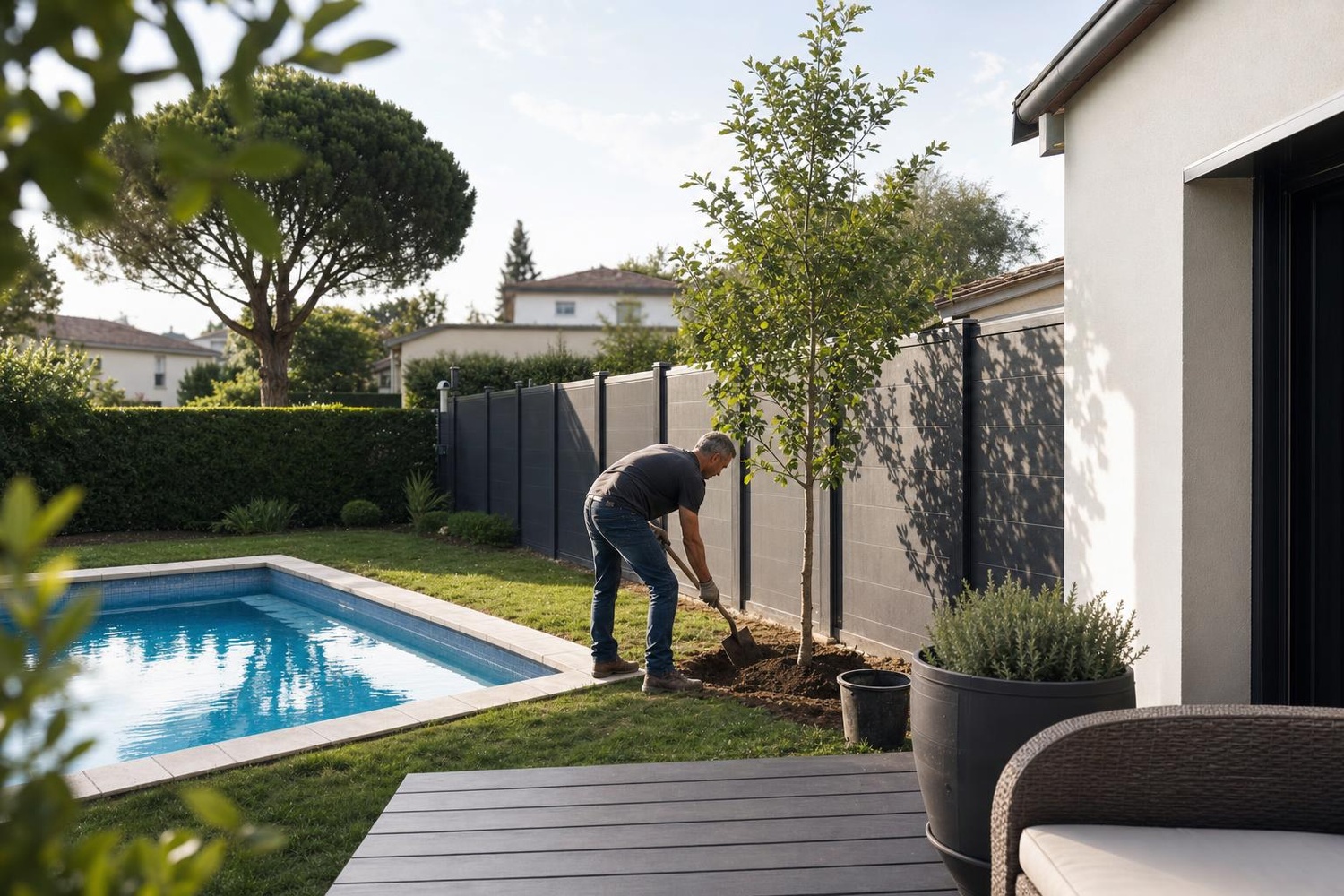
One July morning, you spot your neighbor arriving with a shovel and a young plane tree right behind your pool. You immediately think about shade over the pool, leaves in the skimmer, and the burning question: can he really plant so close to your fence? With the growing number of family pools, scenes like this are likely to recur in 2026, sometimes in front of a judge.
The legal framework, however, is far from intuitive. The Article 671 of the Civil Code governs the planting of trees along property boundaries, but it never mentions pools or jacuzzis. It is the judges, through the notion of “abnormal nuisance to the neighborhood” (trouble anormal de voisinage), who make the link to your pond. For 2026, the rules remain stable, but the calculation of distances deserves to be laid out calmly.
Legal distance between tree and boundary: what the law provides in 2026
In the absence of a different local rule, the law sets a straightforward legal distance. Any plant expected to exceed 2 meters in height must be planted at least 2 meters from the boundary line. For a hedge or shrub not exceeding 2 meters, the minimal distance drops to 0.5 meter. These values apply even if the neighboring plot houses a pool.
Two technical details matter a lot: height is measured from natural ground to the treetop, and the distance is measured from the trunk’s center to the boundary. A slope or mound thus does not allow you to “gain” centimeters. Local rules, such as a PLU or certain practices allowed by the municipality, can set different distances, sometimes down to zero centimeters in the Paris region. For a very old tree, the thirty-year prescription can sometimes block a request for removal.
Piscine, jacuzzi et arbres du voisin : le vrai risque en cas d’ombre excessive
People often imagine an automatic “pool penalty” if the neighbor’s tree is too close. In reality, the risk is civil: the judge may order removal or trimming to the legal height, with damages. In reported disputes, the total bill typically runs from €1,500 to €3,000, depending on the number of issues and the works. The remedy always targets the property owner, even if a tenant planted it.
A case judged by the Court of Cassation has become a textbook example. Pines of 15 meters, though planted 2 meters from the boundary, had to be felled because they shaded the neighboring pool. The judges noted a 3-degree drop in water temperature and a permanent shedding of needles as evidence of an “abnormal nuisance to the neighborhood.” These debris also alter the pH away from the ideal range of 7.0 to 7.4 and force the use of more disinfectant. A garden jacuzzi, treated as a pool, undergoes the same effects.

Distance arbre–piscine en 2026 : la méthode pour éviter le conflit
For the summer of 2026, the calculation method remains the same: add two distances. First, the distance between your pool and the fence, often around 3 meters in planning regulations, even if some existing gardens are tighter. Then, the distance imposed on the tree side: 2 meters if it exceeds 2 meters in height, 0.5 meter otherwise. If the pool sits 3 meters from the boundary and the large tree is planted 2 meters from that same boundary, there would be, for example, 5 meters between the trunk and the water.
On the ground, many pool installers advise going well beyond the legal minimum. Roots can extend 1.5 to 3 times the crown’s reach, so it’s wiser to place large trees 8–10 meters away from the pool, or install an underground root barrier at a depth of 1 meter. A few written exchanges between neighbors about the maximum height and regular pruning are often enough to prevent a dispute.
