
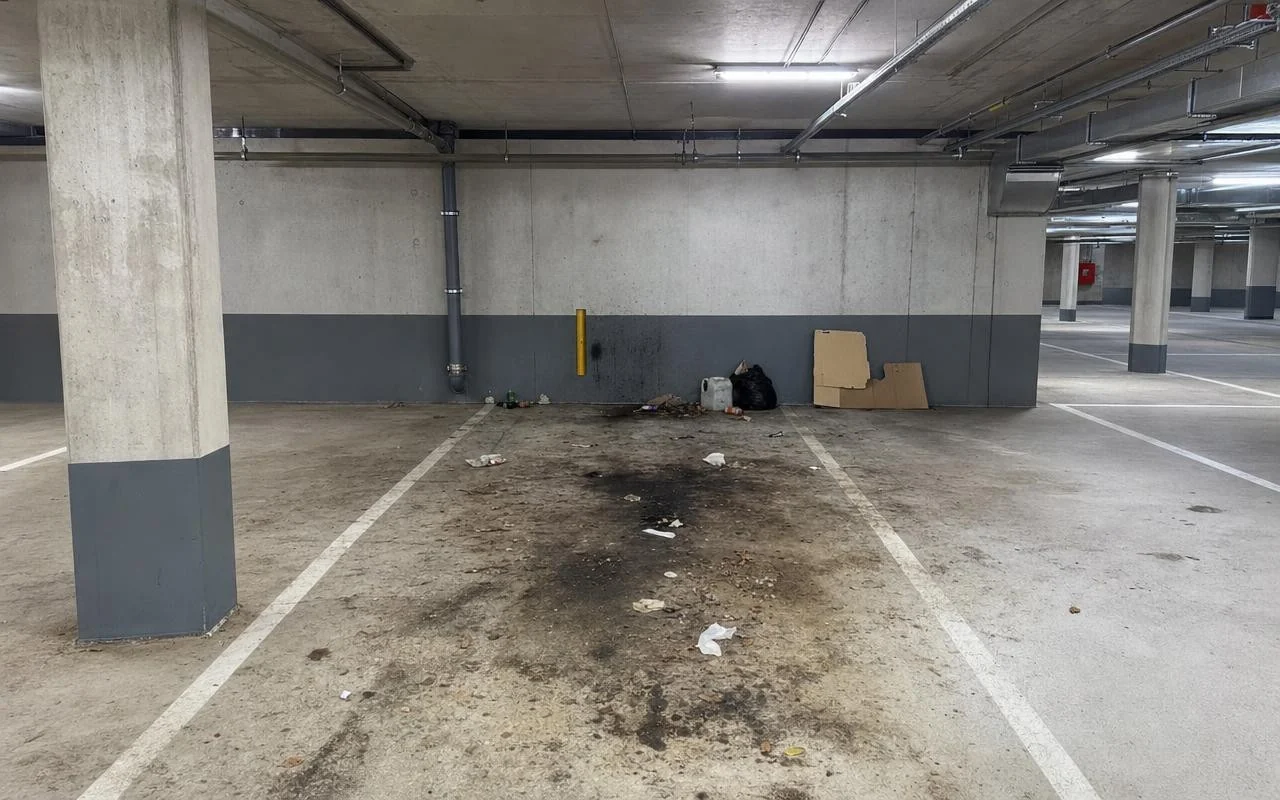
A garage space turned into a dumping ground, oil stains spilling onto the walkway, cardboard boxes stored behind a car… In many Spanish buildings, such scenes spark tensions between neighbors. How far can tolerance stretch, and when does the law actually allow a response against the negligent owner of this private parking space?
In Spain, the answer lies in the Ley de Propiedad Horizontal, which governs life in condominiums. Its article 9.1.b, as published in the Boletín Oficial del Estado and updated on October 3, 2026, imposes on each co-owner a precise duty to maintain their private elements, including their parking space. But not everything becomes sanctionable immediately.
Article 9 of the Ley de Propiedad Horizontal: who must clean the garage space?
Article 9.1.b of Law 49/1960 on Horizontal Property provides that each owner must “keep in good condition their own dwelling or local and its private installations, in such a way that it does not damage the community or other owners, by repairing the damage they cause through their negligence or through those for whom they must answer.” A private garage space clearly falls within these “private installations.”
The law distinguishes common elements (ramp, corridors, access, ventilation, lighting) from private elements such as the parking space allocated by title of ownership. The homeowners’ association covers the cleaning of common areas, funded by charges. The owner, for their part, must maintain their space. When the parking operates on a rotational regime and remains a common element, cleaning falls to the community, unless a user causes an exceptional dirtiness that then engages their individual responsibility.
When the dirt in the garage space truly justifies invoking Article 9
A simple dusting or a few tire marks generally do not suffice to act. Article 9.1.b becomes a legal tool when neglecting maintenance causes real harm to the community or to neighbors: strong odors, accumulation of garbage, appearance of rodents, storage of inflammable materials, or oil stains that spread onto passage areas. The Ley de Propiedad Horizontal allows, via its Article 7.2, to target disruptive, unsanitary, or dangerous behaviors.
In the event of slipping on an oil puddle, the logic is that of civil liability. Article 1902 of the Spanish Civil Code states that “he who, by action or omission, causes damage to another through fault or negligence, is obliged to repair it.” Before reaching that point, specialists and finca managers recommend a graduated approach.
- Speak directly with the neighbor and calmly remind them of their duties.
- If nothing changes, inform in writing the president of the community and the administrator.
- Preserve evidence: dated photos, wide-angle views and close-ups, potential testimonies.
- Request that the problem be placed on the agenda of the junta de propietarios.
- Allow, if the situation persists, a lawsuit grounded on articles 9.1.b and 7.2.
What the community can – or cannot – impose on the neighbor who doesn’t clean
In principle, the homeowners’ association cannot forcibly enter a private garage space to clean it or impose an “in-house fine” without a legal basis. Media commentary echoed by trade press notes that the holder of the space is “only responsible for keeping their private garage in good condition and not for maintaining the community.” Some condominiums include penalties in their by-laws, but they must comply with the Ley de Propiedad Horizontal and have been approved at a junta meeting.
When the neighbor does not respond to requests and the dirt creates a risk or significant nuisance, the junta de propietarios can authorize ordinary litigation to demand cessation of the behavior and repair of damages. In the gravest cases, backed by Article 7.2 LPH, Spanish courts can even temporarily restrict the use of the space. For co-owners, remember that maintaining one’s garage space is not merely a matter of goodwill: it is a legal obligation clearly set out in Article 9.1.b.
