
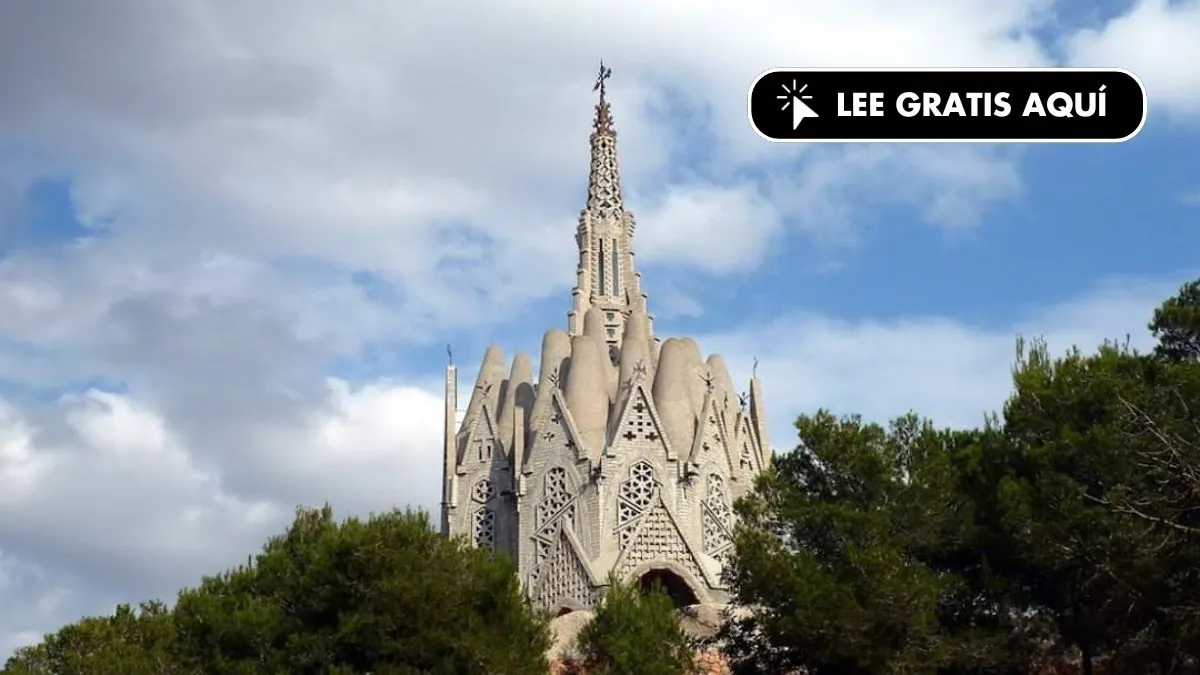
In a tranquil corner of the Alt Camp, amid expansive vineyards and rolling hills, rises a temple that seems to defy time and geography. At first glance, from afar, its silhouette resembles the iconic Sagrada Família of Barcelona, with its sinuous arches and shapes that seem to flow toward the sky, but few know its history and even fewer have had the opportunity to admire it up close. This place is the Montferri Sanctuary, a gem of Catalan modernism that combines faith, architecture, and the rural landscape in a work that is almost poetic.
Montferri Sanctuary is a testimony to the inventiveness of Josep Maria Jujol, Gaudí’s pupil, who left on its walls an architectural language of his own, distant from rigidity and full of harmony with the surrounding nature. Its elongated columns, its inclined arches, and the elliptical forms that adorn the façade seem to rise from the ground as if they were part of the vineyard that surrounds it. The mosaic and the exterior details foreshadow what the visitor will find inside: a space where light filters in in a magical way, playing with the geometry of the walls and creating an atmosphere of contemplation that envelops the senses.
The Origins of the Sanctuary
The history of the sanctuary dates back to 1925, when the Jesuit Daniel Vives, a native of Montferri, decided to build a temple that would bring the devotion to the Virgin of Montserrat closer to the local population, thus avoiding long journeys to the monastery of the same name after the harvest. To carry out this vision he turned to his cousin, Jujol, who contributed a design inspired by the Montserrat Mountains and by the fluidity of nature, with an irregular polygonal plan and 24 segments that combine into a unique composition. The construction included a central tower of 27 meters crowned by a cross, surrounded by domes that lend it an unmistakably monumental air.
However, the project was cut short just six days after its initiation by the outbreak of the Civil War. The damages were considerable, leaving the building exposed to the elements and turning it into an architectural skeleton that remained abandoned for decades. Jujol’s vision was frozen in time, and the sanctuary became part of Tarragona’s best-kept secrets. It was not until 1984 that restoration works began, a meticulous undertaking that sought to respect as much as possible the architect’s original idea and culminated in 1999, when it finally opened to the public.
@vente.conmigo82 To understand the origins of the Montferri Sanctuary one must go back to the late 19th century, when the villagers of the town and nearby localities, after finishing the grape harvest work, would peregrinate to the Barcelona Montserrat sanctuary. Every year, when October arrived, they set out toward the monastery of Santa María de Montserrat in Barcelona to give thanks to the Virgin, the beloved “Moreneta,” for having provided them with a good harvest. This custom continued as traditions do, until Daniel Vives, a Jesuit born in Montferri, wondered why not give the villagers a closer place (they traveled 75 kilometers) to offer that gratitude? One of the mounds in the village belonged to his family, so that hill would be a good location for the Virgin’s sanctuary. Additionally, by chance this Jesuit had a cousin, Josep Maria Jujol, who was an architect, a great devotee of the Virgin, and who, luckily, was Gaudí’s pupil. They must have thought that with so many conveniences—why wait! The first stone was laid on November 15, 1925, and the works progressed at a good pace with the selfless collaboration of the whole town. The only problem is that before it finished, the work was halted for lack of funding and then the Civil War arrived. Finally, the works resumed in 1989 and the Montferri Sanctuary could be inaugurated 10 years later. In total, 74 years were needed to see this brilliant architectural work completed.Montferri (Tarragona) #montferri #montserrat #sagradafamilia #tarragona #santuario ♬ Shadow of the Day – Linkin Park
Today, Montferri is a pilgrimage point not only for religious reasons but also for its artistic and scenic value. From the hill where the sanctuary stands, one contemplates an expanse of vineyards that seem to flow toward the horizon, while the structure rises against the sky like an emblem of human faith and creativity. Its curved shapes and its domes not only recall Gaudí, but they possess a personality of their own, a modernist interpretation that dialogues with the landscape and the air of the region.
A Well-Kept Secret
Visiting the Montferri Sanctuary is to immerse oneself in a space where architecture blends with nature and history is felt in every stone. It is not only a place to admire from the outside; the interior offers a sensory experience, where light enters through strategic openings and transforms the space into an almost celestial setting. Each arch, every column, every mosaic seems to have been designed to guide the eye upward, toward contemplation, toward a moment of pause in the Catalan countryside.
Although many tourists are unaware of its existence, those who discover Montferri carry with them the impression of having found a secret well kept. Compared to the fame of the Sagrada Família, this sanctuary offers a more intimate encounter, a experience that blends spirituality with admiration for architectural ingenuity and respect for the surroundings. Its history of abandonment and rebirth, the heritage of Jujol, and its dialogue with the landscape make Montferri an extraordinary example of how modernism can converse with tradition, faith, and nature, leaving an indelible mark on those who visit it.
