
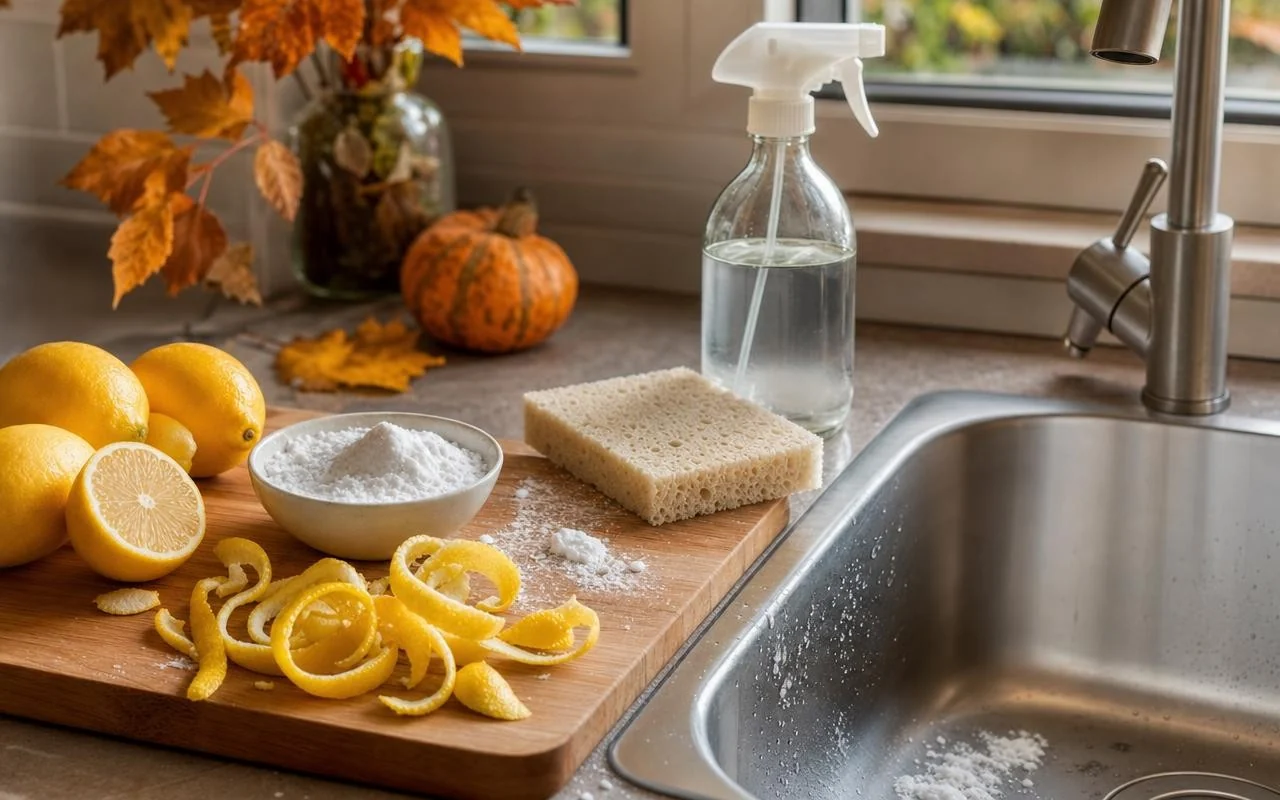
After squeezing a lemon, most of the peels end up in compost or the trash. This autumn, when we cook more slow-cooked dishes and the house is closed up, these yellow rinds can nevertheless become allies for cleaning. Paired with baking soda, a basic item in the cupboard, they create a spectacular foam that has intrigued many home‑care enthusiasts.
On social networks, this duo is presented as a miracle cleaner that degreases, shines, and banishes bad odors. Before adopting it everywhere, chemists and organizations like the American Cleaning Institute remind us that this mixture has its strengths, but also its limits and some risks. Understanding what happens in the bowl helps you use it in the right places, without surprises.
Lemon peels and baking soda: how does this mixture really work
Lemon contains citric acid, while baking soda is an alkaline base. When you rub a peel soaked with juice on a surface sprinkled with baking soda, the two react: carbon dioxide (CO₂) forms, responsible for the fizz. This foam helps to loosen dirt through agitation, but chemically some of the acid and base neutralize, reducing the strength of each component.
According to the American Cleaning Institute, acidic products mainly act on mineral deposits like lime scale, and bases on organic soils, greases, and oils. Baking soda plays the role of a base and a mild abrasive: its fine powder helps to detach residues without scratching as much as a very rough sponge. The peel, for its part, concentrates essential oils and aromatic compounds that leave a fresh citrus scent, without guaranteeing true disinfection.
Where the lemon peel and baking soda mixture is really useful around the home
In the kitchen, this mixture has its place for a somewhat deeper autumn cleaning, when slow-cooked dishes have left a film of grease or stubborn stains. It works well on dishes and sturdy containers: mugs stained by coffee or tea, bowls, saucepans, lightly soiled gratin dishes. It can also be tried on a stainless steel sink or a tiled backsplash splashed by splatters, while being mindful of the surface’s condition.
Experts recommend first a paste of baking soda and water, as the American Cleaning Institute does for hard ceramic, fiberglass, or stainless steel surfaces. Apply, let it work a bit, then rub with a still‑juicy peel and rinse thoroughly. In this context, the mixture mainly serves as a cleaner and light deodorizer: the baking soda absorbs some odors and the lemon provides the aroma.
Précautions avec le mélange citron bicarbonate : surfaces, stockage et sécurité
Not everything is appropriate to scrub with lemon and baking soda. Specialists strongly advise against this duo on marble and, more broadly, natural stone, because citric acid can attack the surface and leave irreversible dull spots. Bare woods, certain glossy laminates, or screens should also be avoided, as the abrasive nature of baking soda can cause fine scratches. On an unknown surface, a test in a discreet corner is preferable.
This mixture should not be prepared in advance. As soon as the acid meets the base, the reaction produces carbon dioxide, which can increase pressure in a closed container; it is best to prepare only the necessary amount. Health authorities also remind never to mix it with bleach or hypochlorite-based products, as the combination can release chlorine, an irritating gas for the eyes and airways; it should be handled like a regular household cleaner.
