
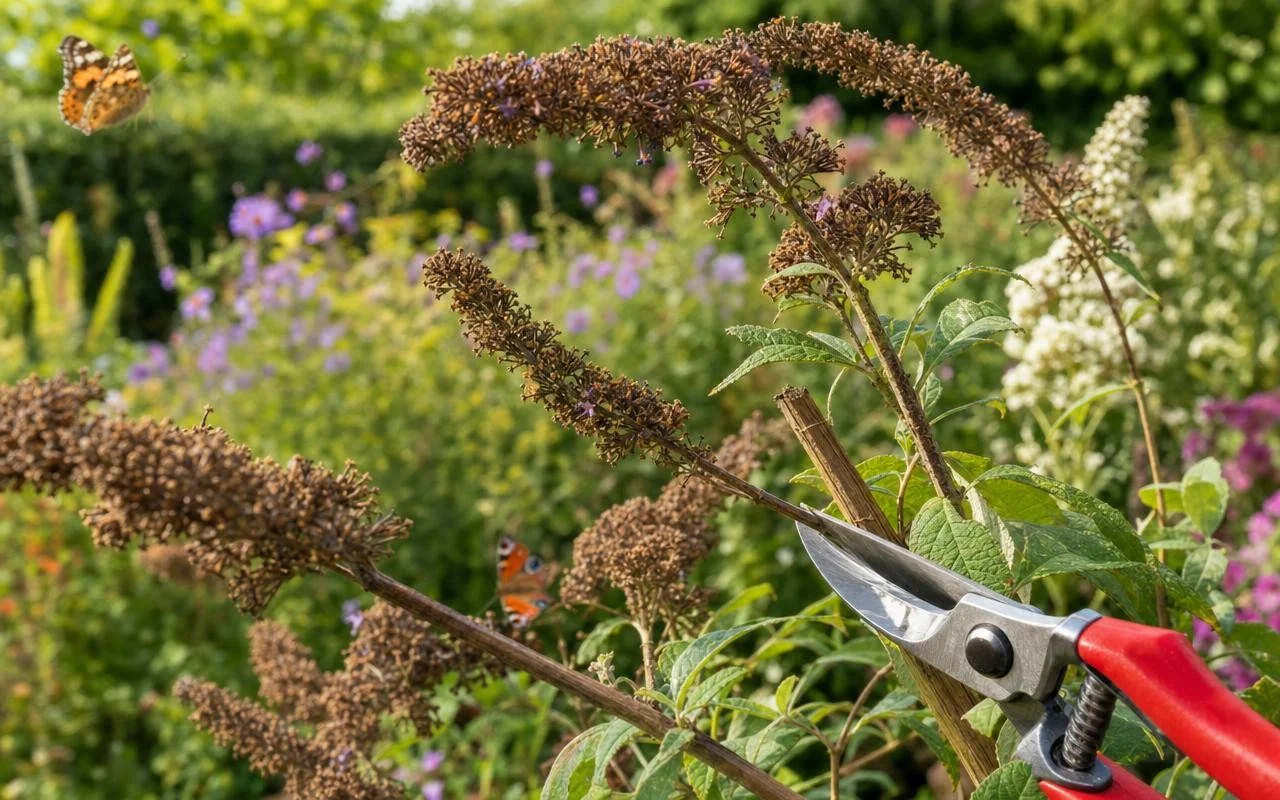
You’re surveying your border and your butterfly bush looks more like a tangle of branches than the elegant, flowering cloud of last summer. The recommended window for pruning the buddleia has long since passed, the secateurs stayed in the shed, and you fear you’ve doomed next year’s bloom. Many gardeners find themselves in this situation, especially when spring rushes by.
The good news is that a buddleia handles neglect fairly well. Missing the ideal window does not condemn the shrub, provided you avoid a heavy cut at the wrong moment. A few simple actions now, followed by a proper reset pruning in the spring, are often enough to regain a beautiful flowering display. The key is mainly knowing what to do now… and what to absolutely avoid.
Why pruning the buddleia at the wrong moment weakens it
Buddleia, or Buddleja davidii, has hollow stems. When you prune hard, you open these stems and rainwater can penetrate. As long as temperatures stay mild, this isn’t a problem. If cold arrives afterward, that water can freeze inside and cause the branches to crack, which seriously weakens the shrub and leaves the wounds vulnerable to diseases.
That is why specialists recommend a heavy prune at the start of spring, after the last risk of frost. At that time, the shrub restarts, the buds swell, and the future flowers form on the current year’s wood. If you prune too late, for example in midsummer, you remove part of these new shoots and the blooming suffers, without giving the plant a real benefit.
Tardy pruning of the buddleia: actions to take now without exhausting it
Once the pruning period has passed, it’s better to forget about severe cutting and focus on maintenance. The right reflex is to regularly remove the spent flowers during summer and early autumn. This action encourages the shrub to produce new flower clusters and limits seed formation. You can also slightly shorten the truly troublesome branches if they intrude on a path or suppress another plant.
For these small touch-ups, always choose a period when no frost is forecast within 48 hours, especially at the end of the season. A cold snap right after pruning weakens the cut ends. To summarize the best practices when pruning was done too late or not at all:
- limit yourself to light pruning on the troublesome stems;
- keep removing the spent flower clusters;
- avoid any heavy pruning in autumn and winter.
Next spring: how to prune the butterfly tree to restart flowering
Before bringing out the pruner in spring, a quick check reassures you about the shrub’s ability to regrow. The presence of many young shoots at the base is a very good sign, because flowers form on this new wood. A buddleia that is still dense, not too bare at the center, planted in a spot that receives close to eight hours of direct sun per day, has every chance of producing beautiful, fragrant panicles.
As soon as the frost risk has passed, you can consider a 30 cm pruning. This means cutting all stems just above the clearly visible new buds, without going any lower. This severe pruning suits summer-flowering buddleias like Buddleja davidii. By contrast, species that flower in spring, for example Buddleja globosa or Buddleja alternifolia, are pruned rather shortly after their flowering, otherwise the buds already formed disappear.
