
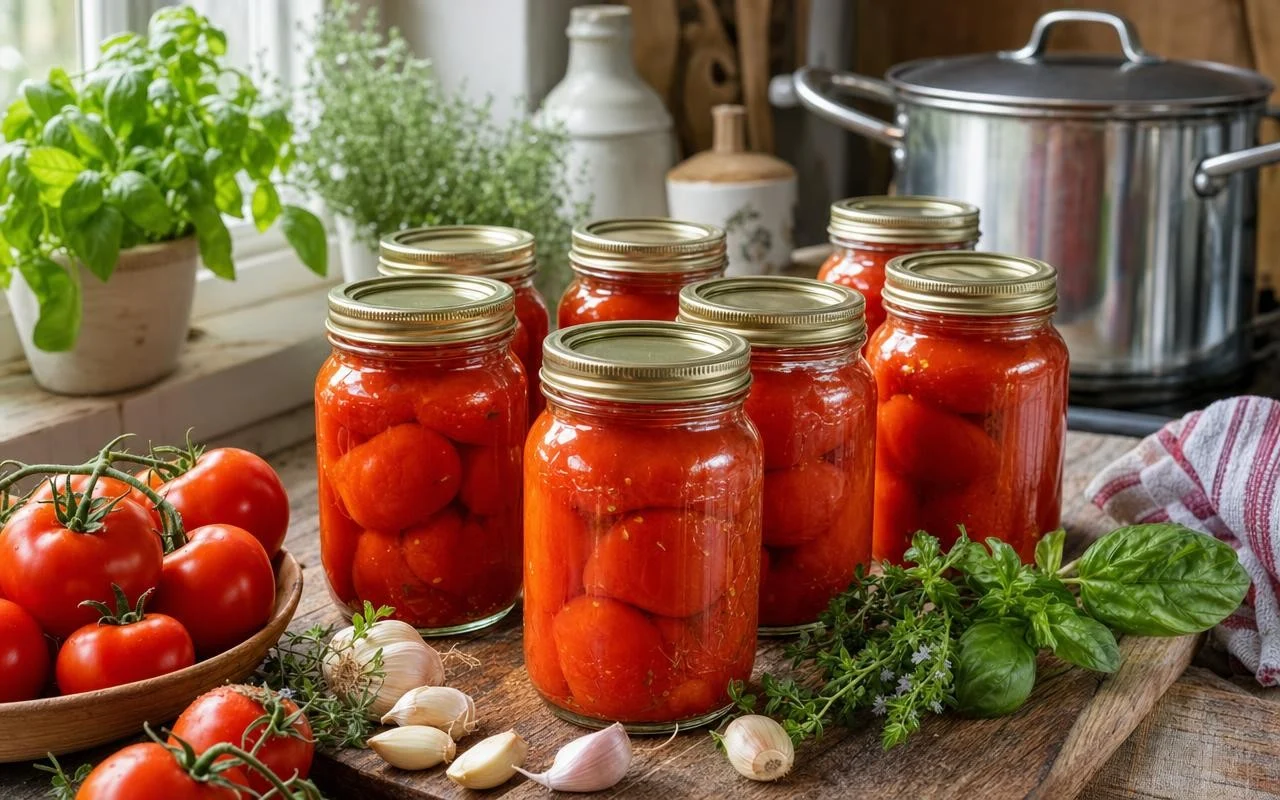
The crates are overflowing, prices are dropping, and the scent of ripe tomatoes fills the kitchen. When summer is in full swing, many dream of preserving that flavor for the colder months without spending their weekends cooking sauces or sun-drying slices. Between family recipes, the freezer, and vacuum-sealing gadgets, confusion can quickly take hold. Yet a simple technique, long used on farms, is making a comeback.
Conservation-focused bloggers, such as Mercado Calabajío, say they drew inspiration from a book by John Seymour dedicated to country living. They write: “The method for canning isn’t ours; it’s taken from the famous John Seymour book *Life on the Farm*, which is enough to guarantee it.” The principle: sealing whole tomatoes or large chunks in jars, with little seasoning, but with perfect safety.
Why preserve whole tomatoes in jars for months
Canning tomatoes whole in jars offers a highly versatile base. These peeled fruits can become quick sauce, pizza topping, soup base, or omelette accompaniment. Sources like Le Parfait explain that a well-prepared jar stored in a cool, dry place away from light can keep for several months, up to a year for good quality. In practice, a large August harvest can cover a substantial portion of winter tomato needs.
Sun-drying or oven-drying greatly changes the texture and takes time; it does not always allow a simple act of opening a jar of nearly-fresh tomatoes. Vacuum-packed preservation, on the other hand, is not the miracle solution one might expect. Virologist Océane Sorel notes that vacuum sealing “does not kill bacteria: it only slows their growth. Bacteria and molds already present wait for their moment as soon as the food is exposed to air.” She also warns: “Vacuum packaging can even create a perfect environment for this type of microbe.” Hence the importance of true heated and acidified canning.
The experts’ method for natural canned tomatoes
Concretely, it all begins with a brief blanching. Mercado Calabajío’s experts write: “The first thing we will do is blanch the tomatoes to peel them for putting in the jars.” We cut each fruit in a cross, plunge it for about thirty seconds into boiling water, then into cold water. The skin then peels off very easily, before cutting the tomatoes into halves or quarters so they fit better into the jars.
While the tomatoes cool, we prepare the equipment. Mercado Calabajío specifies: “Now we will disinfect the lid and the jar by boiling them for a few minutes.” Jars, lids, a spoon, and a small pestle are boiled, then handled with a clean towel. We fill the jars, packing them lightly to drive out the air. Reference bodies then recommend adding a little lemon juice or citric acid to bring the pH below 4.6, followed by sterilization at 100°C according to the duration indicated for the jar size used.
Safety, botulism and mistakes to avoid with canned tomatoes
This acidification is not a detail. In a sealed, low-oxygen jar, anaerobic bacteria such as Clostridium botulinum can produce a toxin if the environment remains moist and not acidic. Authorities remind that its spores survive boiling, hence the importance of following tested processing times.
Once the jars have cooled, check the indentation of the lid and the absence of leaks. Store in a dry place, away from heat, labeled with the date. Upon opening, if there is a suspicious odor, foam, or a bulging lid, discard without tasting.
Sources
- Doctissimo
“This preservation method is bad for health, according to a virologist”
