
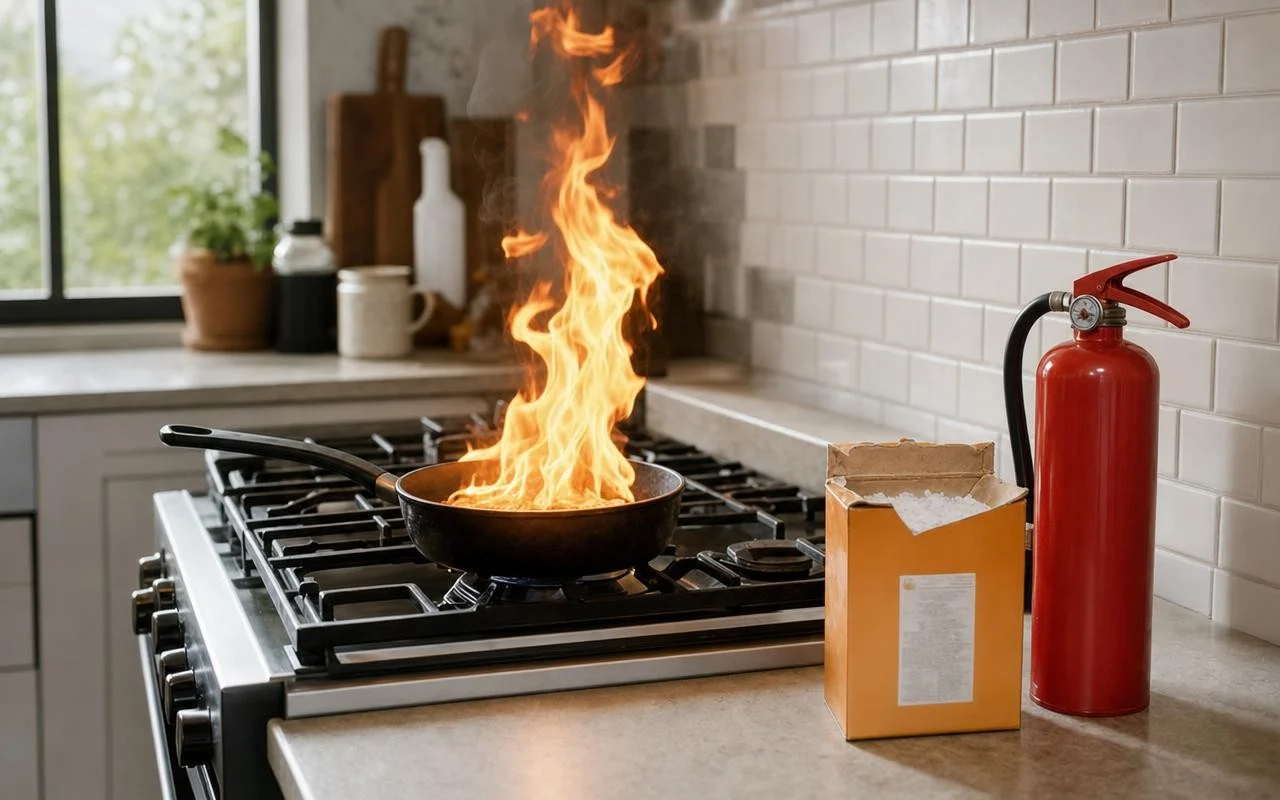
flames suddenly surged in the pan, the oil hissed, panic rose. On the countertop, a box of bicarbonate de soude awaits, often presented as the miracle trick to extinguish a feu de cuisine. Should you trust it or set the box down and do something else?
American authorities remind us that unattended cooking remains the main cause of fires. The U.S. Consumer Product Safety Commission (CPSC) summarizes the situation this way: “Watch what you’re cooking and stay in the kitchen. Unattended cooking is the No. 1 cause of cooking fires,” the agency explains. The right move at the critical moment depends on the type of fire you’re facing.
Identify the kitchen fire before pulling out the baking soda
When oil or fat catches fire in a skillet, the CPSC provides a very clear procedure: slide a lid over the container to smother the flames, cut off the heat source, and leave the lid in place until it has cooled completely. It also stresses never to carry a pan that is on fire, as injuries from this bad idea are all too common.
For other foods burning on the stove, the same CPSC states: “Extinguish other food fires with baking soda. Never use water or flour on cooking fires.” The agency thus draws a boundary: the baking soda for kitchen fires is mainly suitable for foods in flames, in a stable container, when the blaze remains small and well contained.
How to use baking soda safely
The University of Illinois Extension services explain that table salt or baking soda can help for a small grease fire contained in a pan, in addition to the lid when it can be reached without risk. The recommended action is to cut the fire, maintain some distance, and sprinkle a generous amount of powder directly onto the flames, without throwing the box all at once.
However, the Houston Fire Department recalls a troubling figure: more than half of people who try to extinguish a kitchen fire themselves get injured. Firefighters emphasize that baking soda is not a universal solution; a simple small box is not enough if the fire has already intensified or started to spread. In these cases, the safest option remains to exit, close the door, and let professionals intervene.
Actions to avoid and the right equipment against a kitchen fire
American safety bodies outline several classic mistakes that worsen the situation. Water on oil causes flaming splatter, flour can explode into a flaming cloud, and carrying a pan can cause it to topple to the floor or onto the person holding it. An oven on fire should remain closed, simply cutting the heat to smother the flames by depriving them of oxygen.
To memorize the prohibitions, many prevention sheets summarize the key points:
- never pour water on a cooking fire;
- never use flour;
- do not move a flaming pan;
- keep the oven door closed if a fire starts inside;
- give up and leave the premises if the fire does not go out immediately.
Illinois Extension experts also recommend keeping a kitchen fire extinguisher, class B or K, readily accessible, and handling it only after minimal training. The CPSC additionally suggests a functional smoke detector, tested monthly, along with a simple plan: stay in the kitchen during cooking, wear short sleeves, and keep towels and flammable items away from the burners.
