
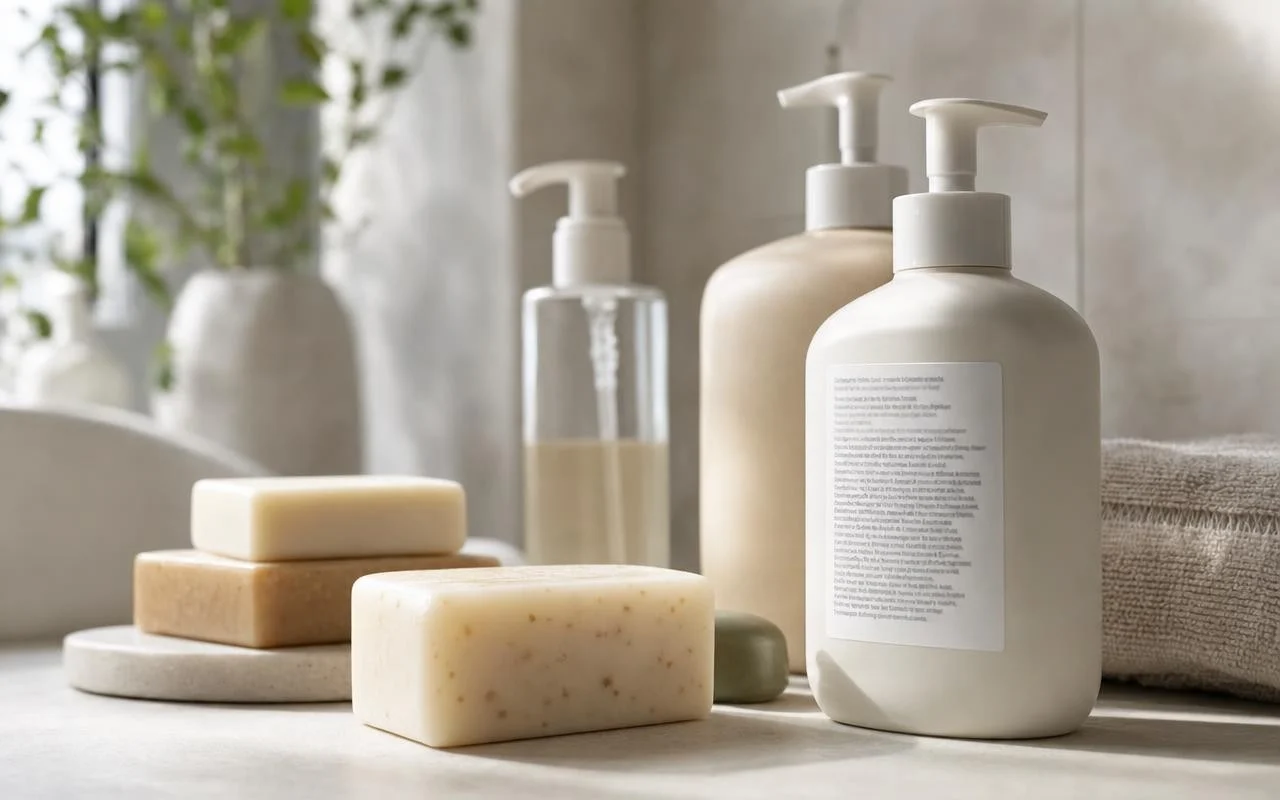
In the hygiene aisles, the shelves display the same promise everywhere: fragrance-free soaps, cleansing gels marketed for sensitive skin, hypoallergenic bars. Facing these reassuring labels, many consumers feel they have found the ideal solution to calm reddening and tightness. The absence of fragrance seems logical, almost obvious, when the skin reacts to the slightest product.
For several years now, the General Directorate for Competition, Consumers and Fraud Prevention (DGCCRF) has reminded us that cosmetic labeling, from soap to shampoo, adheres to precise rules. The INCI list, allergens, and “fragrance-free” claims must provide fair information to the consumer. Behind a simple soap sold as neutral, the reality can be much less evident than it appears.
Savon sans parfum et peaux sensibles : ce que cela veut vraiment dire
A fragrance-free soap essentially means that no fragrance blend has been added to impart a scent to the product. The National Agency for Medicines and Health Products Safety (ANSM) recalls that a group of 26 fragrance substances is subject to an information obligation: for a rinsed product like a soap, their presence must be disclosed above 0.01%, and above 0.001% for a non-rinsed product.
That does not, however, guarantee perfect tolerance for all sensitive skin. For people suffering from fragrance-related allergic contact dermatitis, this labeling remains useful because it reduces a well-identified risk factor. Yet, the tolerance of a product is not defined solely by the absence of fragrance. Dermatologists also emphasize the role of the quality of cleansing agents, of the pH, and of the fragility of the skin barrier, which varies from one person to another.
Lire l’étiquette d’un savon sans parfum quand on a la peau sensible
The DGCCRF insists on reading the full ingredient list. It recalls that this list must begin with the word Ingredients, follow the descending order of quantities, and use the International Nomenclature of Cosmetic Ingredients (INCI). The regulatory authority also notes that some overly general claims, such as “paraben-free” or “hypoallergenic,” do not rest on any truly precise definition for the consumer.
For someone with sensitive skin, the right reflex is therefore to look beyond the promise of “fragrance-free.” A few concrete pointers help form an idea of the product’s true gentleness.
- Prefer a short INCI list, without a long series of components.
- Check for the absence of fragrance or aroma among the first ingredients.
- Identify any named scented allergens if the skin has already reacted.
- Be cautious of “0%” or “hypoallergenic” mentions that are not explained.
pH du savon, barrière cutanée et limites du “sans parfum”
Another often overlooked factor is the pH. Studies published in a scientific journal cited by the United States National Library of Medicine place the average skin pH between 4 and 6, i.e., slightly acidic. The medical site DermNet, written by dermatologists, indicates that conventional soaps are, by contrast, alkaline, with a pH often around 9 to 12.
This pH mismatch can weaken the skin’s protective layer and worsen dryness, especially for those prone to eczema or redness. A soap can thus be fragrance-free yet still too harsh for highly reactive skin. Some cleansers called syndets or fragrance-free cleansing gels, adjusted closer to the skin’s pH, are often better tolerated. In case of repeated reactions despite a product marketed as “fragrance-free” and intended for sensitive skin, a medical consultation helps identify precisely which irritant is at fault.
