
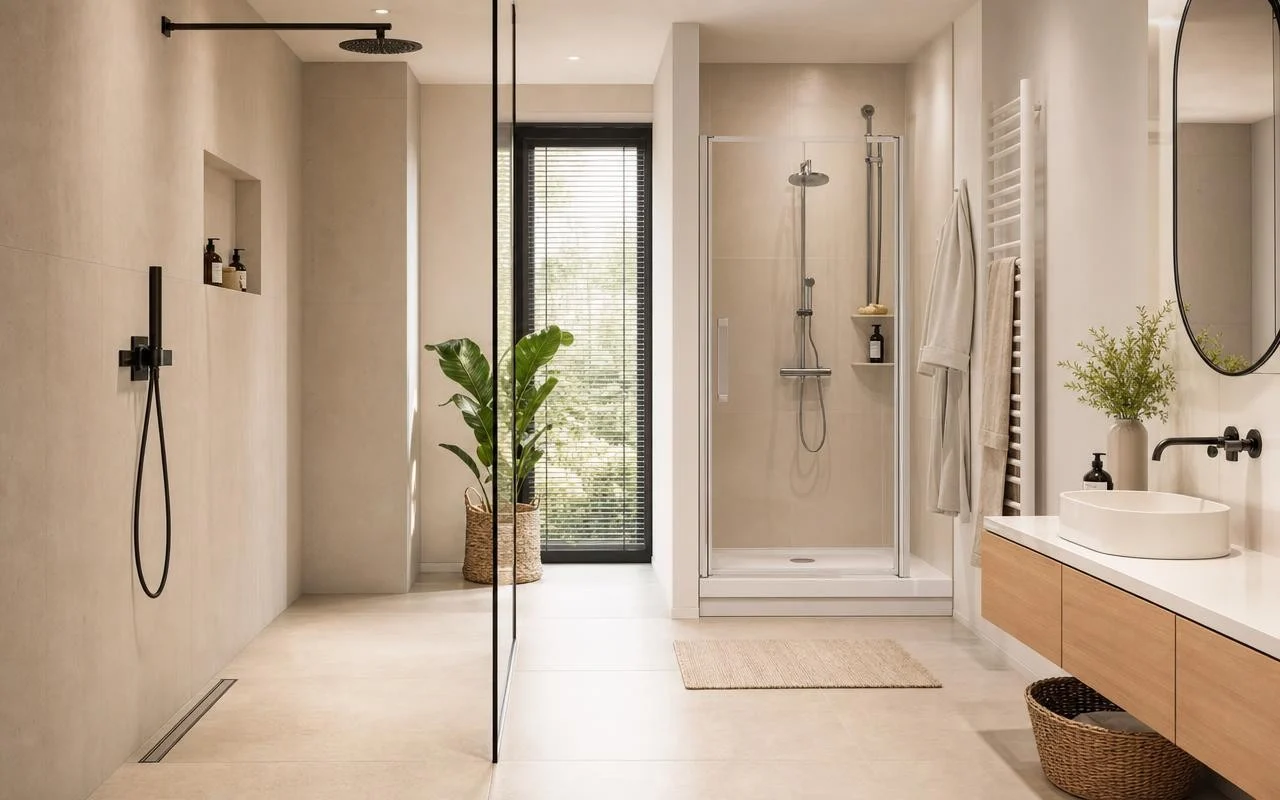
Every morning, many people still step over the white edge of their shower tray, an automatic gesture inherited from bathrooms of the 1990s. In 2026, this ritual of the raised shower base is being questioned by interior designers from Spain, Italy, and France. Home decor media describe the same trend: the traditional model is losing ground to a more discreet and integrated installation.
Since the start of the year, Okdiario, Vanitatis, Trendencias, or Maison et Travaux have talked about a common scenario: in both new homes and renovations, the classic shower tray would be installed less and less, replaced by a so-called Italian model laid flush with the floor. No official ban, but a very clear trend, which is already prompting many individuals to rethink their future bathrooms. It remains to be seen whether your room can follow the movement.
Why the raised shower tray is losing popularity in 2026
For designers, the main critique targets the famous edge between the floor and the tray. In Okdiario, interior designers summarize the issue as follows: “The absence of steps is probably one of the most interesting features of this system. In a conventional shower, there is usually a small elevation between the bathroom floor and the tray. Even if it may seem insignificant, any physical obstacle can complicate access for some people. A walk-in, flush-to-floor shower allows you to enter directly into the bathing area without needing to lift your foot to cross a ledge. This is why architects and interior designers consider it to be a particularly interesting solution when looking to improve a dwelling’s accessibility,” they explain.
The Net Tribunal points to another drawback: maintenance. Rails, seals, corners of the tray and the glass panel trap limescale and soap, at the cost of long cleaning sessions. In this article, one finding recurs: “Interior designers say it plainly, this format has had its day.” With the aging population, this combination of a slippery edge and a bulky wall seems less and less suited to a bathroom used by the whole family.
Walk-in shower: how this flush-to-floor model works
The walk-in shower described by the Spanish and French media rests on a simple principle: the bathing area sits exactly at the same level as the rest of the floor. The tray is recessed, invisible, and a slight 1% slope directs the water toward a drainage channel or a linear drain integrated into the tiling. To prevent any infiltration, the guides from Maison et Travaux stress perfect waterproofing beneath the coating, with a screed preparation more technical than for a simple tray replacement.
On the decor side, the goal is visual continuity. Architects often recommend the same non-slip porcelain stoneware across the entire floor, sometimes a continuous microcement or a natural stone extended into the shower area. The space is no longer read as a block placed in the room, but as a single volume, sometimes simply closed by a fixed glass panel, sometimes completely open in large bathrooms. The desired effect: a cleaner, brighter room that looks larger.
Strengths, limits, and cases where you may keep your raised tray after 2026
If this Italian model is progressing so quickly, it is because it ticks several boxes at once: style, comfort, and accessibility. The step-free floor makes it easier for children as well as seniors to enter, the continuous surface gives the impression of gaining a few extra meters, and the absence of rails reduces some hard-to-clean corners. The advantages highlighted by architects can be summarized as follows:
- Flat-floor access, with no steps to cross.
- Perceived space increase thanks to the continuous floor.
- More minimalist lines and a more contemporary look.
- Fewer profiles and rails where deposits tend to accumulate.
- Better integration into a comprehensive bathroom renovation.
Yet the articles remind us of real limits. Transforming into a floor-level shower requires heavier work, a higher budget, and a floor capable of creating a slope and ensuring waterproofing. In small bathrooms or on certain floors, the shower tray remains easier to install. Okdiario stresses: “For this reason, we cannot speak of the disappearance of the shower tray, but of a shift in trend in bathroom design.” In 2026, the raised shower tray does not disappear everywhere; it mainly gives way to Italian showers where space, structure, and budget allow.
Sources
- Maison & Travaux
“This Italian shower is taking hold in Spain: why your classic tray is also seeing its last months in France”
