
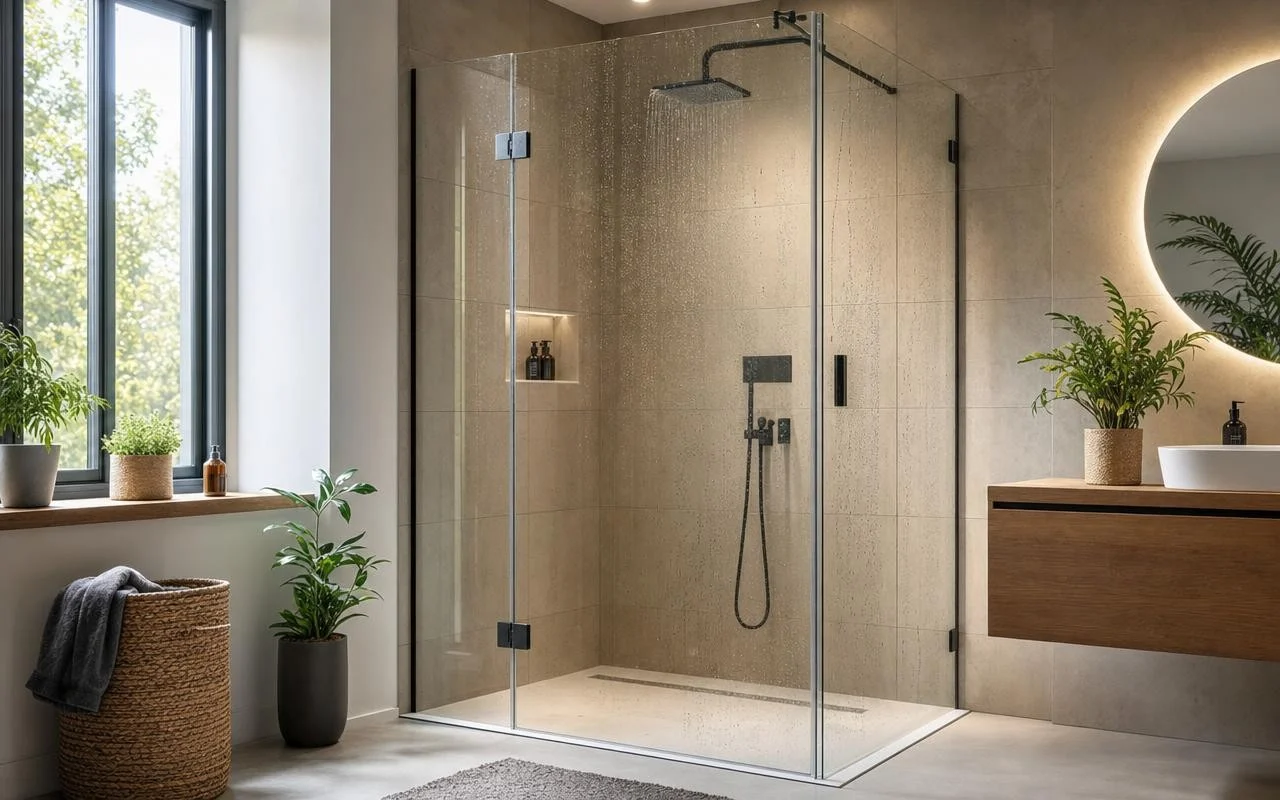
You dream of a bathroom worthy of design magazines, with a large tiled expanse and a flat, spa-like floor? The walk-in shower has long been the obvious answer. We’ve seen it everywhere: in renovation sites, new-build projects, and home décor on social networks. But when it comes to turning the dream into everyday use, many homeowners are starting to rethink their plans.
Water splashes, lime scale creeping across the rest of the room, a chilly sensation when you step out of the spray… In real life, the lack of a door quickly reveals its limitations, especially in a small family bathroom. Since late 2025, media outlets like Le Journal de la Maison or Maison & Travaux have spoken of a “return of the closed shower” for 2026. With, at stake, a solution far more minimalist than one might imagine.
Why the Italian-style shower loses ground in real life
For years, the open Italian shower was presented as the most elegant option: accessible without steps, large slabs, no door to push. But water doesn’t stop at the edge of the tray. With every shower, splashes reach the floor, the rug, and sometimes even the furniture. Limescale extends well beyond the washing area, which greatly increases cleaning time.
Another point often cited by homeowners: temperature. The absence of a closure lets air circulate freely, which quickly gives a “drafty” shower feel, especially in poorly heated homes. Add to this the paw prints of a cat or dog crossing when the floor is still wet, and one understands why this model, perceived as too common and less comfortable, is being questioned.
The minimalist closed shower with a frameless door takes hold in 2026
The trend observed for 2025 and 2026 does not revert to the old bulky plastic cabin. Manufacturers and interior designers are betting on the closed shower with a frameless shower door: a large expanse of tempered glass, fixed by discreet hinges or rails, with no visible vertical profiles. The space is clearly defined, while maintaining an impression of openness and lightness.
This choice affects both style and comfort. Visually, removing the metal frame creates a very clean “all glass” look, which makes the room feel larger and lets light through. Technically, these doors generally use 8 to 10 mm thick tempered glass, a guarantee of safety. Coupled with an ultra-flat tray and a continuous floor, they preserve the spirit of the walk-in shower, but with far fewer splashes.
Choosing your frameless shower door wisely: openings, dimensions, budget
To move to a frameless shower door, the first choice concerns the type of opening. Brands offer three main configurations: the hinged door, the sliding door, and the fixed panel known as “walk-in.” A fixed panel generally measures between 800 and 1,200 mm in width; beyond that, splashes return, especially with a very powerful rainfall shower head.
- For a family bathroom needing maximum watertightness, the hinged door offers a wide passage, provided there is enough clearance in front of the shower.
- In a small space or near a piece of furniture, a sliding door limits bulk while still closing the volume well.
- If the room is large and you want a very open feel, a fixed “walk-in” panel works well, provided you choose a shower tray deep enough.
On the price side, ranges reported by manufacturers such as Kinedo hover around €350 to €600 for a budget frameless panel, €700 to €1,200 for mid-range, and €1,500 to more than €2,500 for a custom model. Before buying, it’s wise to check the sturdiness of the wall support (plasterboard with reinforcements or masonry), the perfect level of the tray, and the measurements to the millimeter. To keep the glass transparent, experts recommend a squeegee after every shower, soft weekly cleaning, and, if the panel is treated against lime buildup, renewing the treatment about every two to three years.
Sources
- JLM
“Dites adieu à la douche à l’italienne : en 2026, voici l’alternative design qui va la remplacer”
