
Have you ever found a torn bag at the bottom of the freezer, or foods dried out despite careful packaging? Many households still use any plastic bag to freeze, thinking it makes things simpler. But not all bags withstand either extreme cold or prolonged contact with food.
Since February 18, 2026, the DGCCRF’s information sheet on materials in contact with food reminds us that chemical substances can migrate to foods if the use is not appropriate. The notion of a material’s “inertia” becomes central. And a seemingly minor detail, the bag’s labeling, suddenly becomes highly important.
Food contact: the first key to a freezer bag that is truly suitable
The starting point is to verify that the bag is indeed an MCDA, that is, designed for food contact. The DGCCRF states that these containers are identifiable by the glass-and-fork pictogram or by wording such as “suitable for foods.” It summarizes: “Whether you are a professional or a consumer, only use utensils and containers intended to cook or store foodstuffs,” under penalty of exposing consumers to a danger.
A trash bag, a store-bought sachet, or a simple storage bag without a pictogram do not meet these requirements. The inertia of the material has not been verified for prolonged food contact, let alone at very low temperatures. The DGCCRF also reminds that the manufacturer commits to specific conditions of use: type of food, temperature, duration of contact, and whether it is for single use or reusable. Without these details, safety cannot be guaranteed.
Temperatures, snowflake, and markings: the evidence that a bag can withstand freezing
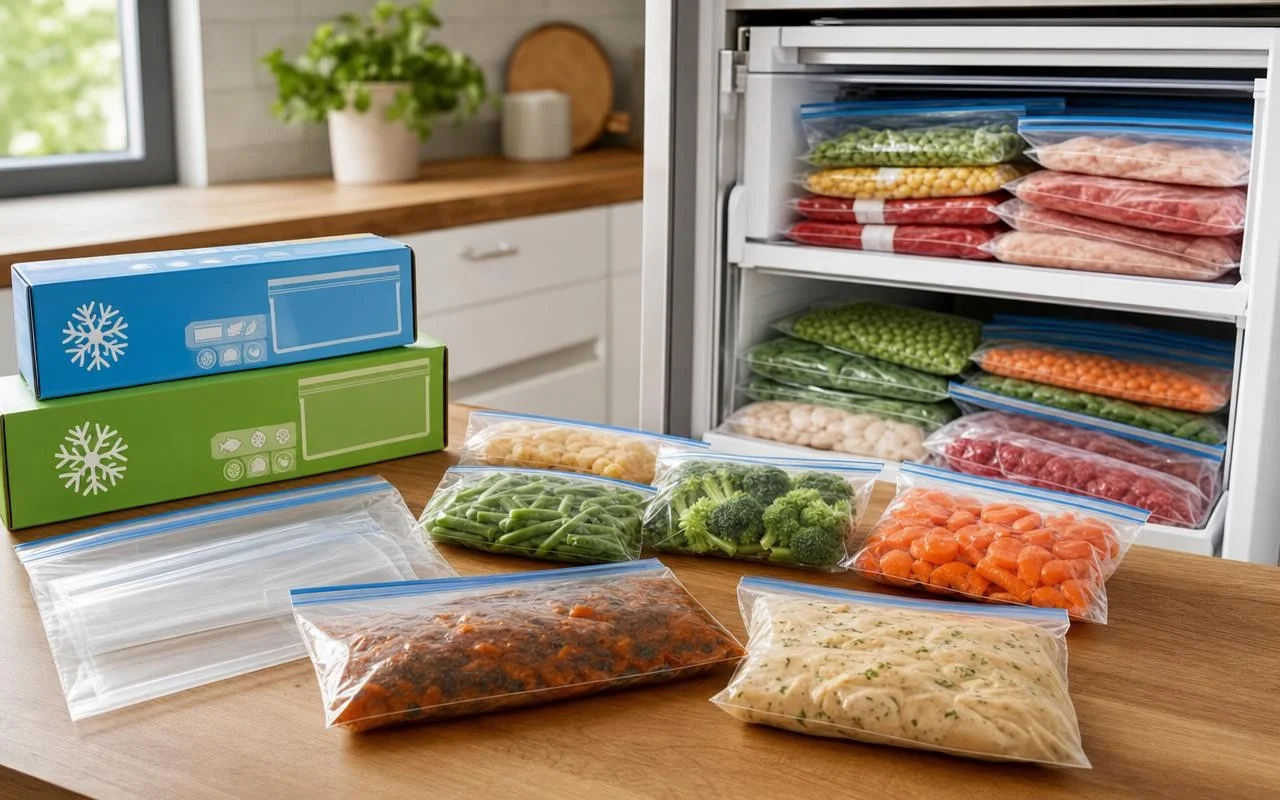
A bag that is suitable for food contact is not automatically a freezer-ready bag. For freezing, there must be a specific proof on the packaging. Look for a “freezing” mention, a snowflake symbol, or a temperature range that includes at least -18 °C. The DGCCRF also cites logos indicating a temperature range, for example from -18 °C to 120 °C, which materializes the manufacturer’s commitment to this use.
If you’re unsure, a few visual clues help you decide:
- Glass-and-fork logo or the phrase “suitable for foods.”
- Mention of “freezer bag,” snowflake symbol, or a temperature range including -18 °C.
- Clear indication “single-use” or washing instructions for repeated use.
In the absence of a freezer-related mention or a negative temperature indication, the precaution rule applies: no proof, no commitment from the manufacturer. Behind these logos lies a conformity declaration, whereby the manufacturer attests that their bag remains safe within the indicated limits.
Thickness, closure, and uses: the details that confirm a freezer-specific bag
Once these initial checks are passed, other indicators confirm that it is indeed a freezer-ready bag. Many packaging labels note thickness in microns: the higher the thickness, the better the bag resists the cold without becoming brittle or porous. Closure systems like zippers or sliders ensure a good seal against air and moisture, which limits ice crystals and freezer burn—this surface drying described by several specialized guides.
Last quick check, reread the “usage” line. The DGCCRF emphasizes: “Do not reuse a single-use container” and “Do not put a container not intended for it into the oven.” Many common freezer bags are designed for a single use. For a reusable model, there must be washing instructions and mention of repeated food contact. And above all, do not cook in a bag intended only for cold storage, unless explicitly stated by the manufacturer, as migration tests have not been conducted for heat.
