
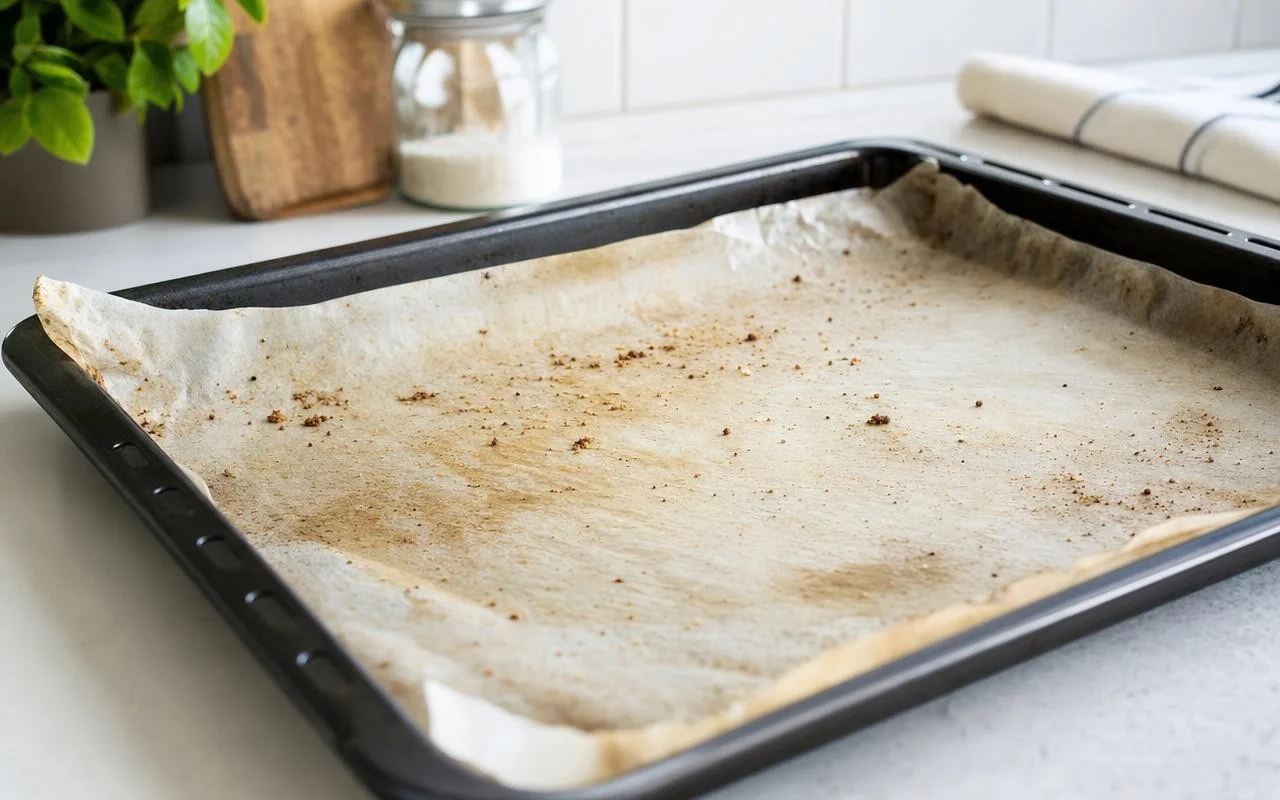
We often place a sheet of parchment paper on the baking tray, slide it into the oven, and it is promptly tossed in the trash. Many home cooks wonder whether this habit is truly justified or if the sheet could be reused for several batches without risk.
This baking paper is not ordinary paper: it is coated with a thin layer of silicone that makes it non-stick and heat-resistant, but also very difficult to recycle. Hence a practical question for anyone looking to limit waste in the kitchen: how many uses can a single sheet reasonably withstand before it must be discarded?
How many uses can parchment paper really withstand?
Experts agree on one point: there is no single figure that applies to all situations. The culinary author PJ Hamel, for King Arthur Baking, sums up the basic rule this way: “Reuse parchment paper only if it has been used for baking and only if it is easy to wipe clean,” she notes. A clean sheet, marked only by a few grease spots and crumbs, can therefore go again for another round.
For domestic use, manufacturers like Reynolds Kitchens and experts interviewed by Martha Stewart suggest a simple benchmark: up to 2 or 3 uses for cookies or mildly sticky preparations. Thick professional sheets can go up to about 8 passes, or even 16 for certain premium papers, according to the French site Emballage Fûté. But these figures hold only if the sheet remains intact, not saturated with grease, and used within the prescribed temperature limits, often around 220 °C.
Grease, Heat, and Grime: What Really Wears the Paper
The lifespan of a reused baking sheet mainly depends on four factors. First, grease: as batches accumulate, it builds up, oxidizes, and eventually emits a rancid odor that can transfer to the food. Temperature also matters: King Arthur Baking notes that very hot bakes, near 230 °C, brown and sometimes carbonize the edges. These darkened areas remain reusable as long as the sheet doesn’t crumble, but they weaken the support.
Next come stuck-on residues, such as caramel, burnt sugar, or tart overflow, which become impossible to remove without tearing the paper. Finally, mechanical integrity plays a key role: as soon as the sheet becomes brittle, develops holes, or the edges break into small pieces, it has reached the end of its useful life. It is here that the theoretical number of uses matters less than the sheet’s actual condition.
Safely Reusing Parchment Paper at Home
Food safety imposes some clear prohibitions. Experts cited by Martha Stewart, including specialist Darin Detwiler, strongly discourage reusing a sheet that has been in contact with meat or fish, especially raw or very fatty. The same goes for parchment used for glazes, creams, or unbaked butters: it’s best to discard after use. Conversely, PJ Hamel notes that cooking above 121 °C greatly reduces the bacterial risk on dough residues containing eggs or dairy.
When it comes to cakes, brownies, and very sticky bars, sources agree: the sheet often comes out soaked, covered with residues that are impossible to clean, and should generally be treated as disposable. To extend the life of paper in good condition, King Arthur Baking’s bakers suggest wiping it with a slightly damp cloth, letting it dry completely, then storing it flat, in the open air, for example resting on top of the stack of baking sheets, ready for the next batch.
