
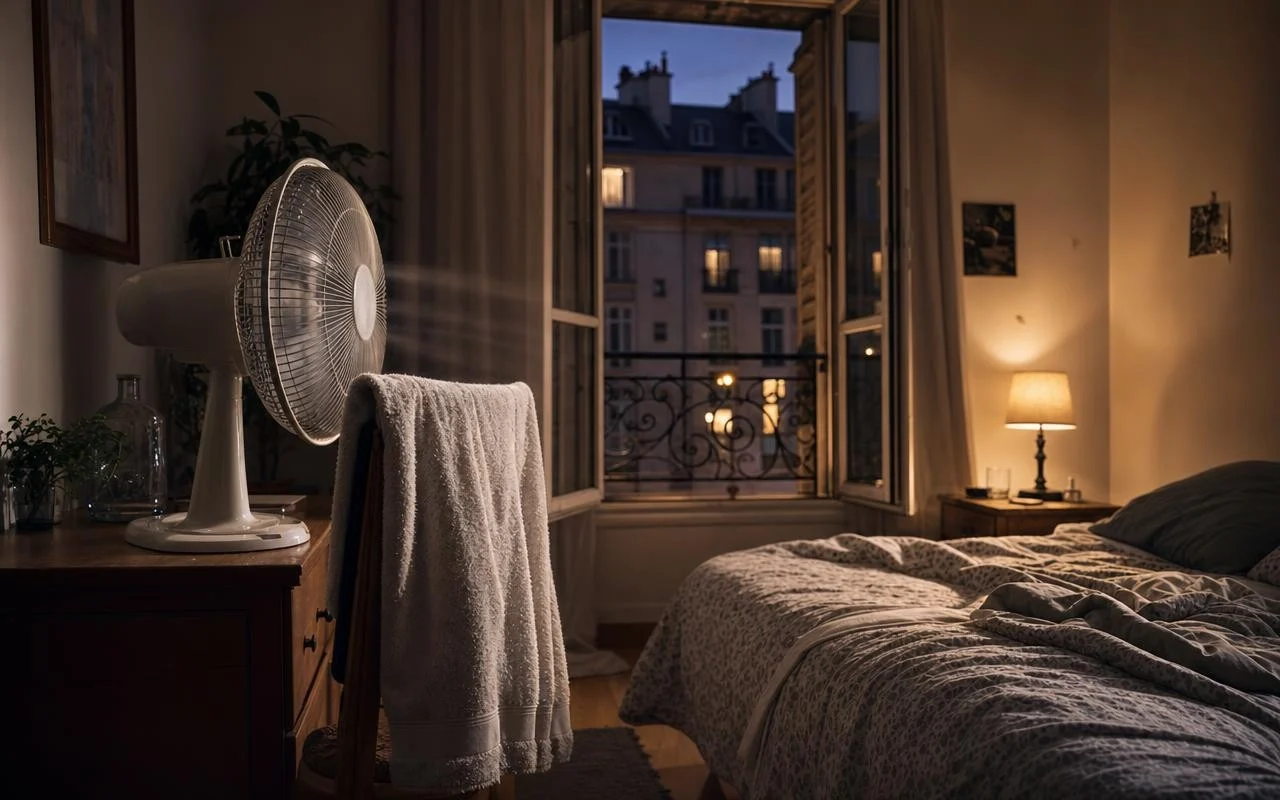
Hot nights during a heatwave tend to feel the same: clingy sheets, a pillow that feels like a burn, a fan pushed to maximum which seems to merely move warm air around. Many people end up dreaming of air conditioning, even though it is expensive and drives up the bill. Yet a simple damp cloth, placed correctly in the bedroom, can already make the atmosphere more breathable.
Architect Leo Rogel has turned his attention to this very practical question: how to sleep better despite the heat, without renovations or extra equipment. His solution relies on air circulation and the evaporation principle, with a simple placement trick. Everything actually hinges on the exact spot where you install this towel.
Heatwave: correctly placing a damp towel and the fan in the bedroom
For Leo Rogel, a fan does not cool the air; it stirs it. If the air in the room is thirty degrees, it will stay warm until its interaction with the water is altered. The architect therefore bets on evaporative cooling: forcing the airflow to pass through a lightly dampened surface to create a cooler current felt on the skin.
Concretely, he recommends placing a damp towel right behind the fan. Hang it, well wrung out, from the back of a chair or a small drying rack positioned behind the unit, ensuring the fabric does not touch the grille or the blades. The ideal is to set the fan close to an open window at night: the outside air, often cooler, first passes through the towel, then is projected into the room with a slight refreshing effect.
Why the damp towel behind the fan truly cools the air
In this arrangement, the water contained in the fabric evaporates as it comes into contact with the moving hot air. This evaporation consumes thermal energy and lowers the perceived temperature of the breath reaching you, even if the thermometer barely moves. Some tests conducted with a damp sheet in front of a slightly ajar window indicate a local gain of two to three degrees in the incoming air, especially at the level of the airflow.
This method works best when the air is fairly dry. If the atmosphere is already heavy and humid, adding more water risks making the room clammy and less comfortable. Hence the importance of a simply damp towel, well wrung, and good ventilation so that excess humidity can escape. “With this heat, every degree counts,” notes the architect, highlighting a low-cost solution with no extra electrical consumption beyond the fan alone.
Instructions and pitfalls to avoid for better sleep during the heatwave
In practice, installation takes a few minutes. To make the most of this towel-fan duo, simply follow a small evening ritual just before bedtime.
- Dampen a towel or a lightweight sheet with cold water, then wring it thoroughly so that it stops dripping.
- Hang it behind the fan, leaving a small air gap between the fabric and the device, ensuring no contact with the grille or the motor.
- Direct the airflow toward the bed, preferably toward the body or a nearby wall rather than directly at the face all night.
- Monitor the ambiance: if the room becomes too humid or if the towel dries out completely, adjust or remove the setup.
If the air remains stifling, on certain evenings this technique can be complemented by a light mist in the room before turning in, as suggested by Leo Rogel. ADEME guides also advise keeping shutters closed during the day and airing the room widely at night: placed at the window, the fan then helps bring in the cooler outdoor air, which passes through the damp cloth before cooling your bed.
Sources
- JLM
“Canicule: this damp towel placed in the right spot finally helps you sleep better”
