
When the thermometer climbs above 35°C, many pool owners watch their pool shift from blue to green in just a few days. The water rises to around 30°C, the sanitizer evaporates, and eyes sting. We then wonder whether it’s necessary to overhaul our entire maintenance routine or if there is a simple evening gesture to take back control.
The heatwave disrupts the water balance. Beyond 28°C in the basin, chemical reactions accelerate, the disinfectant is consumed faster, and margins for error shrink. A pool managed without stress at 24°C can tip over in 48 hours when the heat sets in. The key moment hinges on a precise hour: 8 PM.
Heatwave and chlorine: why pool water goes out of balance so quickly
As soon as the water reaches 28°C, the free chlorine degrades much faster under the combined effects of heat and UV rays. A correct dose in the morning can be exhausted by mid-afternoon. When the pH exceeds 7.6, the sanitizing power of chlorine is halved. The targets to keep in mind: pH 7.2–7.6, free chlorine 1–3 mg/L, total alkalinity (TA) 80–120 mg/L.
Another consequence of the heat: chloramines, formed when chlorine reacts with sweat and solar products. For this heatwave, attendance increases and the heat speeds this reaction. Result: strongly smelling water, eyes that sting, and too little chlorine available. The remedy is a chlorine shock treatment in the evening, followed by continuous filtration until the next morning.
Why 8 PM is the best moment to treat your pool
In the heat of a summer afternoon, the sun strikes the water and UV rays destroy a large portion of the disinfectant in just a few hours. After 8 PM, the sun is lower, the water warms less, and the product can act without being immediately degraded. Knowing when to add chlorine to your pool makes a real difference in product consumption and water stability.
If the readings are correct and the water is clear, simply top up with slow-dissolving chlorine and keep the filtration running almost continuously during the heat. If the water becomes cloudy, smells strong, or turns into green water, switch to a shock treatment, with a higher chlorine dose and continuous filtration for at least 24 hours.
8 PM Ritual: The List for Impeccable Water All Summer
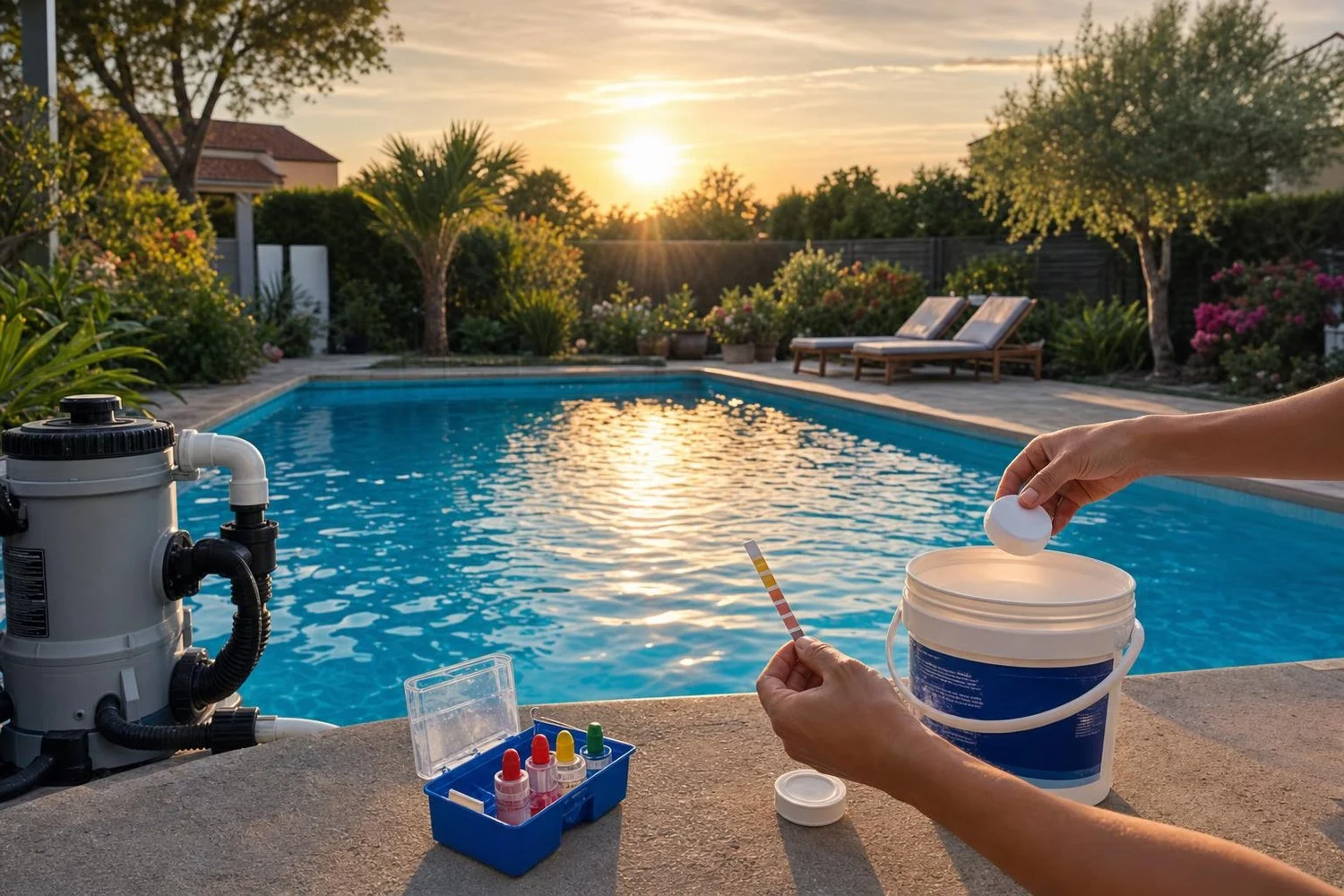
To avoid unpleasant surprises, daily monitoring becomes essential during a heatwave. Experts recommend a test in the morning before the first swim, then another in the late afternoon. The 6-in-1 test strips yield results in 5 seconds and measure chlorine, pH, TA, hardness, and stabilizer. Then comes the evening ritual, to start around 8 PM once the last swimmers have exited.
- Test the water: chlorine, pH, and if possible TA and stabilizer.
- Correct the pH if it lies outside the range 7.2–7.6 indicated on your test strips.
- Brush the walls and floor, empty the skimmers and verify that the filter is delivering properly.
- Pour in slow-dissolving chlorine or shock depending on water condition, then let the filtration run all night.
This evening protocol limits chloramine spikes, slows algae growth, and prevents the water from turning turbid between swims. A weekly anti-algae treatment, doubled during very hot periods, further strengthens this barrier. In case of over-stabilization after several weeks of stabilized chlorine, even a well-dosed shock may seem ineffective: partial dilution of the pool water is then required. With these reflexes, your pool remains welcoming all summer, despite episodes of extreme heat.
