
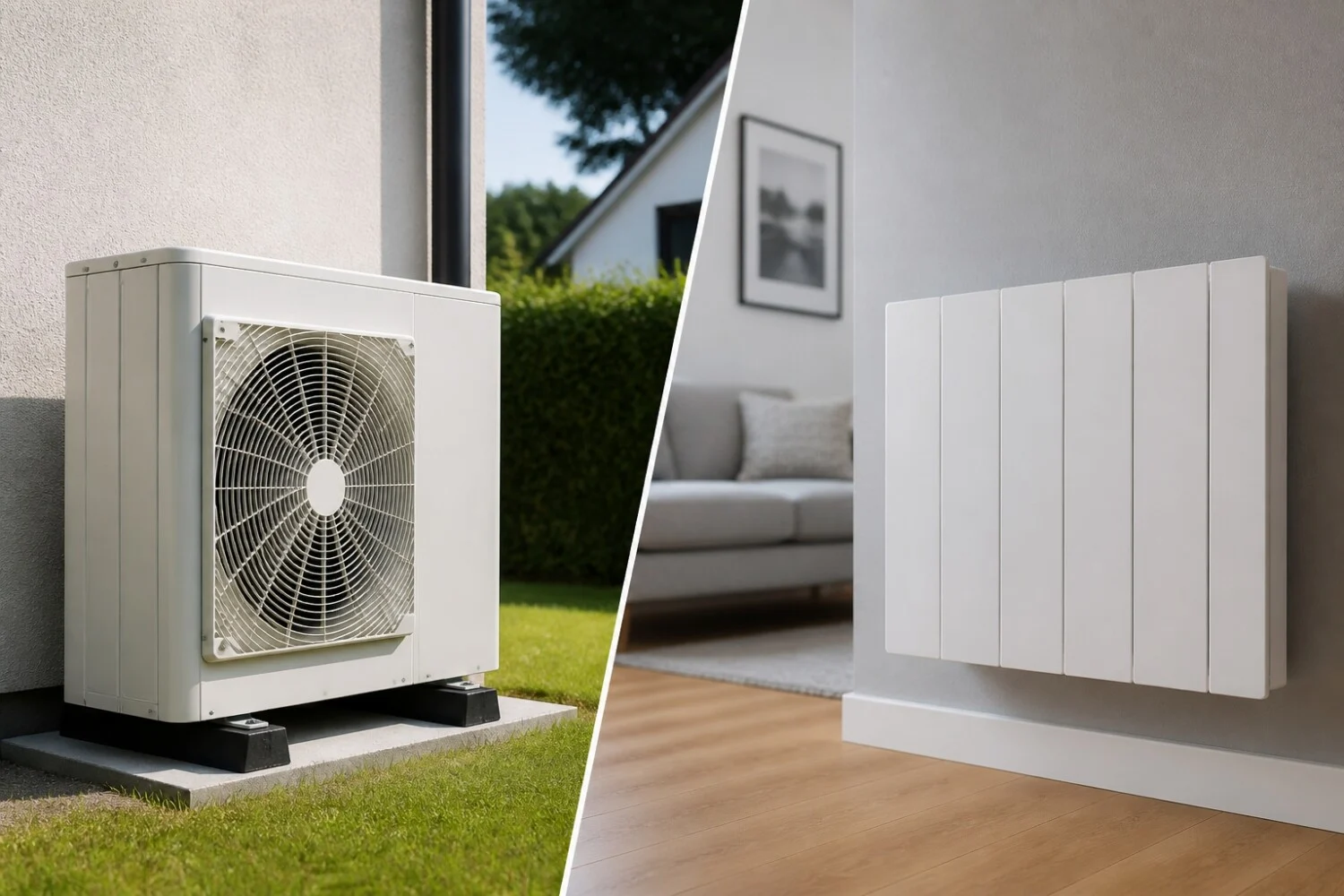
Heat pump or electric radiators: the answer mainly depends on the dwelling
Heat pumps and electric radiators do not fit the same energy renovation scenario. A heat pump generally suits a global, holistic project, especially when the dwelling is already well insulated or when envelope improvements are planned. Electric radiators remain simpler to install, more suitable for a specific room, a secondary residence, or a quick replacement of old emitters. In 2026, the right choice depends less on a principled opposition and more on the actual use of the dwelling.
The decisive criterion remains the coherence between the heating system, the quality of insulation, the area to be heated, and occupancy patterns. A poorly insulated home heated solely by electric radiators can lead to lasting discomfort. Conversely, a heat pump installed in a house that is not well prepared can disappoint if thermal losses remain too high.
What is the concrete difference between a heat pump and electric radiators?
A heat pump draws calories from the air, the ground, or water to produce heat. Electric radiators, by contrast, directly convert electricity into heat in each room. This technical difference changes the logic of the project. The heat pump fits into a centralized system, with considerations about the emitter, regulation, and sometimes the production of hot water. Electric radiators follow a more modular approach, room by room.
In the residential heating sector, manufacturers like Daikin or Atlantic are commonly associated with heat pumps, while Thermor, Acova, or Intuis are regularly cited when it comes to electric emitters and room-by-room comfort. This distinction does not prevent broader ranges, but it helps to understand the families of solutions available on the market.
What criteria to look at before choosing a heating system?
Choosing a heating system in energy renovation should never be limited to the purchase price of the equipment. You must examine the dwelling’s thermal performance, ease of installation, available space, acceptable noise level, regulation, maintenance, and the system’s ability to heat evenly. An old house, an apartment occupied intermittently, and a recent extension do not call for the same technical response.
The main criteria to compare are the following:
- Insulation of the dwelling : a high-performance envelope improves the results of any heating system.
- Type of use : primary residence, rented dwelling, supplementary room, or secondary residence.
- Acceptable works : a heat pump often requires more structural intervention than a radiator replacement.
- Expected comfort : temperature stability, heating response, zoning regulation, and uniformity.
- Maintenance : electric radiators are easy to operate, whereas a heat pump requires more supervised technical oversight.
In which cases is a heat pump most relevant?
The heat pump becomes particularly relevant when a household undertakes a coherent energy renovation, with careful attention to insulation and regulation. It can suit a house that is inhabited year-round, with regular heating needs and a desire to modernize the installation. The project then takes on a broader dimension than simply replacing emitters.
In this segment, Daikin and Atlantic are among the players often considered by households comparing central heating solutions. Their presence in market comparisons underscores a reality: the heat pump is evaluated as a complete system, not as a single device. Sizing, adaptation to the dwelling, and the quality of installation are as important as the technology itself.
In which cases do electric radiators retain real relevance?
Electric radiators retain practical relevance in several scenarios: light renovation, a dwelling without a hydraulic network, the need to heat a specific zone, or a preference for a quick project. They can also suit modest surfaces or intermittent use, provided the devices chosen are appropriate and insulation is not neglected. Comfort then depends a lot on the quality of regulation and the thermal inertia of the emitter.
In this family of equipment, Intuis, Thermor, and Acova regularly appear in discussions about domestic electric heating. Their presence on the market reminds us that there are several levels of comfort and control. Not all electric radiators are equally effective in practice, particularly regarding heat diffusion, thermal stability, and room-by-room management.
How to position each solution according to the dwelling profile?
A simple decision framework helps better align the technology with the usage context. The aim is not to declare a universal winner, but to identify the most coherent solution given the type of property, the level of works, and daily use. This reference helps avoid overly abstract comparisons between central heating and electric emitters.
| Dwelling profile | Often coherent solution | Why |
|---|---|---|
| Well-insulated house occupied year-round | Heat pump | Global approach, homogeneous heating, structuring project |
| Apartment without a water circuit | Electric radiators | Easier installation, limited works |
| Secondary residence | Electric radiators | Occasional use, targeted reheating |
| Heavy renovation with a complete overhaul of heating | Heat pump | Whole-system logic and modernization |
| Added room or extension | Electric radiators | Local response, rapid implementation |
What mistakes to avoid before deciding?
The first mistake is choosing a heating system without a minimal diagnostic of the dwelling. A heat pump does not compensate on its own for insufficient insulation, and high-performance electric radiators do not correct substantial losses. The second mistake is to think only in terms of equipment cost, without integrating user comfort, regulation, and the renovation project’s lifespan.
Another caution concerns comparing brands and product families. For example, Intuis and Thermor are often mentioned on the electric radiator side, while Atlantic can appear in more global heating solution comparisons. Daikin is regularly associated with heat pumps, and Acova is often mentioned when looking at emitters and comfort in rooms. The right approach is to compare solutions within the same category, then verify their fit for the dwelling. In energy renovation, technical coherence remains more important than the name on the device.
FAQ on choosing between a heat pump and electric radiators
Is a heat pump always more suitable than an electric radiator?
No, a heat pump is not always the best choice for every dwelling. A heat pump becomes particularly relevant within a global project, with proper insulation and regular heating needs. In an apartment without a hydraulic network, a small area, or a secondary residence, well-chosen electric radiators can remain more coherent. The right arbitration depends on the building, the level of works accepted, and the way the dwelling is occupied.
Are electric radiators still relevant in energy renovation?
Yes, electric radiators retain relevance in several targeted renovation cases. They are suitable when it is necessary to limit works, heat a specific room, or equip a dwelling without a central heating installation. Their relevance depends on the quality of insulation and the choice of devices. Manufacturers like Thermor, Acova, or Intuis are often studied for this room-by-room comfort and local regulation logic.
Which system is best for an old house?
For an old house, the choice primarily depends on the thermal state of the building fabric. A poorly insulated old house must first be analyzed in terms of heat losses, as no heating can by itself correct a weak envelope. If a comprehensive renovation is undertaken, a heat pump can become coherent. If works stay limited or progressive, electric radiators can constitute a transitional or localized solution, provided one remains realistic about their limits in large volumes.
Which heating is most suitable for a second home?
In a second home, electric radiators are often easier to consider. A secondary residence typically requires heating that is easy to operate, quick to restart, and compatible with intermittent occupancy. In this context, electric radiators can meet a practical need, especially on a modest surface. A heat pump can also make sense, but more so if the property is frequently inhabited and if the renovation project goes beyond the mere heating question.
Should brands be compared before choosing the technology?
No, it is better to first choose the technology suited to the dwelling. Comparing Daikin or Atlantic with emitter specialists like Acova, Thermor, or Intuis only makes sense after defining the type of heating sought. The first step is to determine whether the dwelling calls for a centralized system or a room-by-room solution. Only then does comparing ranges, regulation, and user comfort become truly useful.
Can you mix a heat pump and electric radiators in the same dwelling?
Yes, a hybrid approach can be coherent in certain projects. A dwelling can pair a heat pump for the main rooms with electric radiators in an extension, a rarely used room, or a space that is difficult to connect. This hybrid approach should remain legible and well-regulated. It can respond to a progressive renovation, provided that unnecessary overlap is avoided and a clear usage logic is maintained for each heated zone.
