
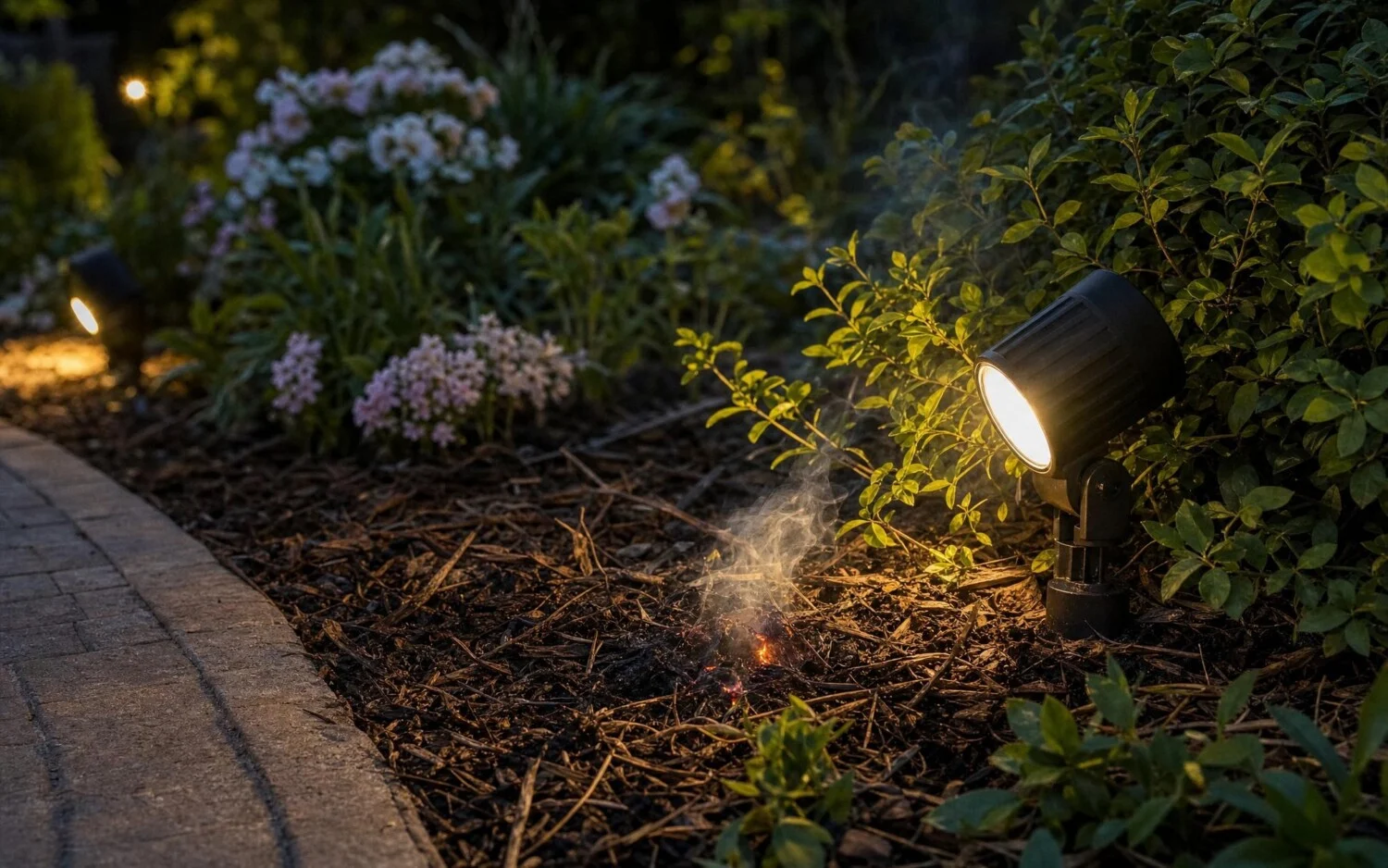
The border bed glowed as if from a catalog, bathed in the warm light of a few freshly installed garden spots. Under the roses and lavender, the small projectors tucked among the clumps gave the garden the look of a theater stage. When the shutters were closed, no one suspected that this summer lighting would soon become the onset of something sinister.
In the middle of the night, the smell jolted her awake: a mix of charred wood and hot plastic, carried by the warm air entering through the window. In the bed, the light flickered amid a cloud of smoke, a few embers already glowing red in the mulch. This scene, recounted by many gardeners, illustrates a very real risk that is often underestimated.
Spots in the borders: when overheating lights up the garden
The scenario is almost always the same. For a more natural look, you slip the light unit under the shrubs, hide it behind dense foliage, or place it directly on a decorative mulch. The evening passes, the garden spots stay lit for hours, heat slowly rises, trapped under leaves and dry twigs.
A 50 W halogen bulb can exceed 200 °C, while a comparable LED spotlight often stays around 50 °C. In a ceiling, you plan for air around it; in a border bed, you sometimes press the lamp against fallen leaves and wood chips. After a while, these materials reach their ignition point, without an initial flame: simple overheating is enough.
Dry foliage, organic mulch: a perfect fuel around the spotlight
In summer, shrubs shed leaves, the thinnest stems dry out, and dry foliage accumulates at the base of plants. Many gardeners add an organic mulch of wood chips or bark to keep things cool. Visually it works, but all of this remains very dry wood, placed just millimeters from a continuous heat source.
When the spotlight is buried or wedged under the shrub, the heat no longer dissipates. Leaves yellow, darken, then start to smolder. The smell of burnt wood or heated rubber sometimes barely precedes the first embers. Another common trap: relying solely on the IP65 rating or equivalent, which protects against water and dust, but does nothing about contact with flammable materials.
Securing border lighting to keep the magic without the risk
The good news is that a few simple precautions are enough to enjoy illuminated borders without fearing a fire. First, replace old sources with LED lights, much cooler, and favor stake-mounted models that are slightly elevated. Around each lamp, carefully clear several centimeters of space free of leaves, twigs, and chips.
To further limit the risk, around the spotlight you can replace the wooden mulch with a mineral mulch: light gravels, crushed slate, pebbles. Some opt for solar spots, which avoid cables and are generally less powerful. In case of a burnt smell, a few simple steps should be taken immediately:
- turn off the lighting at the breaker or switch;
- water or remove, if safe, the leaves and mulch around the hot projector;
- monitor the area for several minutes to ensure no ember is smoldering;
- call emergency services as soon as a flame appears or smoke thickens.
Sources
- Pleine Vie
“Three purchases under €50: steel edging, mineral mulch, and solar spots transform a garden in one evening”
