
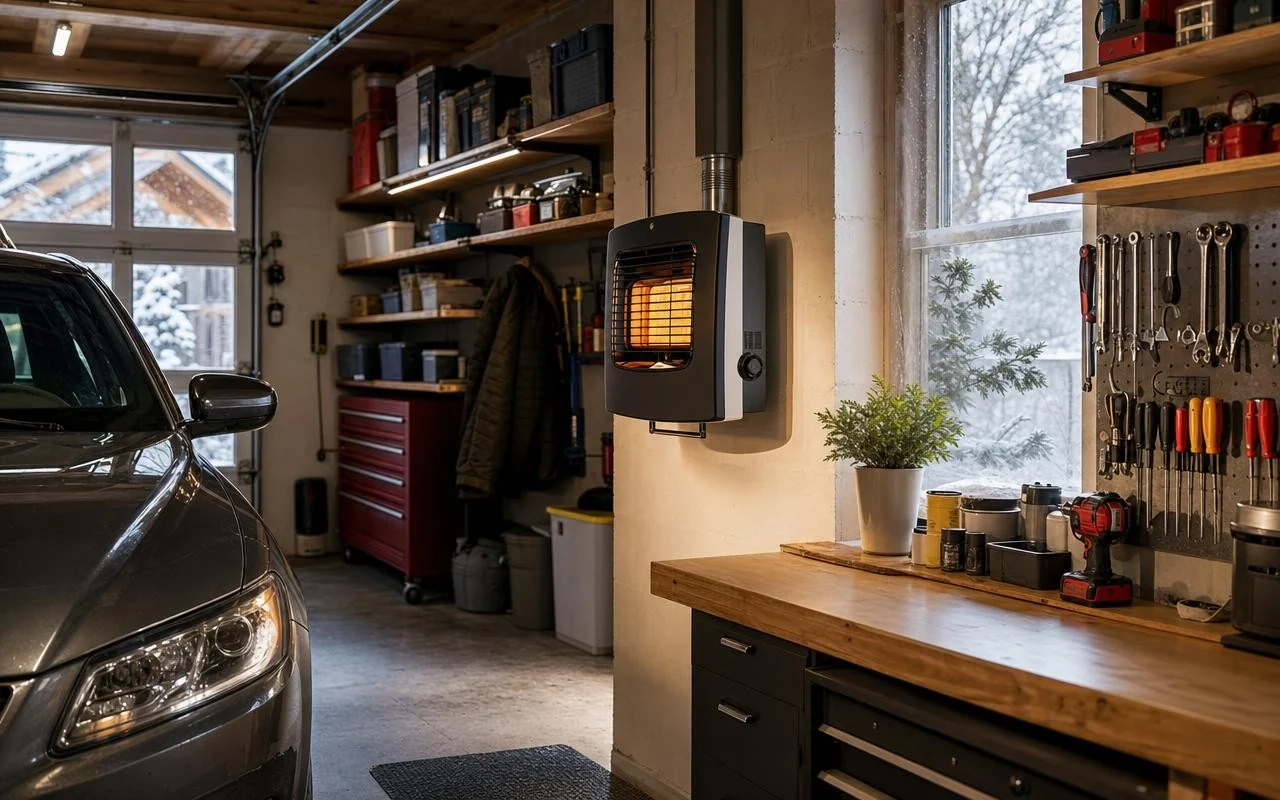
When the thermometer drops, many garages turn into freezers, even though they’re used as workshops, offices, or gyms. Extending a central heating circuit to this space is costly, raises safety questions, and isn’t always suitable for a space that is often poorly insulated.
That’s where a find at Home Depot catches the eye: a compact ventless natural gas heater, the ProCom 10,000 BTU, priced around $129.10 (about €120). A unit designed to heat a small garage, but one that comes with a few very specific conditions.
Home Depot’s 10,000 BTU Ventless Natural Gas Heater ProCom in Brief
This ProCom model uses the Blue Flame technology, a convection heating system that warms the room’s air rather than one particular object. It is powered by natural gas and claims an efficiency of 99.9% with a heat output of 10,000 BTU, marketed to heat roughly 500 square feet, i.e., a small garage or a well-insulated workshop.
The unit offers five heat levels, a built-in thermostat, and a piezo igniter, meaning it can start without electricity— a real advantage during a power outage. It can sit on the floor or be wall-mounted via a 3/8 inch gas connection. The ProCom manual notes that “installation and maintenance must be performed by a qualified installer, a maintenance service, or the gas supplier,” and local regulations may require a permit or inspection.
A heating solution only suitable for certain garages
With 10,000 BTU, experts say this model is suitable for a single-car garage that is well insulated, but not for a large volume like a two-car space. House Digest notes that this power is enough for a small space with proper insulation, not for a large, cold, drafty room. This ProCom therefore remains a supplemental heater, not a full replacement for home heating.
Before splurging on this Home Depot find, consider a few practical questions:
- Is my garage not larger than the advertised area of roughly 500 square feet (46 m²)?
- Do the walls and door provide good insulation to limit heat loss?
- Do I store gasoline, kerosene, or solvents in this enclosed space?
- Is my dwelling located above about 4,500 feet in altitude, the usage limit noted by ProCom?
- Do local building codes permit ventless natural gas heaters in living or working spaces?
Garage Installation: Height, Clearances, and Carbon Monoxide Safety
In a residential garage, U.S. codes such as the California Mechanical Code require burners and pilots to be located at least 18 inches (around 45 cm) above the floor, particularly to limit the risks associated with gasoline vapors. The ProCom manual repeats this requirement for wall mounting, with additional clearances of at least 36 inches in front of and around the unit from any flammable material.
This heater remains a flame-ignited appliance. In a garage where gasoline, paints, or thinners are stored, this point must be taken seriously. Californian authorities have even banned this type of ventless natural gas device, and local gas suppliers say these heaters are “not approved” for residential use in that state.
A ventless model releases combustion byproducts into the room, including carbon monoxide and water vapor. In a closed and poorly ventilated space, this can cause headaches, nausea, or dizziness. The ProCom includes an Oxygen Depletion Sensor (ODS) that cuts off the gas if the air becomes oxygen-poor, but this ODS does not replace a dedicated carbon monoxide detector. The manuals also remind that this type of heater increases indoor humidity, which can lead to condensation, damp walls, and rusted tools in an overly tight garage. For many users, the solution is a compromise: check local regulations, have the installation inspected by a professional, and, if needed, compare with more expensive but vented options, such as a gas-fired air heater or a conduit-less heat pump.
