
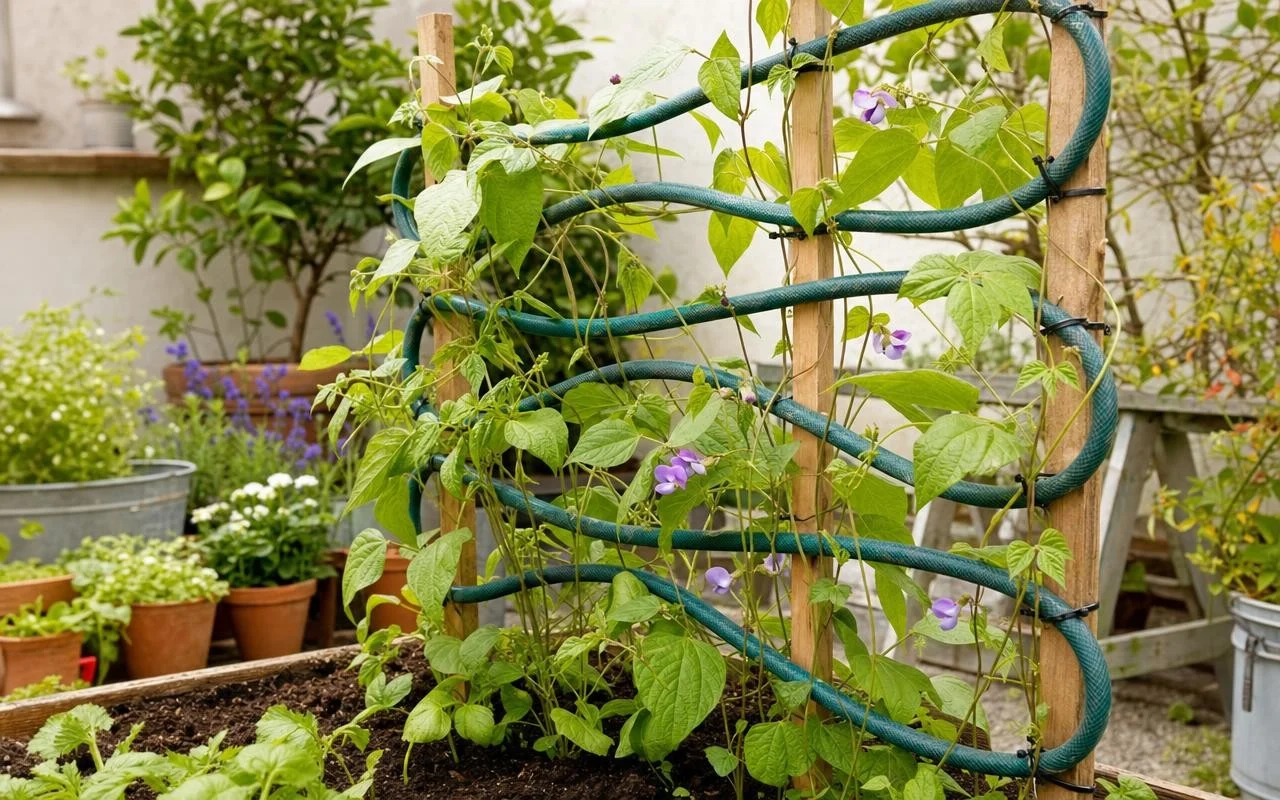
An old, cracked watering hose lying around the shed often looks like junk fit for the bin. Holes, leaks, knots that are impossible to undo… we tell ourselves it’s done its time. Yet this rubber serpent hides real potential for the garden.
By recycling it, it can be transformed into a sturdy trellis for your climbing plants, in the vegetable garden as well as on the balcony. At a time when a commercial support can cost between 40 and 200 dollars, or roughly 37 to more than 185 euros, this upcycling idea is becoming very appealing.
Why an old hose makes an excellent garden trellis
A hose is designed to stay outdoors, enduring sun, rain, and twists. Even if punctured, it keeps this resilience, while being flexible enough to be cut and attached easily to stakes. In horizontal rows, these segments become the rungs on which beans, peas, or cucumbers cling effortlessly.
Trellises already inspire many gardeners. A reader, questioned about her green fence, sums it up: “I pulled everything up, I hardly water anymore and everyone stops by my place,” about her Japanese privacy screen with star jasmine. Her example shows that a simple, well-thought-out support, even homemade, can completely change the vibe of a garden or a terrace.
The step-by-step to make a hose trellis
For this DIY trellis, you just need to gather a few items that many of us already have on hand:
- an old, clean hose, even if punctured,
- 2 or 3 sturdy stakes in wood, metal, or plastic,
- galvanized wire or sturdy fasteners,
- a robust cutting tool, such as tin snips or reinforced scissors, and a small drill, if needed.
Start by removing the metal end caps from the hose, rinse it, and let it dry. Then drive two straight stakes into the ground, spaced about 1.5 meters apart and pressed in about 30 cm to stay stable, then connect them at the top with a crossbar. Measure the width between the stakes, then cut the hose into evenly sized sections slightly longer than this distance.
Ideas for climbing plants and finishes for your trellis
Two simple techniques exist for fixing the sections. You can drill a hole at each end, thread the wire through the hose, then tie it around the stakes. Or place each section directly on the front face of the stakes and secure it with a “square fastener” tightened with wire or plastic tie. By spacing the rows regularly, you obtain a trellis about 1.5 meters high, sufficient for most climbing vegetables.
This homemade support works very well for pole beans, peas, cucumbers, or cherry tomatoes, but also for decorative climbing plants. Star jasmine, honeysuckle, or certain clematis create a true green curtain, pleasant to look at and somewhat shaded. On a south-facing balcony, a leafy trellis can help protect pots from the hottest afternoon hours.
On finishes, many DIY enthusiasts choose to paint the frame and the hose sections with exterior paint for a uniform dark green, black, or shade matching the facade. The cut ends can be protected with duct tape or small caps, to avoid any sharp edge for children or pets.
One last detail that really changes things: check the spacing between the bars and the strength of the fastenings. If the rows are too far apart or not tightened properly, the hose may bend under the weight of the plants. By taking a few minutes to properly tension the wire and test stability in the wind, this old hose truly becomes a reliable and nearly free trellis, ready to roll out again for several seasons.
Sources
- Modes & Travaux
“Balcon plein sud: une canicule est annoncée ? Repérez où sera l’ombre à 16 heures pour sauver vos plantes des fortes chaleurs”
