
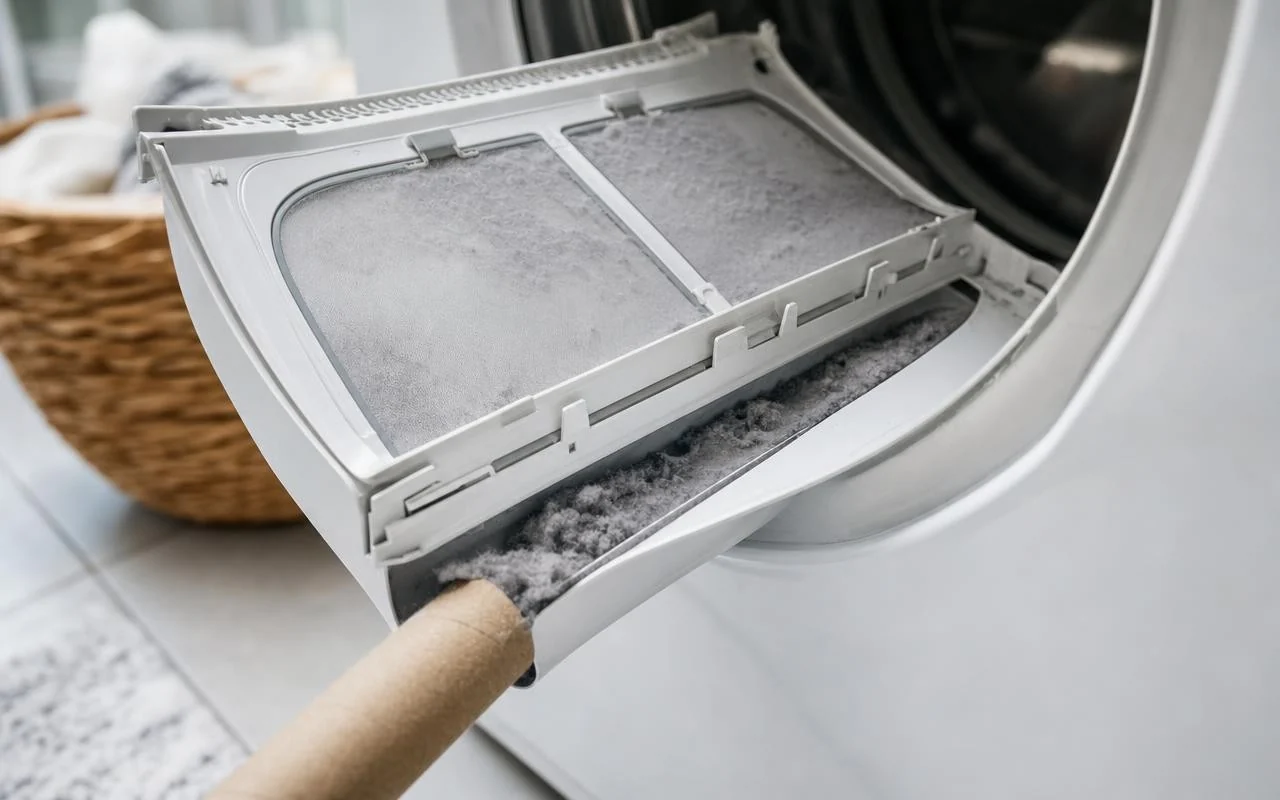
You may already be clearing the visible lint from your dryer’s lint filter, but cycles still seem longer and the appliance gets very hot. The reason often lies a little further down, in the tight housing of the filter, where fingers and vacuum nozzles struggle to pass. What you cannot see, however, accumulates with every drying cycle.
The National Fire Protection Association notes that about 32% of domestic clothes-dryer fires are related to inadequate cleaning, and 27% start when dust, fibers, and lint ignite. In other words, this small fluff is far from harmless. The good news is that a simple empty paper towel roll can become your best ally for reaching this hidden area.
Why the housing for the dryer lint filter gets clogged in silence
On most models, the lint filter sits in the door opening or right at the drum entrance. You pull out the screen, manually remove the fibrous mat, put it back, and assume everything is clean. In reality, some lint slips under the filter and falls to the bottom of the slot or cavity designed to hold it. This space is narrow, deep, and full of corners where deposits can get lodged.
Over weeks, these accumulations reduce air flow, lengthening cycles and potentially raising the electricity bill. The NFPA specifically points to this combination of buildup, heat, and poor ventilation as a common cause of fires. Manufacturers recommend cleaning the filter after every cycle and also checking the surrounding housing. The challenge is to find a tool thin and flexible enough to reach there without dismantling the appliance.
The paper towel roll trick to vacuum the bottom of the lint filter
That’s where a simple cardboard roll, normally destined for the trash, can make all the difference. All you need is a vacuum with a hose, an empty paper towel roll (or, if unavailable, a tube from gift wrap or toilet paper) and a bit of masking tape. Slip the cardboard tube over the nozzle, then gently flatten the free end to transform it into a flat nozzle thin enough to slip into the filter slot.
Start by removing the filter and manually removing as much lint as possible. If it’s very dirty, soak it for a few minutes in warm soapy water. In the meantime, securely attach the cardboard tube to the hose, wrapping it with tape if it tends to float, so it won’t come loose during suction. Turn on the vacuum, carefully insert the flattened end into the filter housing, then fold and direct the cardboard to follow the corners and suck up the hidden fluff. Also run it along the door and around the opening, where fibers often cling. When everything is clean, remove the tube, keep it for next time, brush the filter, rinse it, and let it dry completely before putting it back.
Best practices and warning signs for a truly safe lint filter
Brand manuals generally advise removing lint from the filter after each drying cycle and regularly cleaning its housing. The cardboard roll trick remains compatible with these recommendations, provided you stay within the accessible cavity behind the filter, without attempting to reach into the branches or internal ducts. It is also best to avoid forcing the cardboard in, to prevent damage. If your manufacturer advises against using the vacuum in certain areas, the manual takes precedence.
After this cleaning, a dryer in good condition returns to shorter cycles and a drum that feels cooler to the touch. However, certain signals should prompt a professional inspection:
- cycles that noticeably run longer despite a clean filter and housing,
- a burning odor, even a faint one, during or after drying,
- air that seems to circulate poorly or a unit that is unusually hot on the front.
In these cases, the paper towel roll trick no longer suffices, and a full check of the appliance and the exhaust becomes necessary.
