
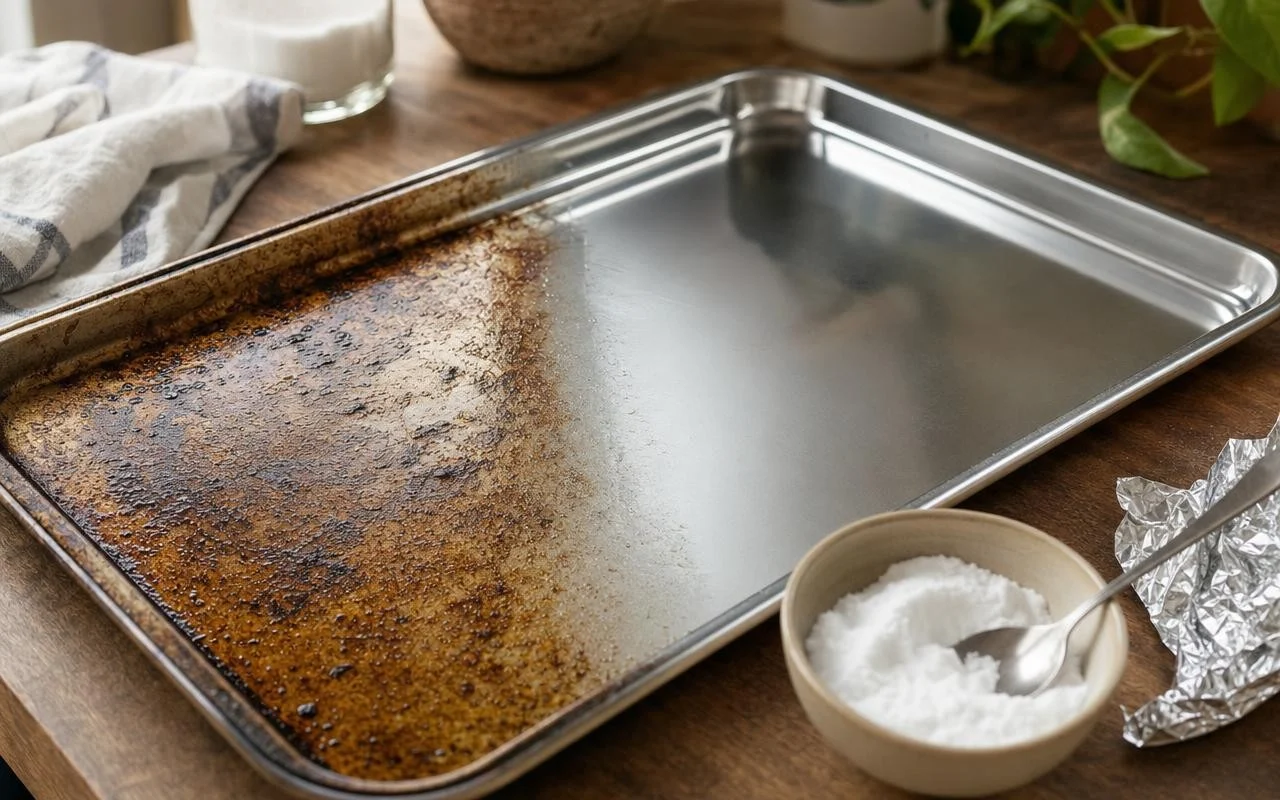
A oven tray that comes out of the dishwasher with brown halos, darkened corners, and a surface that remains greasy to the touch quickly makes you want to replace it. Between roasted vegetables, overflowing gratins, and cookies that stick, the sheet metal gets dirty and loses its original shine, even for those who wash it after every bake.
Before throwing away these tarnished baking sheets and buying new ones, there is, however, a simple method to restore them. It relies on the heat of hot water, a bit of dish soap, and a basic accessory that you almost always have in a kitchen drawer, with no harsh products or long stripping baths.
Why your tarnished oven trays aren’t necessarily trash
Over time, splashed grease, caramelizing sugars, and sauces that spill over cook at very high temperatures. They end up forming a dark film on uncoated aluminum or stainless steel trays, even when you think you’ve washed them well. A useful clarification: we are talking about a removable oven tray here, not about induction or ceramic glass surfaces.
This coloration does not necessarily prevent you from cooking well, but the embedded fat layer becomes harder to remove with successive uses. American cleaning experts explain that before resorting to a very powerful cleaner, you can rely on a gentle mechanical action that uses an unexpectedly simple object to scrub without scratching the surface too much.
The easy trick: aluminum foil ball, hot water and dish soap
Concretely, to clean a tarnished oven tray using this method, you need very little. The idea is to combine the heat of hot water, the degreasing power of dish soap, and the slightly abrasive effect of a crumpled ball of aluminum foil. For a stronger result, baking soda can complete the mix.
- An uncoated aluminum or stainless steel oven tray
- A sheet of aluminum foil to crumple into a ball
- Dish soap and very hot water
- A little baking soda for heavily soiled spots
Start by rinsing the tray, then let it soak in very hot water with dish soap for ten to twenty minutes to soften the residues. Next, loosely crumple the aluminum foil into a ball and rub the tray’s surface, focusing on the brown stains, without pressing down hard. For the most stubborn marks, lightly sprinkle baking soda on the wet tray before rubbing with the foil ball. Finish with a thorough rinse and dry completely to prevent water spots.
Nonstick coatings, scratches… when this trick isn’t right
This technique works for stainless steel or uncoated aluminum trays, but it isn’t universal. Experts note that you should avoid using the aluminum foil ball on nonstick coatings or any already fragile surface, to avoid damaging the protective layer. In that case, it’s better to stick with a non-abrasive sponge or a nylon scrub pad, with warm water and a little baking soda to help, rather than seeking too aggressive a scrub.
The retailer Boulanger also recommends tackling the task while the surface is still warm, using a soft cloth or non-abrasive sponge, dusting a little baking soda onto the residues before gently rubbing, and banning corrosive products. Even with these good practices, some very old or heavily used trays keep a cooking patina: specialized articles remind that they will not always regain their original shine, while remaining perfectly usable. The key is to remove the stuck-on grease to limit smoke and odors, even if you have to accept a few signs of wear.
