
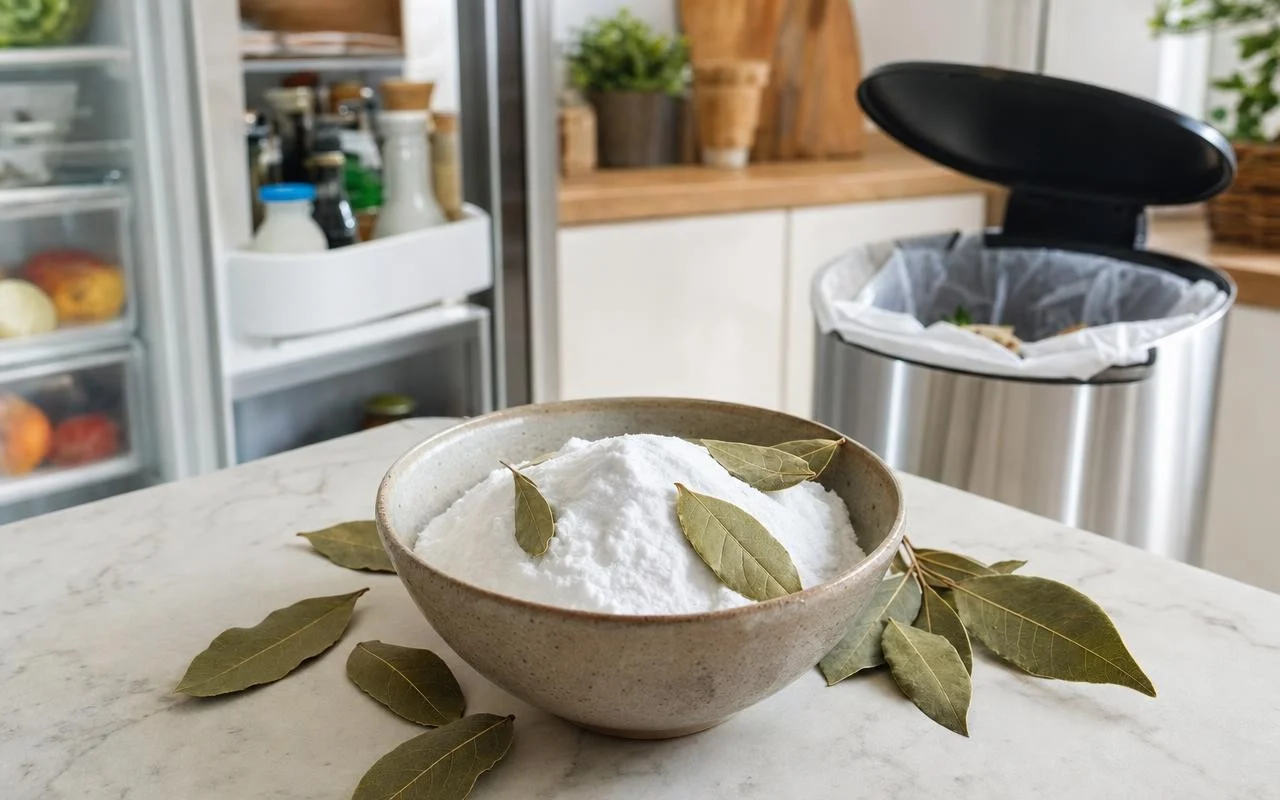
A simple dish placed on a shelf can sometimes change the smell of a room. On social media and in magazines, the recipe that keeps coming back is this blend of bay leaves and baking soda. Many adopt it as a natural deodorizer, but a question quickly arises: where should you place it for it to work effectively, and how long can you keep it before it becomes saturated.
The principle relies on the combination of sodium bicarbonate, which absorbs moisture and neutralizes odors, and bay laurel, Laurus nobilis, rich in eugenol and cineole. A study cited by the National Library of Medicine describes the aromatic and antimicrobial properties of its essential oil. Together, these two ingredients form a natural deodorizer that is both absorbent and fragrant. It remains to choose the right place and the right replacement rhythm.
Bay Leaf and Baking Soda Dish: The Right Recipe for an Effective Homemade Deodorizer
The various practical articles published in September 2026 converge on the same base: two teaspoons of baking soda in a small dish, then five to six very dry bay leaves, intact or slightly crumbled. Mix with little effort, just enough to distribute the pieces. The preparation slides into a ramekin, a small bowl or a stable glass, or even into a sachet in fabric for drawers and cabinets.
This dosage offers a good compromise between absorbent power and staying power. The bicarbonate captures the molecules responsible for odors from food, stuffiness, or shoes, while the bay leaves diffuse a subtle herbal scent. Household care specialists remind us that this effect remains gentle: it does not mask strong odors like an industrial perfume, it gradually reduces them, especially if the surface being treated is clean to begin with.
Where to Place the Bay Leaf and Baking Soda Dish in the Fridge, Cupboards or Near the Trash
In the refrigerator, magazines like Marie France recommend placing the dish on a central shelf, toward the back to avoid bumps, and away from foods left uncovered. It then acts on odors from cheese, onion, or leftover dishes. The cold limits ambient humidity, which delays saturation of the mixture. It is even more effective if the inside of the fridge has been cleaned before placing the jar.
For cupboards, wardrobes, and drawers, the dish works best in a dry space. You can place it high on a shelf, or hang a fabric sachet filled with the mixture from a hanger, so that the air can circulate slightly. In a shoe cabinet, it fits on the side, away from bumps. Near the trash can, several guides suggest placing it on the floor against the bin or attaching a small container inside the lid. By contrast, very humid zones like the bottom of a wet trash can, the edge of the sink, or a poorly ventilated bathroom quickly cause the bicarbonate to clump and promote mold on the leaves.
When to Replace the Bay Leaf and Baking Soda Dish and What Signs to Watch For
Articles from Modes et Travaux or Pleine Vie cite an average duration of two to three weeks for maintaining good effectiveness. In a kitchen where fish or very odorous dishes are frequently prepared, or in a damp entry, it is better to aim for ten to fourteen days. In a well-dried cabinet, three weeks remain realistic. Over time, the bicarbonate becomes loaded with odors and water vapor, while the bay leaf loses its fragrance: beyond that, leaving the dish in place yields diminishing returns.
To keep track, some propose a simple visual and olfactory checklist:
- baking soda that has become lumpy, crusty, or stuck to the edges of the dish;
- dark spots or the start of mold on the bay leaves;
- bay leaf scent nearly imperceptible when you bring it close to your nose;
- odors from the trash, stuffiness, or the fridge that return very quickly.
As soon as any of these signs appears, simply discard the mixture with the household waste, rinse the dish, and prepare a new batch using perfectly dry leaves. Some people reuse the old baking soda to clean a siphon or to gently scrub a trash can before rinsing. With this small regular maintenance, the bay leaf baking soda dish remains a simple and economical ally in the home.
