
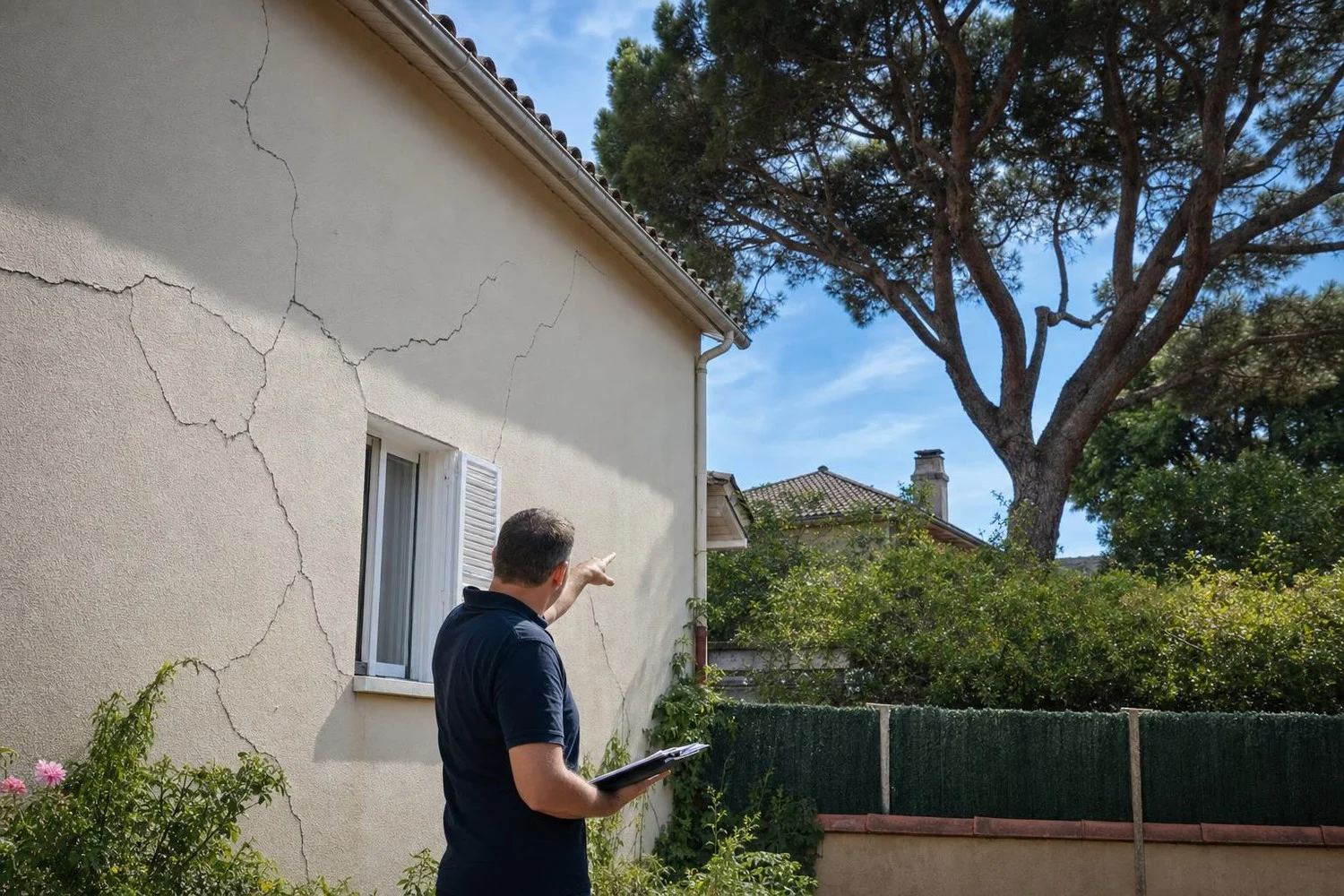
When the first cracks appeared on the facade, in the middle of a heat wave, everything seemed obvious: it was yet another instance of drought. Clay soil, extreme weather, one immediately thinks of a natural disaster and home insurance. Many homeowners stop there and file a claim hoping for a quick settlement.
The story changes when a crack expert inspects the house. In several reported cases, these specialists have traced the path of the cracks, circled the property… only to stop in front of the neighbor’s large tree, planted less than two meters from the wall. Behind the cracks, the real culprit can indeed be hidden in the adjoining garden.
Cracks in the House: Drought or Neighbor’s Tree?
In France, the shrink-swell of clays affects more than 55% of the territory at a moderate or strong level, with more than twelve million homes exposed. Clay soils retract when they dry and then swell again during heavy rains, creating accordion-like movements under the foundations. The average cost of such a claim hovers around €24,000, with a statutory deductible of €1,520 for drought recognized as a natural disaster.
This climate context explains part of the issues, but not always everything. In some cases, expertise shows that the cracks caused by the neighbor’s tree are linked to nearby vegetation that amplifies the phenomenon. The expert then looks at the position of the trees, the nature of the soil, and the depth of the foundations to determine whether the adjoining garden plays a decisive role.
Tree Roots, Clay Soil, and Shrink-Swell: The Crack Mechanism
When a building rests on a clay soil, the roots of a neighboring tree planted within less than two meters of the boundary become a real risk. These roots act as powerful underground pumps that absorb, during hot periods, tens of liters of water per day. The clay retracts abruptly, voids form beneath the foundations, the house sinks locally, and the cracks deepen, sometimes even opening the joints in the paving or blocking doors and windows.
To untangle this mechanism, the involvement of an independent crack expert is often recommended. They advocate for the homeowner and examine the orientation of the cracks, the location of the disruptions relative to the tree, and the type of foundations, often shallow on an earth-fill base. They may propose a G5 geotechnical soil study to confirm differential settlement on the vegetation side and to size the underpinning works.
What to Do If Cracks Come from the Neighbor’s Garden?
From the earliest cracks, proof becomes the nerve of the case. Photograph the cracks with a visible date, measure their width, place a plaster witness that will break if they evolve to track their progression. In case of invading roots, the neighbor’s liability can be engaged for abnormal neighbor nuisance, under Article 1240 of the Civil Code, if a link between their tree and your disordered areas is established.
- Take dated photos of the cracks and measure the distance from the trunk to the wall.
- Enter into amicable discussion with the neighbor, showing them the findings.
- Report the claim to your home insurance, respecting the 30-day window after any natural disaster declaration.
- Call in an independent crack expert and, if needed, request a G5 soil study.
- Follow the recommendations for underpinning and structural reinforcement.
Technical solutions aim first to stabilize the house before any cosmetic repair. Micropiles work to anchor the building in the “good soil” located several meters deep, less sensitive to humidity variations. The injection of expansive resin, when the soil allows, fills and compacts the ground beneath the foundations, improving its bearing capacity and reducing permeability. Next come the structural reinforcement works, such as crack stitching, followed by finishing. One question many forget: how far are your walls really from the neighbor’s large trees?
