
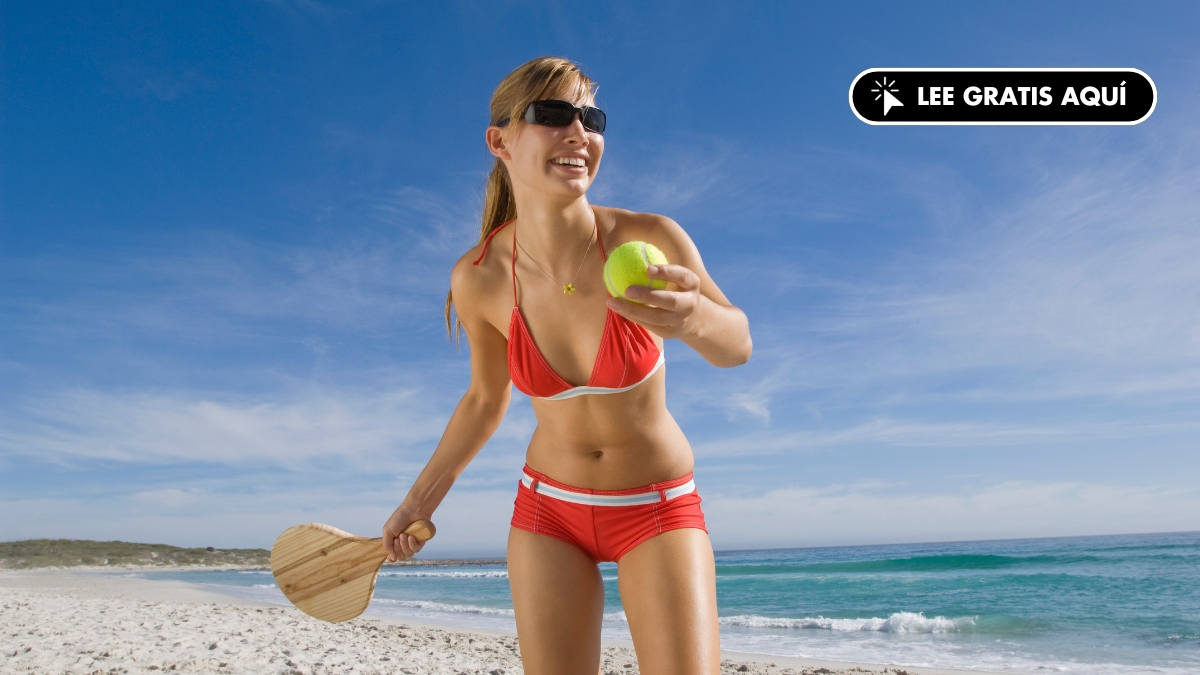
Setting off on vacation while continuing to train is something quite feasible and, in fact, fairly common, since it’s a way to stay in shape and not neglect the body. By now it is well known that exercising on the beach is one of the best options, especially with those small walks you can take along the sand and along the water’s edge. But did you know that you can also train even when you’re playing something as simple as paddle ball?
What for many is a completely normal way to spend time with friends, for health and sports experts it is a super complete physical exercise, especially when played on the shore, since the wet ground on the beach doesn’t burn, cools the feet and allows you to play for a long time without feeling the typical fatigue of the gym. With short steps, quick turns and small bursts of speed to ensure the ball doesn’t hit the ground, the mind focuses on the game while the body works a lot, even without you realizing it.
Why does this game help burn calories?
Paddle ball on the beach is a fantastic workout for the heart and for burning energy almost without you noticing. According to personal trainer José Ruiz in the magazine Lecturas, in just one hour of play you can burn about 300 calories. This happens because during the match you never stop moving: you sprint in short bursts, brake abruptly, and change direction to avoid losing the ball. Moreover, every time you strike the ball you have to exert force with your arms and your core, which makes your heart beat faster and grow stronger while you’re having a good time without even feeling like you’re engaging in an intense sport.
The key to strong glutes and legs
The terrain on which you play is fundamental, which is why doing it on the beach makes a significant difference. As coach José Ruiz notes, the instability of the sand forces you to perform greater physical work that strengthens especially the legs and the glutes. Since you don’t tread on a hard surface like asphalt or a track, the foot sinks slightly and you are compelled to adjust your step constantly. Additionally, to avoid losing balance during the game, the abdomen has to contract naturally, working as well without you realizing it.
On the other hand, the physiotherapy specialist Wendy Lozano, from the Carrión Institute, explains that sand and water are soft, unstable surfaces that force the body to make small automatic movements to not lose balance. By trying not to fall, we set into motion parts of the body that we hardly use in daily life, such as the feet, ankles and hips. Each time you step on the sand, the ankle repositions and the leg exerts force to keep you upright. All this repeated effort gradually makes the muscles stronger, which in the long run helps us move with much more agility and ease in our daily routines.
