
At the start of every autumn, the same question returns before the aisle of autumn lawn fertilizer: is it really worth feeding your lawn before winter, or should you let nature do its work to avoid wasting money. The bags promise a “greener lawn in spring,” but the soil, it seems, has its own rules.
Experts remind us that grass does not stop living right after summer: it slows down, stores, and strengthens its roots. On one hand, a good autumn fertilization can reinforce this quiet phase. On the other, a bad product, applied at the wrong moment, ends up washed away or burns the lawn. This is where the line between a helpful nudge and wasted money is drawn.
Autumn Lawn Fertilizer: What the Lawn Really Does This Season
The Spruce site, cited by AOL, clearly sums up the value of this period: “In general, nutrients should be added in the autumn to help the lawn prepare for winter.” It adds: “In autumn, the grass begins storing nutrients and strengthening its roots for the next spring.” The idea, therefore, is not to grow leaves at a rapid pace, but to fill underground reserves.
In France, Terre d’Humus notes that autumn opens “a second perfect window.” “Between September and mid-October, autumn fertilization prepares the lawn for the cold season,” explains the site, “a fertilizer rich in potassium strengthens the grass’s resistance to frost and foot traffic, while promoting rooting.” When these conditions are met, fertilizing in autumn really helps the lawn get through winter and restart more quickly in spring.
When Autumn Fertilizer Is Useful… and When It Is Useless
In practice, this act makes sense only if the lawn is still active and if the soil can absorb the nutrients. A simple rule of thumb: as long as the grass continues to grow and requires mowing from time to time, the roots are still at work. Conversely, on frozen soil or on a lawn that is completely dormant, the fertilizer remains on the surface or leaves with the rain, with no benefit.
AOL stresses a prerequisite that is too often forgotten: “You should always test the soil’s level and its pH before adding fertilizer.” If the analysis shows potassium is already sufficient, adding a “special autumn” product amounts to spending for nothing, with a risk of leaching into runoff waters. Terre d’Humus also warns: “Applying fertilizer to a thirsty or yellowing lawn only makes the situation worse.” On dry or scorched lawn, first rehydrate and repair, not feed.
- Soil that is not frozen and slightly moist, with no flooding or pronounced drought.
- Lawn still green, growing enough to justify mowing.
- Need confirmed by a soil test or by a history of nutrient deficiencies.
- Fertilizer suited to the season, richer in potassium than in nitrogen.
How to Fertilize Your Lawn in Autumn Without Wasting Your Money
Before fertilizing, the basic garden practices count a lot. The 24matins article dedicated to spring reminds us that a light mowing, following the “rule of thirds,” promotes the absorption of granules and helps limit diseases. This logic also applies in autumn: mow moderately, let it dry for 24 to 48 hours, then intervene on a soil that has dried. Terre d’Humus advises applying the fertilizer “on slightly moist soil, ideally just after mowing and before a predicted rain.” This helps the nutrients descend to the roots.
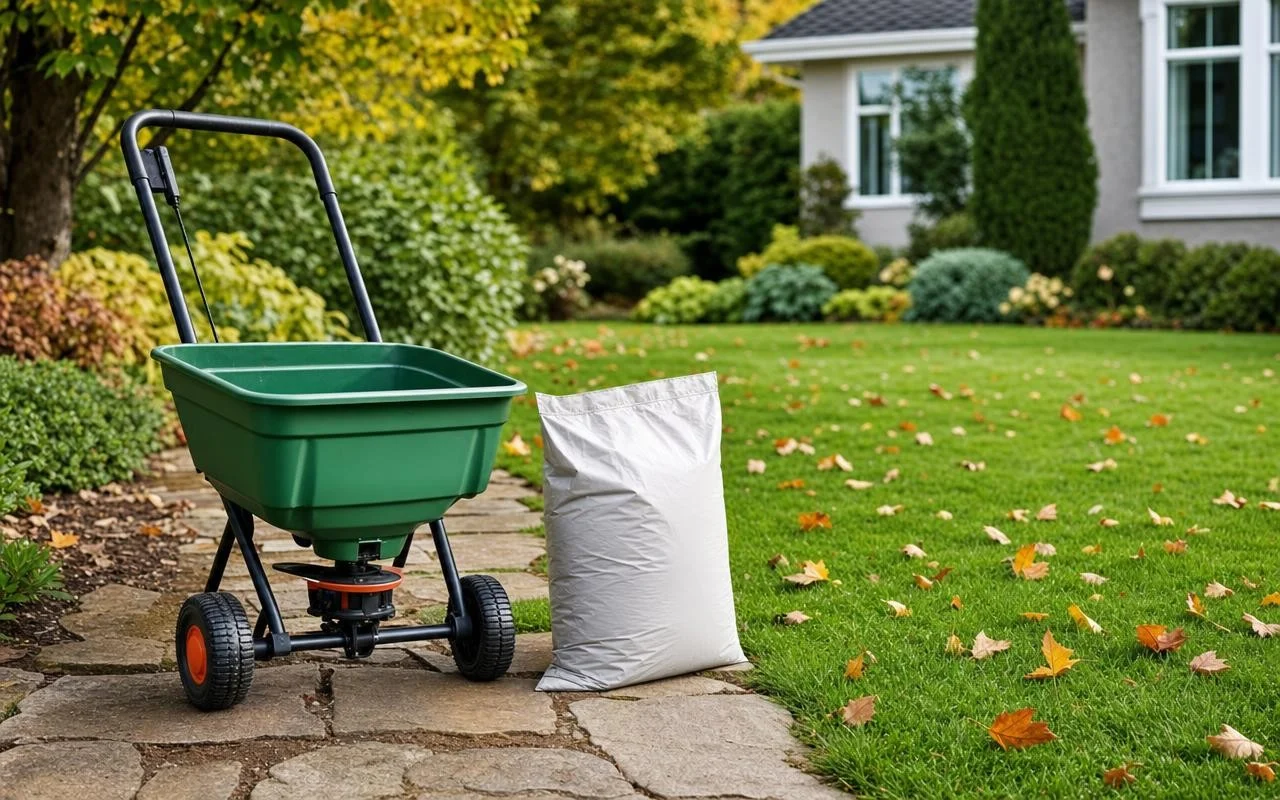
AOL also recommends preparing the watering: “The day before fertilization, water your lawn thoroughly and also water afterward, so that any fertilizer stuck to the blades is carried into the soil.” A spreader allows for even distribution without overloading certain areas. In autumn, favor a slow-release fertilizer, richer in potassium, with a reduced nitrogen content, which limits the risk of tender and fragile growth. By sweeping up granules that land on the driveways and returning them to the grass, you also prevent part of what you paid for from washing straight into the gutters.
