
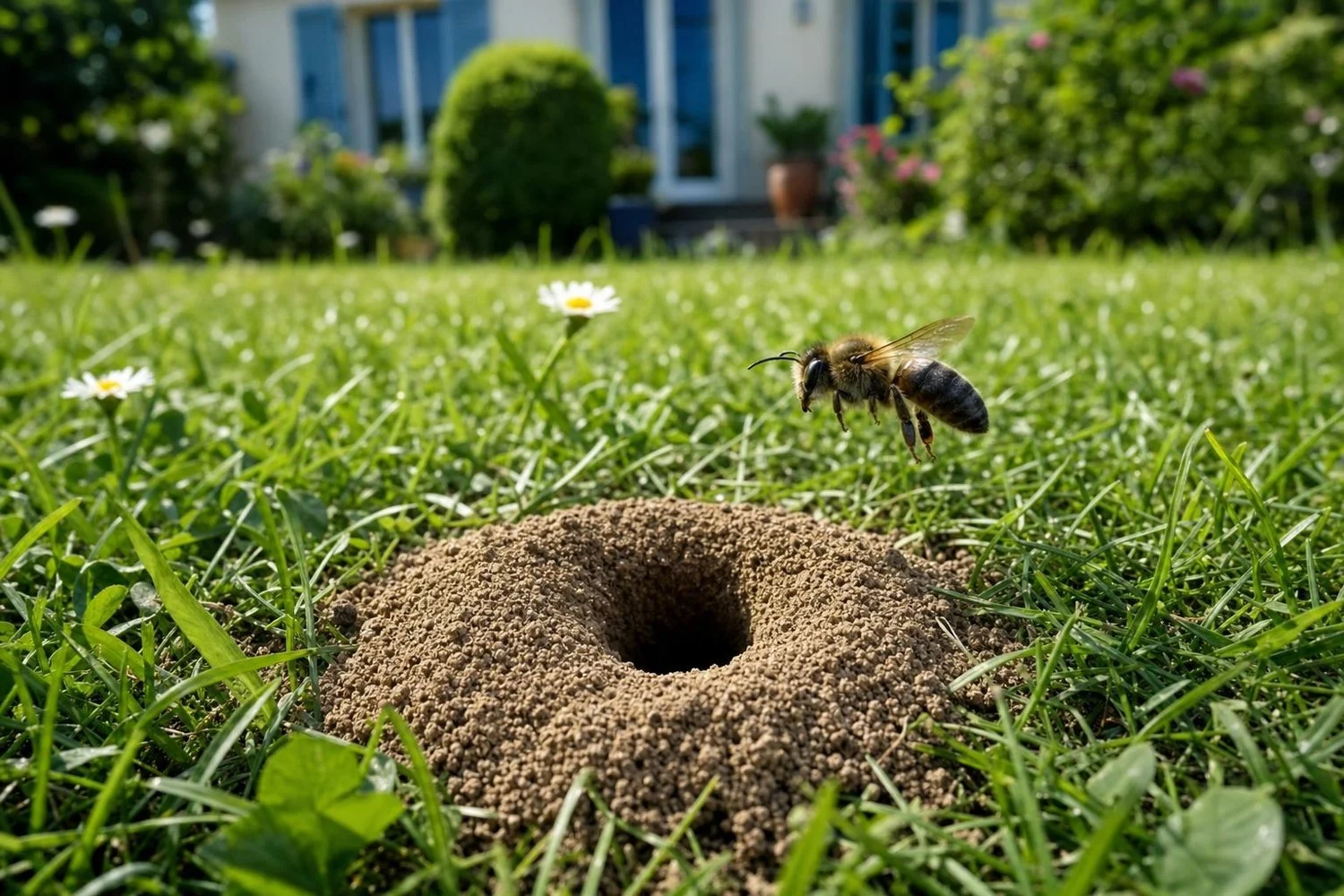
You walk calmly across your lawn when your eye catches a small crater, barely wider than a thumb, surrounded by fine soil. The immediate reflex is to grab some potting soil to fill it back in and regain a perfect lawn. This gesture may seem trivial, especially in mid-July when every garden imperfection is under close scrutiny.
This round hole is not always just a surface flaw. In the heat of summer, it can signal the presence of guests very valuable to your flower beds and your vegetable patch. Before you grab the shovel, a quick glance is enough to know if you are about to condemn a true living treasure.
Hole in the Lawn in July: the Express Test Before Filling It In
Ground-nesting solitary bee nests, sometimes called earth bees or miner bees, are fairly easy to spot. Naturalists describe a small circular entrance a few millimeters in diameter, surrounded by a tiny volcano of fine soil standing 1 to 3 cm high. The whole thing is often located in a sunny area, on bare ground or in a lawn that is a bit sparse, making it easy to dig.
To determine whether this thumb-sized hole hides a pollinator nest, a few cues are enough:
- Central hole diameter: typically around 3 to 8 mm for earth bees, versus 2 to 4 cm for a field mouse or a vole.
- Shape of the mound: very fine soil in a regular cone for burrowing insects, a large molehill of 6 to 8 cm for a mole.
- Time of activity: daytime, sunlit traffic for bees; activity mainly nocturnal for many rodents.
- Soil texture around: dry, almost bare soil for bees; mown grass, tracks or a strong odor for mammals like the skunk.
Ground-nesting Bees and Bumblebees: These Neighbours That Boost the Garden
Behind these little craters often lie highly effective wild pollinators. The female ground-nesting bees, such as the ash-colored Andrena (Andrena cineraria) or certain Halictidae, dig a gallery of about ten centimeters to lay their eggs and store their pollen. Several entrances side by side give the impression of a small underground village, active from spring to the end of summer.
These insects tirelessly visit the flowers of tomatoes, zucchini, peppers, and many ornamental plants. Naturalist studies classify them among the garden’s best pollination agents. Their presence often improves yields without adding a gram of fertilizer. Bumblebees, which sometimes occupy old holes, play a similar role. Field observations show that they stay very calm and sting rarely, making coexistence in a family garden possible, provided caution in case of known allergy.
Protecting These Nests in the Lawn Without Sacrificing the Grass
Once the nest is identified, lawn maintenance requires only a few adjustments. During mowing, widely bypass the area to avoid blocking the entrance with blades or repeated wheel passage. Nature conservation associations also recommend limiting or eliminating insecticides and herbicides nearby: those products directly weaken the bees and the larvae hidden in the galleries.
During periods of intense heat, a heavy watering right above the hole can flood the underground corridors and drown the future generation. It is better to water with a fine spray, diverting the jet or sprinkler to preserve this area. Activity naturally declines after a few weeks: when there is no more traffic, you can then gently refill the hole with a little fine soil, then reseed the lawn. If the hole exceeds 3 cm in diameter, accompanied by pulled-up grass or a strong odor, the likelihood of a rodent or another mammal increases, and a specific, non-brutal management approach may be considered.
