
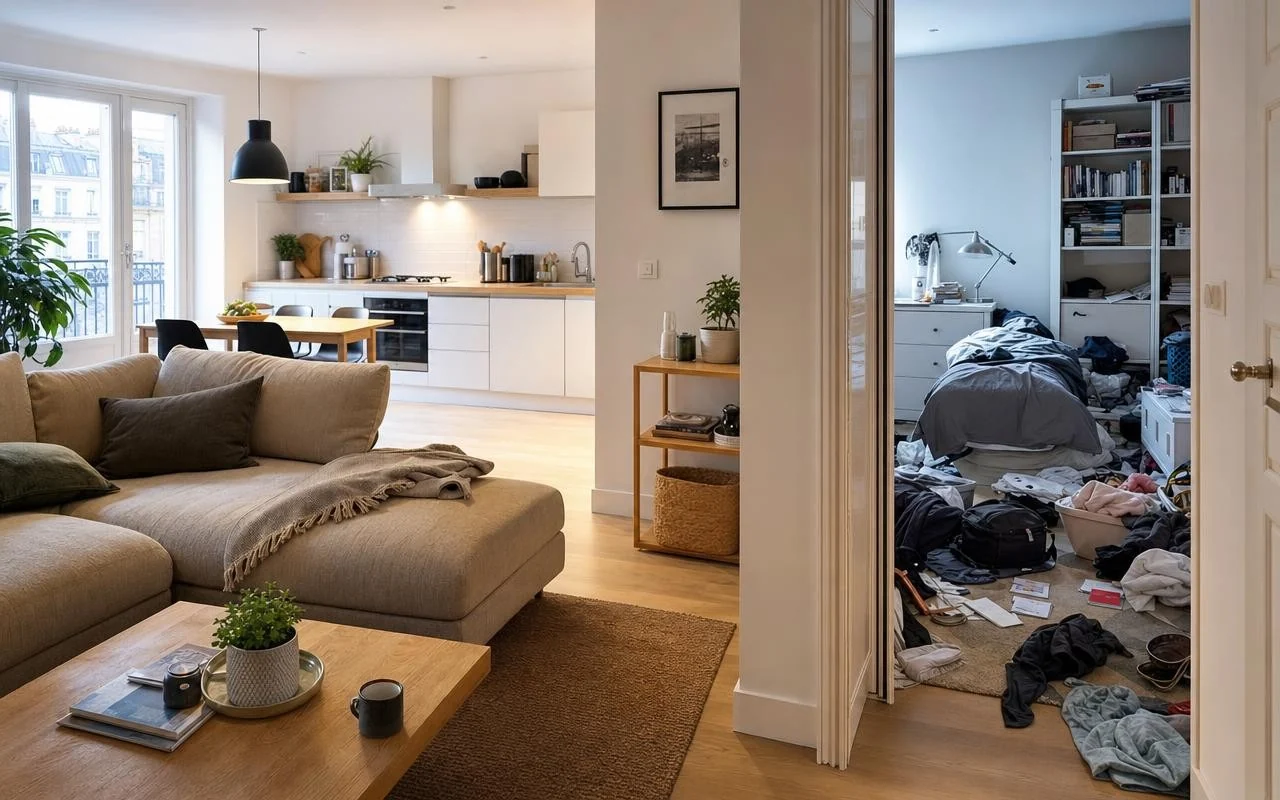
In many homes, the scene repeats itself: a spotless living room, a neatly kept kitchen, cushions perfectly aligned, a clean table… and a bedroom door that people prefer to keep shut. Behind it, the decor shifts completely: piles of clothes, papers stacking up, the bed left unmade. The contrast is as intriguing as it is guilt-inducing for those who live with it every day. And what if this messy bedroom isn’t what we think it is?
This pattern isn’t limited to families with teenagers. Adults living solo or as a couple tend to tidy the spaces everyone sees while their private sleeping area remains a lower priority. Media outlets such as OKDiario, AS.com, or Marie France have asked psychologists to explain the gap between shared spaces and the private room. Their response questions our relationship with home, how others view us, and our own energy.
Why tidy living rooms and kitchens take precedence over a disordered bedroom
Experts first remind us of the function of the different rooms. The living room and the kitchen are shared spaces where people move around, cook, entertain, and play with children. Keeping a certain level of order in these areas makes life easier for everyone: you can find your things, you can prepare meals without hindrance, and you can answer the door to unexpected guests. Tidying these places becomes almost a reflex, because they are in constant use and visibly visible.
The psychologist Leticia Martín Enjuto, cited by the magazine ¡Hola! and echoed by OKDiario, notes that this arrangement has nothing to do with an obsession with appearances. According to her, “this does not necessarily mean that people are hung up on others’ opinions, but that they distribute their attention according to how each space is used and how visible it is,” a pragmatic way of managing one’s interior. The experts therefore speak more of a hierarchy of priorities than of chronic laziness.
Messy bedroom: what psychologists say
The bedroom does not carry the same symbolic weight. For many, it is a refuge, a place where one changes clothes, sleeps, leaves a book or a T-shirt lying around without witnesses. As long as the bed remains accessible and one can get ready in the morning, the demand for tidiness diminishes. People accept that piles of laundry wait on a chair because this space is intimate, set apart from guests’ eyes and often from children as well.
When responsibilities pile up, there isn’t enough time to do everything. Many prioritize what seems urgent: starting a washing cycle, clearing the countertop, tidying the living room before dinner. The bedroom often comes after, and sometimes after everything else. OKDiario notes that this disorder often reflects a lack of time, stress, or fatigue. In these phases, decluttering the bedroom becomes an option, not an absolute imperative.
When clutter speaks of priorities, and when it alarms
This logic of prioritization does not prevent clutter from impacting well-being. A study published in the Personality and Social Psychology Bulletin followed around sixty active couples; women describing their homes as cluttered showed more signs of stress. Without aiming for perfection, a few simple benchmarks can help keep a bedroom tolerable for nerves:
- Limit what piles up on the floor to allow easy circulation.
- Free the surface of the bed and a nightstand, even if the rest has to wait.
- Schedule a regular, even brief, moment to restore a minimum amount of order.
Psychologists point out especially a few warning signs: when chaos prevents proper sleep, creates a risk of tripping, or triggers persistent distress about one’s own interior. In these situations, help from a close person or a professional can be useful. Outside of these cases, many bedrooms that are a little messy simply reflect limited energy and the compromises that people choose to make.
