
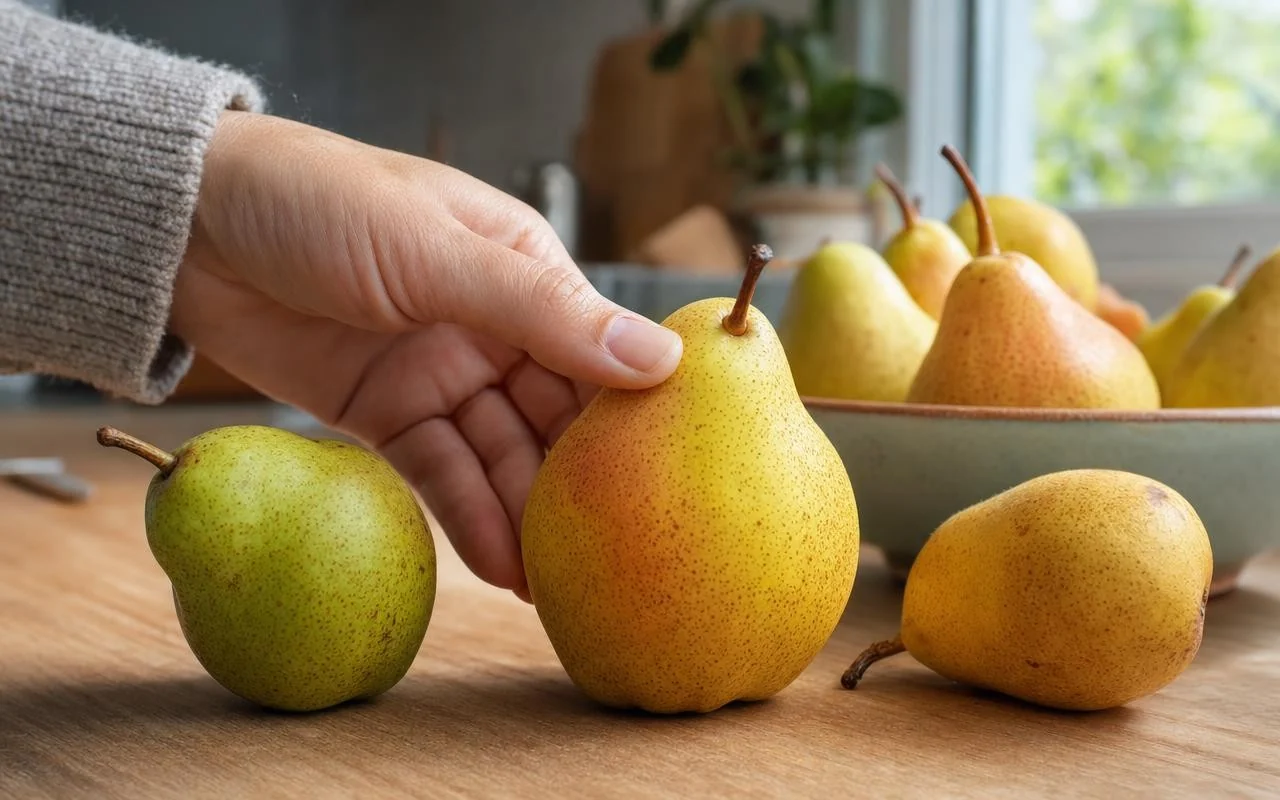
You placed a few pears still hard in the basket, confident they would last the week… and, after returning from a weekend, they all yield to a touch. Two days later, half end up as improvised compote. This little scenario happens often, because the pear doesn’t warn: it stays firm for a long time, then shifts quickly to the overripe stage.
This rapid switch is tied to how pears ripen after harvest. A climacteric fruit, it continues to transform away from the tree, quietly, in the heart of your kitchen. Sold firm, it becomes melt-in-your-mouth at home, but once ripe, “ripe, it should be eaten within 2 to 3 days.” The whole difference hinges on a very simple gesture, right beside the stem.
Why do pears ripen so fast in the fruit basket?
Pears are among the climacteric fruits, like apples or bananas. The association Vergers Vivants reminds us that “a fruit is said to be climacteric if its ripening depends on ethylene. Ethylene is not just a gas; it is also a hormone that controls the ripening of climacteric fruits. It is synthesized by the fruit during ripening and stimulates the various biochemical and textural changes of the fruit.” In other words, the pear itself generates the signal that makes it ripen, even far from its tree.
Another decisive detail: some nearby species release even more ethylene. Apples produce a lot, which “accelerates the ripening of pears placed nearby” in a crate or basket. Handy if you want a quick dessert, tricky if you’re away for a few days. In orchards, pears are picked firm to prevent them from turning blue on the tree; at home, it’s then the basket that finishes the job, sometimes faster than you’d expect.
Thumb test near the stem: how to tell if a pear is ripe
To avoid getting caught off guard, the most reliable gauge remains the thumb test around the stem. The Journal des Seniors summarizes: “A pear is ready when the fruit becomes soft around the stem.” A light daily pressure is enough, as you pass by the basket. There is no point pressing the middle of the fruit, often still firm, while the area near the stem indicates the right moment.
This action yields three very clear states:
- the flesh stays hard: the pear simply continues to ripen;
- it yields slightly: the pear is at its peak, the 2 to 3 day window has just opened;
- the finger sinks in firmly: it has started to breakdown and will quickly be cooked into compote, crumble, or cake.
Best ways to store pears: basket, fridge, and neighbors to avoid
The ideal approach is to organize the basket like a little queue. Pears that are still firm stay at room temperature, in a relatively cool and dry room. The dietitian-nutritionist Caroline Seguin reminds us: “Generally, fruit storage is ideally done in a cool and dry place, not piled on top of each other, to avoid the risk of crushing.” Keep away from a sunny window, a radiator, or the top of the oven, which all accelerate ripening.
To save time when a pear is just ripe, a short trip to the refrigerator, in the vegetable drawer, slows the process a little more. Gardeners who store their harvest also aim for a ventilated space between 4 and 10 °C to keep apples and pears longer. Also beware of neighbors: mixing pears with delicate red berries isn’t a good idea, because “placing strawberries in contact with fruits like apples or pears, which release ethylene, could therefore accelerate their ripening,” warns Caroline Seguin. It’s better to keep berries refrigerated, pears in the basket, and check daily that little point near the stem.
Sources
- Modes & Travaux
“Apples and pears: 3 simple visual signs for a harvest at perfect ripeness” - Top Santé
“Growers explain why it’s better to separate these two families of fruits”
