
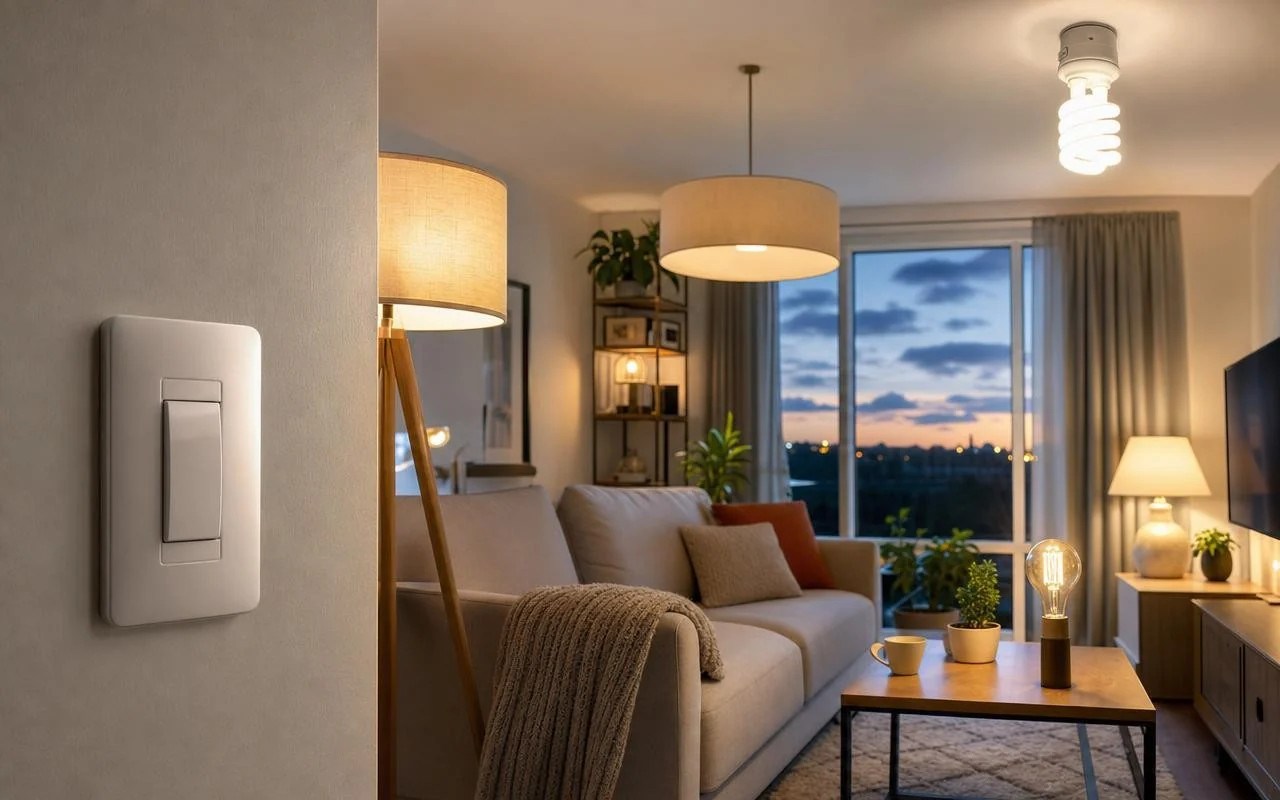
We were told as children that, when leaving a room, you press the switch to turn off the light. This small gesture reassures us; it feels like we’re doing good for our wallet and for the planet. And at home, some people are meticulous about it, even to the point of crossing the corridor to switch off a lamp that was forgotten ten seconds earlier.
Yet energy-saving specialists remind us that this rule doesn’t apply in every situation. It all depends on the type of bulb, on how well it tolerates repeated switching on and off, and on the length of time the room stays empty. The idea that turning the light back on consumes more than leaving it on is from a different era. The correct answer lies in your ceiling fixture.
Should you switch off the light every time: what experts say
The first point raised by experts is the notorious “power spike” at the moment of switching on. It exists, but it lasts only a fraction of a second and hardly weighs on your bill, especially with LED bulbs. These lamps convert most of the electricity into light and can use up to 90% less energy than old incandescent bulbs, with a lifespan often reaching 25,000 hours.
Another crucial factor is the bulb’s lifespan and how it responds to frequent on/off switching. Compact fluorescent lamps, or CFLs, consume about 85% less electricity than incandescent ones and last on average around 8,000 hours, but turning them off and on repeatedly can shorten this time. Specialists recommend turning them off if the room will be empty for more than 15 minutes, and leaving them on for very short absences.
LEDs, CFLs, and halogens: when to switch off the light when leaving a room
For LED bulbs, the instinct is simple: you can switch them off as you leave the room, even if you’ll return a minute later. Their electronics cope very well with on-off cycles, while offering an expected lifespan of around 25,000 to 40,000 hours depending on the model. On the halogen and incandescent side, which convert 80 to 90% of energy into heat, experts recommend turning them off as soon as the room is unoccupied.
The fluorescent tubes in garages or basements require a bit more nuance. For older models with electromagnetic ballasts, advisory bodies explain that too frequent switching significantly shortens their life: it’s often advised to cut them off if you’ll be away for more than 20 minutes, and to leave them on for only a few minutes. The famous 15-minute rule remains mostly applicable to these compact fluorescents and older neon tubes. To keep things simple, here are a few easy benchmarks:
- LED: I always switch off when leaving, even for 1 or 2 minutes.
- Compact fluorescent or old neon: I switch off if I’m away for more than 15 to 20 minutes.
Choosing bulbs and equipment to save without thinking
To reduce forgetfulness, experts point to motion detectors and timers, useful in passage rooms. Public bodies also note that modern dimmers can lower consumption by 5 to 50% depending on the desired light level.
Another lever highlighted: gradually replacing older bulbs with LED models. Replacing a traditional bulb with an LED can generate about €72 in savings over its lifetime. After this step, the question “do I switch off or not” returns to combining the type of bulb with the duration of absence.
