
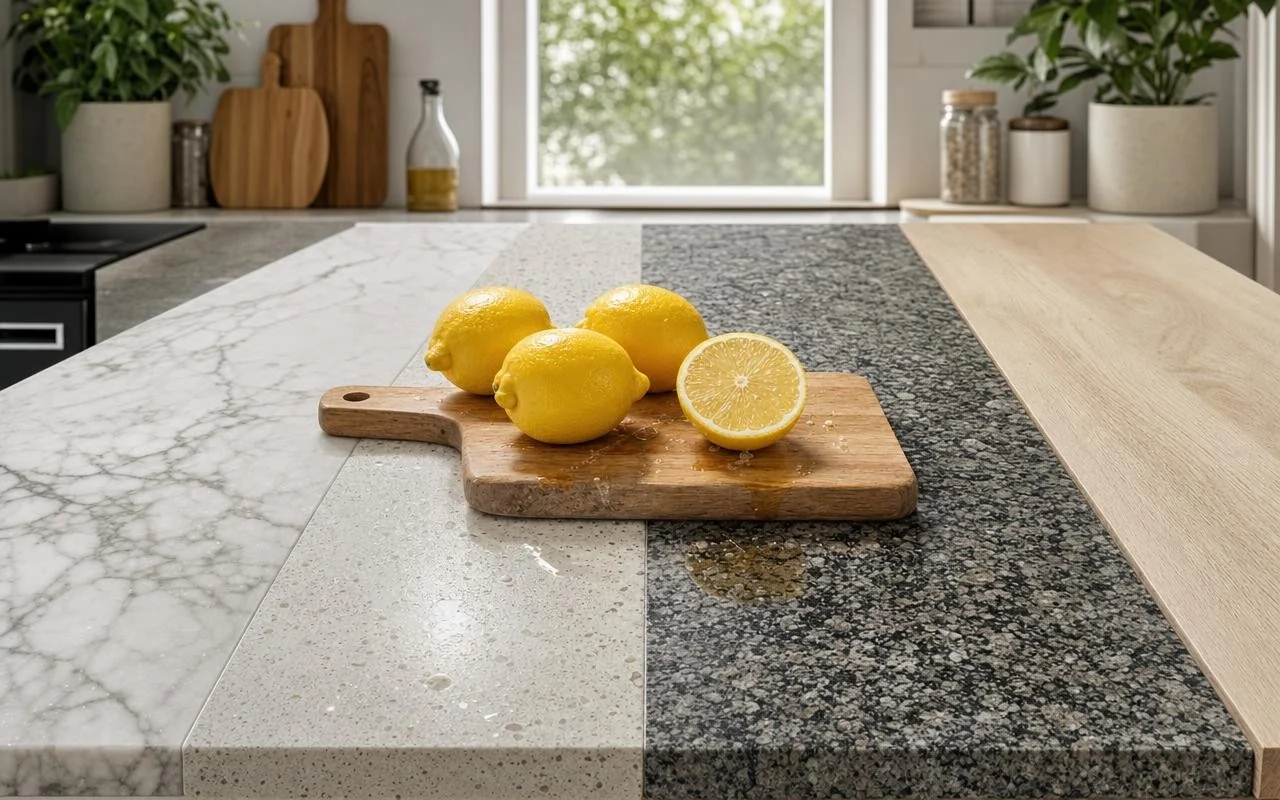
The half-lemon left forgotten by the sink, the juice dripping while you’re preparing fish, or that homemade lemon-and-baking-soda mix to brighten the kitchen: these scenes resonate with everyone. We tell ourselves it’s natural, therefore harmless. Yet on some countertops, a few droplets are enough to leave a matte mark that cannot be wiped away with a simple sponge.
Between grandmother’s recipes praising lemon as a miracle degreaser and manufacturers’ instructions warning about acidic-pH products, it’s easy to get overwhelmed. In reality, it all depends on the material: quartz, calcareous stones like marble or travertine, granite, and laminate do not react in the same way at all, and the duration of contact also changes the outcome. On some surfaces, a forgotten lemon for ten minutes is enough to mark the surface.
Lemon and quartz or stone countertops: when the risk is highest
The problem primarily stems from the citric acid contained in lemon, whose pH sits around 2 to 3. Calcareous stones, such as marble, limestone, or travertine, are largely made of calcium carbonate: the acid reacts with this base and slightly gnaws at the surface. The result is dull, flat areas, sometimes slightly rough, that no longer look like a greasy stain but like irreversible wear.
The maintenance guides from stone countertop manufacturers therefore recommend avoiding not only lemon juice, but also vinegar or wine on these calcareous surfaces, especially when cleaning the backsplash. For composite quartz, the message is similar: this material contains about 90 to 93% crushed quartz and 7 to 10% polyester resin, and this resin can be attacked by very acidic liquids, particularly those with a pH below 3. You then observe halos, localized lightening, or a loss of shine.
Granite and laminate: lemon tolerated, but under strict conditions
Granite countertops are often seen as indestructible. This rock is indeed much less sensitive to acids than marble because it isn’t calcareous. It remains microporous, and it is usually protected with a hydrophobic treatment or a specific sealer. A forgotten lemon juice around the sink can eventually attack this treatment and leave duller or darker patches.
For routine granite maintenance, manufacturers therefore recommend mild products: warm water and dish soap, optionally a neutral cleaner. Lemon has no place as a cleaner, even if a splash wiped up within a minute shouldn’t damage well-sealed granite. Laminate, on the other hand, handles daily life fairly well, but its decorative layer remains thin and its edges are susceptible to infiltrations. Consumer organizations note that prolonged contact with acidic or colored foods can eventually stain the surface, or even cause swelling of the panel at the joints.
What to do with lemon on your countertop on a daily basis
Facing a spill of lemon juice, it’s best to respond quickly, with the right steps depending on the material.
- Marble, limestone, travertine: wipe immediately, rinse with clear water, and dry gently.
- Quartz composite: never use lemon as a cleaner, remove all droplets and then wash.
- Granite: avoid lemon for maintenance, favor warm water and mild soap.
- Laminate: don’t let it linger, especially near joints and chips.
When in doubt about the nature of your countertop, the safest rule is to avoid acidic products and to strictly follow the maintenance guidance provided by the kitchen designer or the manufacturer.
