
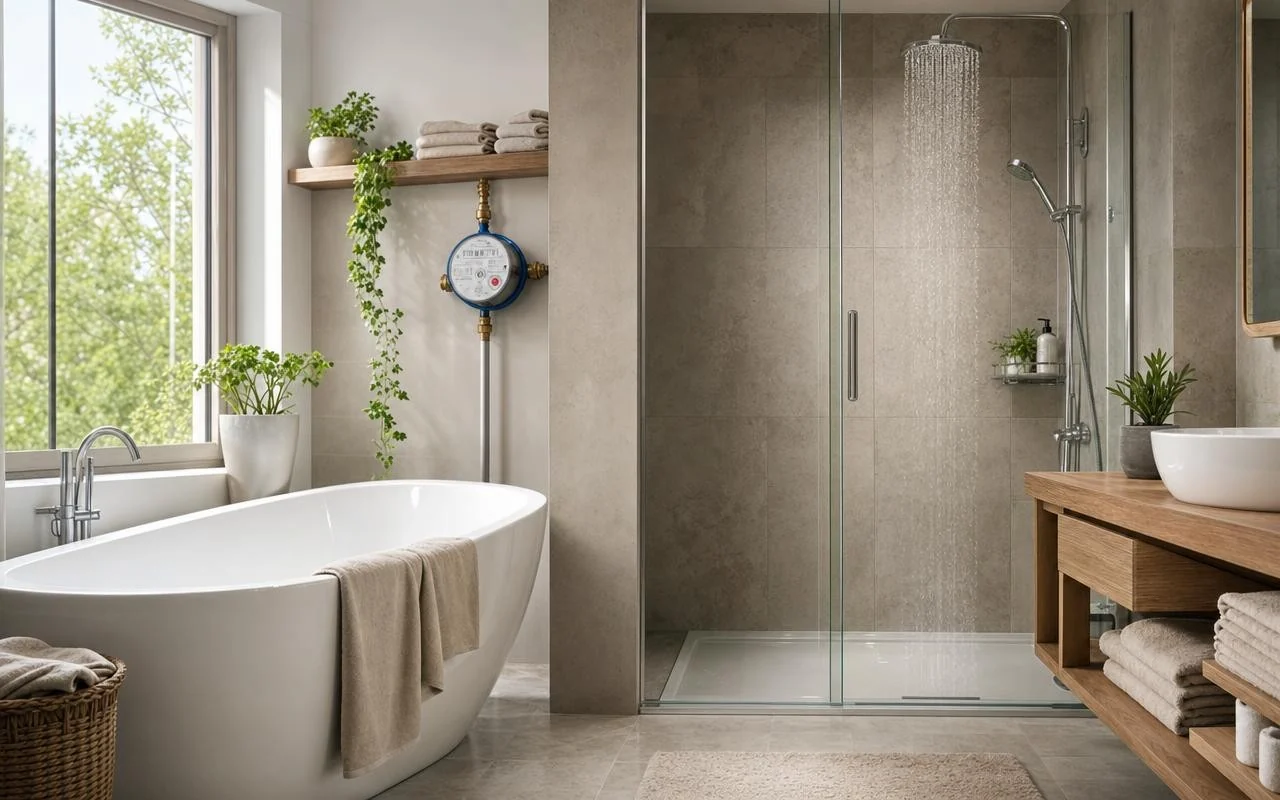
The message is simple, almost too good to be true: during drought periods, Spanish plumbers and the Consumers and Users Organization (OCU) claim that replacing a bathtub with a shower can save up to 70% of water for a household. Behind this promise lie very concrete figures, precise shower durations, and a few technical adjustments not to be neglected.
In Spain, the National Institute of Statistics rounds the average consumption to 133 liters of water per person per day, of which 36% is spent purely on hygiene. According to an article relaying the view of Fontaneros en Armilla, 69% of households already favor showers over baths, amid a growing drought. The real question, then, remains: under what conditions does this switch from bath to shower truly bring you close to the 70% saving?
Replacing a bathtub with a shower: where does this 70% water-savings figure come from
The plumbers cited by OKDIARIO are unequivocal: “showering uses between 60% and 70% less water than filling a bathtub,” say Fontaneros en Armilla. The pages of Spain’s Ministry for Ecological Transition (MITECO) provide the rough estimate: a bath is around 200 liters, whereas a five-minute shower with an economical showerhead uses about 50 liters.
In practical terms, a short shower therefore uses only a quarter of the volume of a bath. The calculation is straightforward: if your tub holds 180 liters, and your five-minute shower delivers 7 liters per minute, you are using 35 liters. The saving then exceeds 80%. With a 200-liter bath and a 50-liter shower, the savings even reach 75%. The “up to 70%” promised becomes a realistic order of magnitude, but only in this type of scenario.
OCU and plumbers: the conditions to really save under the shower
Public bodies remind us that the key is duration. ADEME notes that a 15-minute shower already approaches 100 liters, nearly as much as a small bath that can reach 200 liters. Conversely, a quick shower is limited to about 35 liters. For households where a bath remains indispensable, the OCU clearly recommends “fill the bathtub only up to half.” The organization adds that “installing aerators or flow reducers that cap consumption at a maximum of 6 liters per minute” helps to meet the promised savings.
The flow rate of the showerhead changes everything. MITECO distinguishes a classic shower at 12 to 15 liters per minute from an efficient shower at 6 to 7 liters per minute. Municipalities like Grand Chambéry indicate that an eco-showerhead can reduce the flow by 30 to 70%, for example dropping from 15–20 liters per minute to 6–8 liters per minute. The Spanish experts and the OCU thus converge: to target those famous 60 to 70% less water, one must both limit time under the water and aim for a flow rate of about 6 liters per minute.
Before breaking the bathtub: renovations, the bucket test, and small equipment
In practical terms, Geberit’s specialists remind us that bathtubs take up more space and require a dedicated overflow, but their installation remains fairly standard. Replacing with a shower, especially a walk-in one, often demands more care with tiling and waterproofing. The brand notes that these showers can be installed “without difficulty” if the chosen solution is well adapted to the configuration. This type of work also presents an opportunity to install a mixer or a thermostatic faucet, which quickly reaches the right temperature and helps reduce waste.
Even before renovating, energy experts advise measuring what happens at home, using the “bucket test” described by Alpiq. The method consists of a few simple steps:
- place a graduated bucket under the shower, open at normal flow for 30 seconds to 1 minute, then read the volume to know the flow per minute;
- multiply this flow by the usual shower duration to obtain the liters consumed.
From there, everyone can compare this volume to that of their bathtub, or to the 150–200 liters benchmarks given by ADEME and MITECO. The OCU finally notes that a “leak, even if it’s only a few drops per minute, can represent a loss of up to 30 liters per day.” Between fixing leaks, installing a low-flow showerhead, and controlling the time spent under water, the potential savings become very concrete even before bidding farewell to the old bathtub.
