
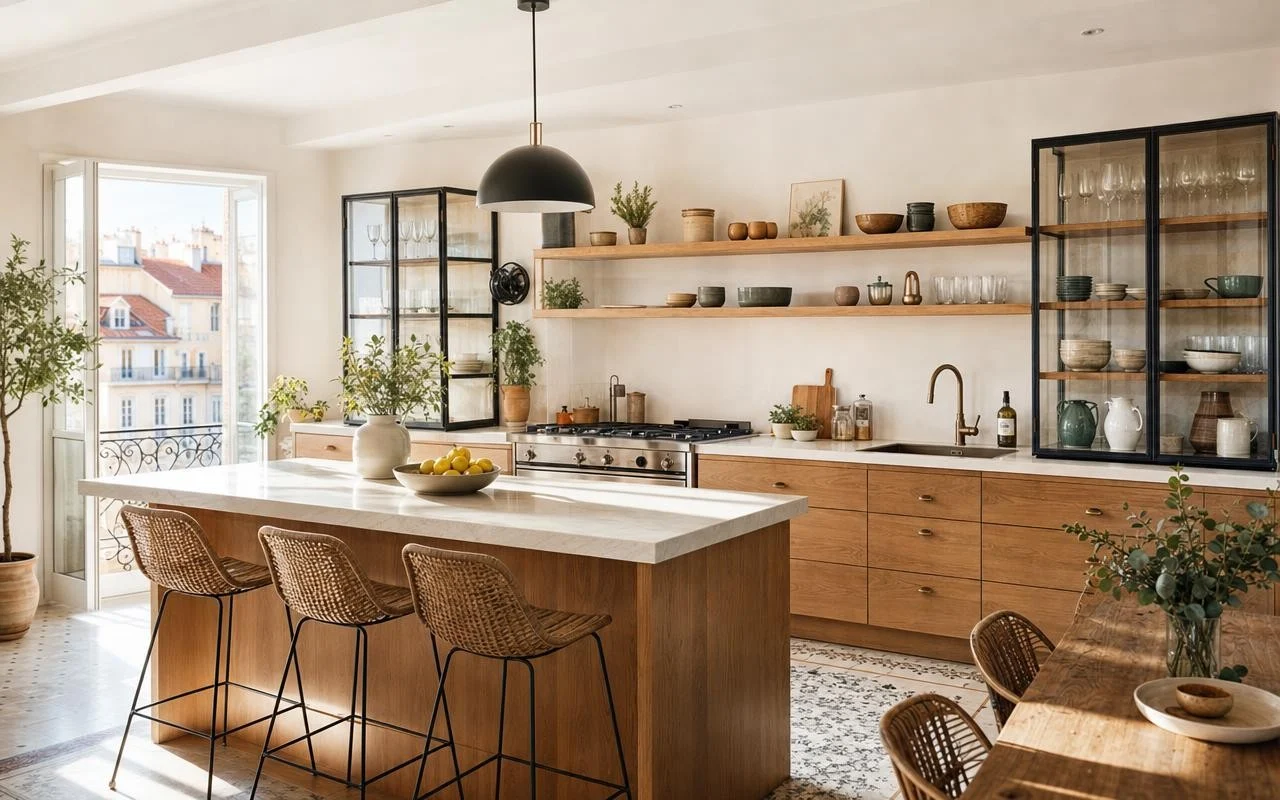
Spanish kitchens are bidding farewell to rows of wall-mounted cabinets that kept everything behind solid doors. In just a few seasons, what was once simply a preparation area has evolved into a living space that opens onto the living room, and it struggles with bulky blocks above the workspace. The trend hailed as the most modern, functional, and practical for 2027 is already taking hold there, softly and gradually.
Since 2025, decorating reports in Spain have shown a clear shift toward kitchens without tall cabinets, extended in 2026 by more sophisticated solutions. The interiors highlighted by OKDIARIO or the El Mueble site illustrate the same movement: open kitchens, wide perspectives, storage redesigned from floor to ceiling. Once the traditional furniture is removed, the question remains what to replace it with.
Why the kitchen without upper cabinets is gaining ground in Spain
For stylist Olga Gil-Vernet, the kitchen has completely changed its status. She summarizes this evolution by explaining that “it is no longer merely a place to cook, but a space where we share conversations, laughter, and intense moments with friends and family. Since they are open or semi-open, they are increasingly integrated into daily life and sociability. Today’s kitchens aim to be warmer, more welcoming, and with a soul, reflecting how we live and enjoy the home.” Rows of high, closed cabinets weigh visually in this new context.
Open kitchens open onto the living room and rely on large central islands, often extended by a “desayunador,” a breakfast nook where one enjoys coffee or a light meal. All the furniture then belongs to the same volumetric space, visible at a single glance. Removing the upper cabinets frees the walls, brings in more natural light, and delivers that sense of expansiveness that appeals to Spanish urban interiors.
What Spaniards are replacing traditional kitchen cupboards with
Experts cited by El Mueble note a rapid evolution in storage solutions. “If in 2025 we saw many kitchens without upper cabinets, in 2026 what we will increasingly see are large display cabinets, spectacular designs,” explain sector specialists in an article published on El Mueble. Large glass-fronted display cabinets rise in prominence, alongside modern pantries, columns, and well-integrated tall modules.
The famous open shelves, those baldas that replace the classic cupboard, remain very much present for displaying crockery, glassware, or decorative pieces. OKDIARIO describes them as an elegant storage solution, even more refined when wood is chosen, a material now indispensable in the new Spanish kitchens. This type of storage lightens the room, highlights objects, and helps visually structure the space, provided one does not overdo it.
How to adopt a kitchen without upper cabinets without sacrificing practicality
Olga Gil-Vernet notes that “in 2026 we are moving away from cold and minimalist spaces, kitchens that are all white or black, finishes that are too glossy, and slim, smooth countertops. Open shelves, inconvenient for daily use, are also reduced,” she states on this specialized site about kitchen trends taking hold in Spain in 2026. The message is clear: the future isn’t about opening everything, but about finding a balance between closed display cabinets, columns, and a few well-placed shelves.
In projects highlighted by the Spanish decor press, a formula shaping 2027 begins to emerge: bare walls, a few decorative open shelves, large display cabinets for everyday dishware, and generous storage in the lower portion. To translate this trend at home, interior designers often suggest treating the furniture as a continuous unit, from the living room to the kitchen, maintaining coherence of materials and lines.
- Reserve the open shelves for the finest pieces and for items used infrequently to limit dust.
- Place daily dishes and glasses in closed display cabinets, which protect them while preserving visual lightness.
- Concentrate most of the storage in low furniture, columns, and perhaps a pantry, to compensate for the disappearance of tall cabinets.
