
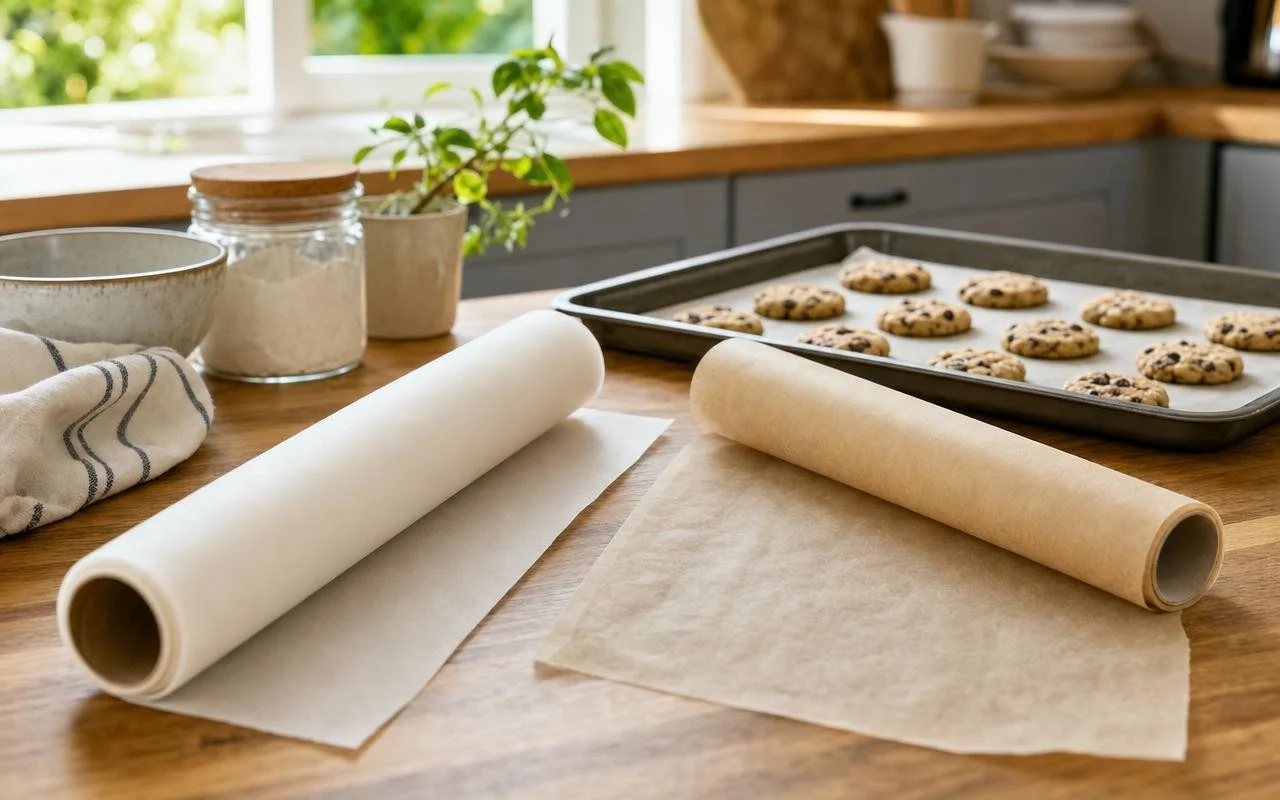
Have you ever placed a cake on a blank sheet and wondered vaguely whether it was baking paper or parchment paper? In most kitchens, you grab the roll without really reading the label, convinced that it all amounts to the same thing. Yet behind these two expressions lie somewhat different realities, especially when discussing heat and non-stick properties.
Cooking sites and even some packaging keep the ambiguity going: one day they mention baking paper, the next day parchment paper, sometimes parchment or silicone paper. Technical articles explain that the term baking paper designates, in reality, a family of papers suitable for the oven, whereas parchment paper refers to a specific manufacturing process. A nuance that changes everything when you look at the details.
Why does everyone confuse parchment paper and baking paper
In everyday language, the difference between parchment paper and baking paper almost disappears. In France, most rolls sold in supermarkets bear the label baking paper, sometimes followed by parchment or non-stick. In Quebec or North America, people speak more of parchment paper, which corresponds to the same product type. For the user, all this vocabulary ends up referring to the same thing: a paper that can be used in the oven.
On the manufacturers’ side, the reality is more precise. Technical sources, like Wikipedia, describe parchment paper as paper treated with sulfuric acid: this treatment gelifies the cellulose, seals porosity, and makes the sheet less permeable to grease and water. The silicone-coated paper, meanwhile, is paper covered with food-grade silicone, which reinforces the non-stick effect and significantly eases unmolding.
Parchment paper, silicone-coated paper: what it changes in the kitchen
A simply parchment paper already endures heat quite well. Technical data sheets mention a typical maximum temperature around 215 to 230 °C, and many recipe sites rely on the benchmark value of 220 °C. As long as you stay within this range, the paper maintains its structure, does not catch fire, and limits fat migration onto the sheet, which is enough for most family cooking.
The role of silicone mainly changes user comfort. A roll marketed as silicone baking paper offers a genuinely non-stick surface, useful for very sugary cookies, macarons, or fatty preparations that tend to stick. Some baking papers use other waterproofing treatments; articles cited by Wikipedia mention, for example, compounds called PFAS, which prompts careful reading of the details on the packaging.
In practice: how to choose your baking paper at the supermarket
For a sheet of roasted vegetables or a simple cake, the answer is reassuring: in most cases, baking paper and parchment paper refer to the same product type, suitable for the domestic oven. Cookery guides mainly remind to check the temperature indicated on the roll, often around 220 °C, and to avoid exceeding it, especially for long and very fatty cooking.
When purchasing, a few cues guide the choice. The mention baking paper or parchment paper signals oven use, parchment specifies the process, silicone emphasizes the non-stick property. The brown color often corresponds to unbleached paper, viewed by some commentators as more eco-friendly. Pre-cut sheets stay flat on the sheet, whereas the classic roll can buckle. Some articles also mention reusing a clean sheet if it has not darkened.
