
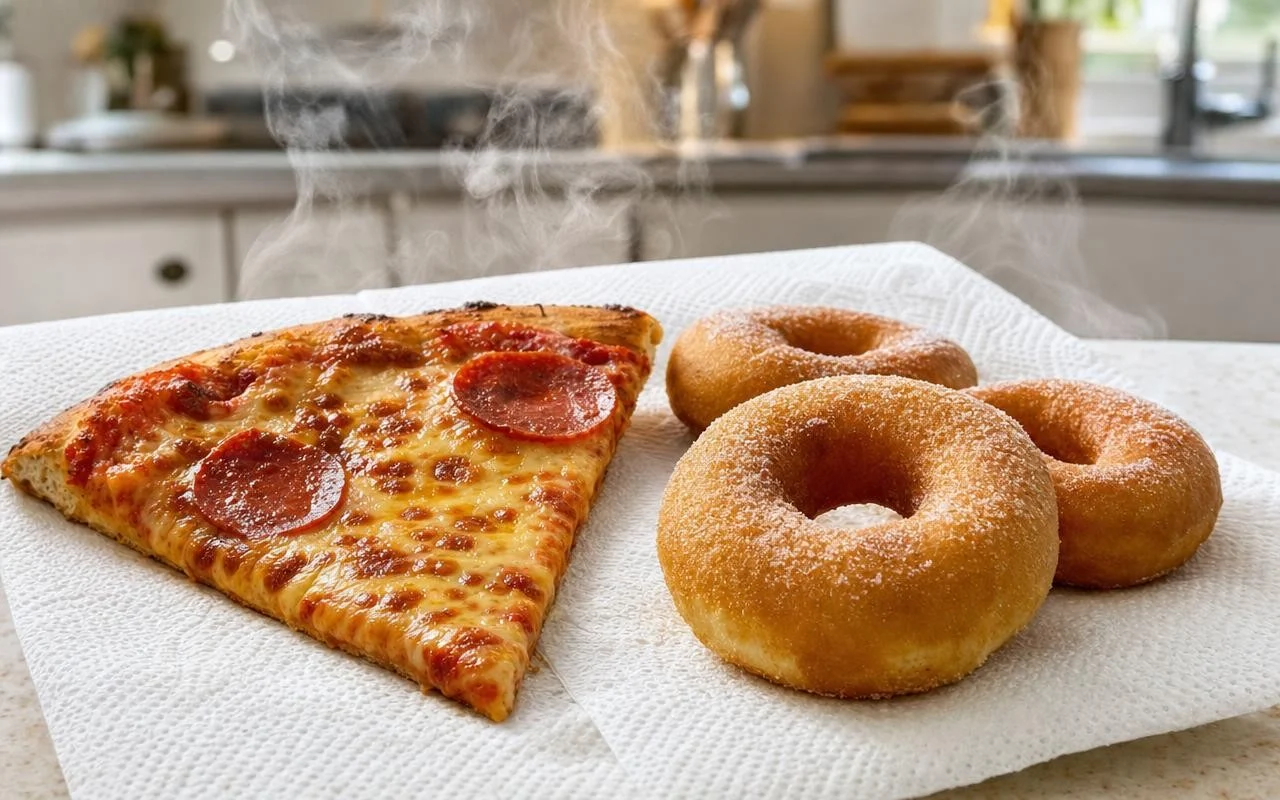
We place a steaming slice of pizza on a sheet of paper towel, or let freshly fried doughnuts drain on absorbent paper… These actions seem harmless. Yet not all papers react in the same way to heat and fat, especially when the food is truly scorching hot.
Behind a simple roll of paper towels lies an entire regulatory framework, namely the materials in contact with foodstuffs (MCDA) rules overseen by the DGCCRF. Temperature, duration, paper type, presence of inks or coatings: several parameters come into play. And one very precise limit, 40 °C, can completely change the situation.
Hot food on absorbent paper: what the regulations say
The DGCCRF recalls that heat as well as cold can promote the transfer of substances from a material to the food. For papers and cardboard, manufacturers must check the overall migration and the specific migrations through tests carried out under the conditions provided by Regulation (EU) No 10/2011: temperature, contact duration, and type of food or simulant.
Absorbent papers used as paper towels fall into the category of “short-contact” materials. The methods described by the DGCCRF include, for example, water extractions at 80 °C for 2 hours to test hot behavior, or durations up to 30 minutes to simulate this short contact. In home kitchens, a hot food item greatly exceeds ambient temperature, which further amplifies possible transfers.
Choosing the right absorbent paper: temperature, fat, and contact duration
In practice, three factors guide the choice of absorbent paper: the temperature of the food, whether it is fatty or moist, and the length of contact. A very hot, very fatty donut placed for a long time on an unsuitable paper will be more exposed to migrations than a lukewarm vegetable laid down for a few seconds. The higher the combination of heat, fat, and time, the more you need a material designed for this use.
The first rule is to look for the “glass and fork” pictogram or a label stating “suitable for contact with food.” This logo indicates that the paper has been designed to touch food under the conditions specified by the manufacturer. The DGCCRF also notes that the printed face should not be in direct contact with the food, even if it is varnished, because inks and solvents represent an additional contamination source.
- For hot and fatty foods, prefer a paper bearing a food-contact pictogram and, if possible, an indication of hot-use (oven, microwave).
Waxed papers, paper towels and hot foods: limits to know
Some papers are coated with a wax, paraffin, or silicone coating to better resist fats. The DGCCRF sheet “Coated papers and boards” is very clear: “Papers and boards coated with waxes or paraffins cannot be used at temperatures above 40 °C.” A truly burning-hot food is well beyond this threshold, so these supports should not receive directly a product coming out of the oven or fryer.
The case of the ordinary paper towel is somewhat different. It is typically an uncoated paper designed to absorb small amounts of liquid or grease over a short period. Placing fries for a few moments to drain them remains within this “short contact” approach. As soon as the contact time is extended or the item is heated in a microwave, the situation changes: some oven instructions, such as those from Panasonic, recommend avoiding recycled or non-microwave-compatible paper towels. Before placing a hot, burning food on it, check the paper type, the pictograms, and limit the contact time—that remains the best protection.
