
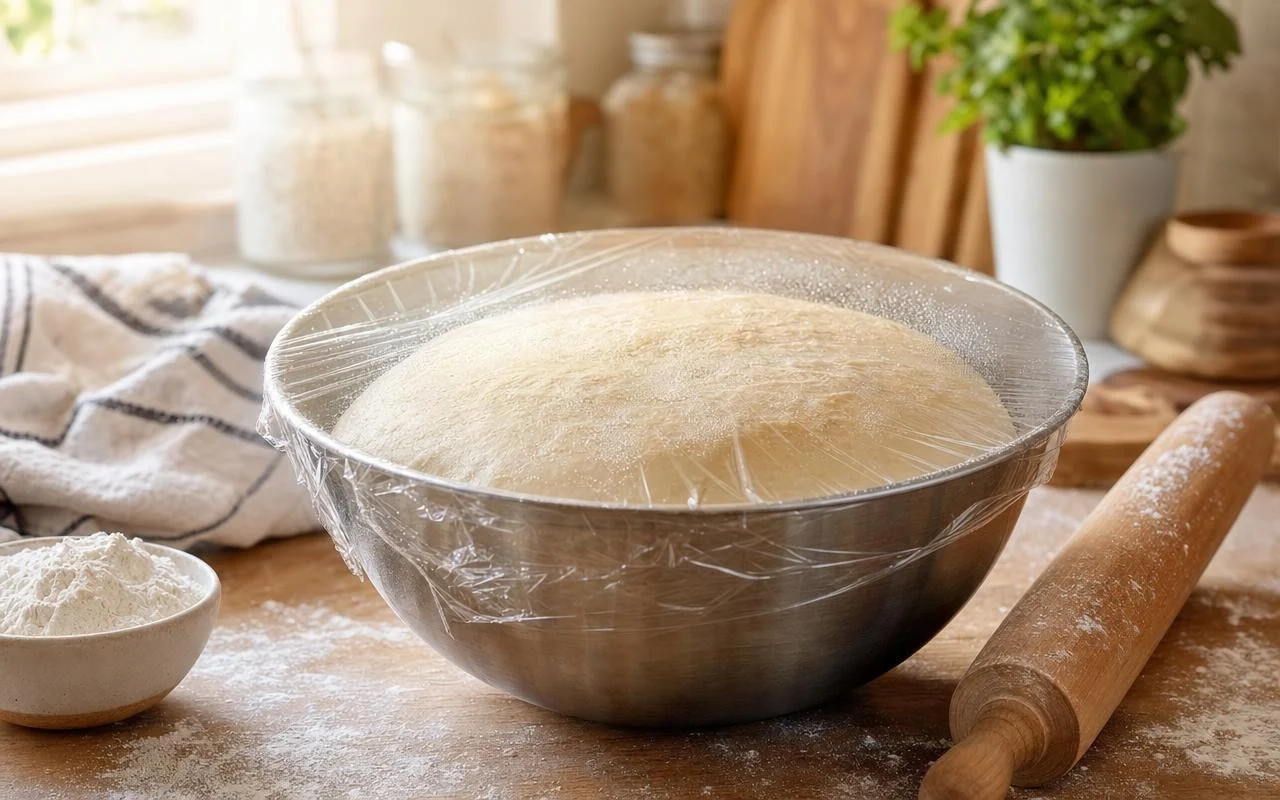
Your brioche was supposed to double in size, but you end up with a somewhat sad lump, cracked on top. Many bread enthusiasts have already faced this frustrating scenario. Sometimes the yeast is blamed, sometimes the room temperature, and one seemingly trivial step is forgotten: covering the dough during the rise. Yet this simple detail directly influences the final texture of your bread or brioche.
In many recipes, a short line tells you to cover the dough with plastic wrap or to place it in a covered bowl, without explaining why. Some cooks therefore wonder whether this plastic wrap is really useful, or if it might even “smother” the dough. What happens under that film, and especially without it, deserves a closer look.
Why covering dough with film during the rise changes its fermentation
A dough in full fermentation likes gentle heat and humidity. In the open air, water migrates to the surface and then evaporates: the top layer dries out, forms a skin, and begins to harden. This thin crust slows the dough’s expansion, limits the final volume, and can even create irregular tears when baking.
Tests from the King Arthur Baking site compare a dough covered with a towel to a dough protected by a non-porous lid. In the same environment, the first drops from about 78 °F (25.5 °C) to 65 °F (18.3 °C), whereas the second only falls to 74 °F (23.3 °C). A colder dough ferments more slowly: airtight coverage thus helps the yeasts work steadily.
Plastic wrap, towel or lid: which to choose for dough proofing
A towel laid over the bowl protects from dust, but it remains porous. Air circulates, moisture escapes, and the dough surface is likely to dry out, especially in a dry or air-conditioned kitchen. For doughs with relatively low hydration—below about 70% water by weight of flour—this water loss is felt even more quickly, according to the Knead Rise Bake site.
A well-fitted plastic wrap creates an almost airtight barrier: it limits air currents, keeps the moisture in, and maintains the dough’s temperature more stably. A well-sealing lid, a reusable plastic bag, or a coated fabric bowl cap yield a similar result. To navigate the covering decision, a few guidelines really help.
- long-rise or low-hydration dough: the most airtight covering possible;
- short rise at gentle room temperature: a lid on or a reusable cap suffices;
- if using a towel, choose one that is clean and slightly damp to limit drying out.
How to cover dough in practice and when to skip it
To cover properly, place the dough in an oiled bowl or in a suitable container, leaving room for the dough to swell. The film sits on the rim of the container, not stretched to the limit, so as to create a small “tent” above the dough ball. If the dough touches the film, you can lightly oil the film to prevent the surface from sticking when you remove it.
This step remains important for a long fridge-proof rise, as the cover also limits the absorption of unfamiliar odors. Still, there are a few exceptions: for certain very hydrated doughs, or for a short resting period of a few minutes between shaping steps, partial coverage may sometimes suffice. When in doubt, the Knead Rise Bake authors recommend following the recipe, always favoring a non-porous protection over a dry towel.
