
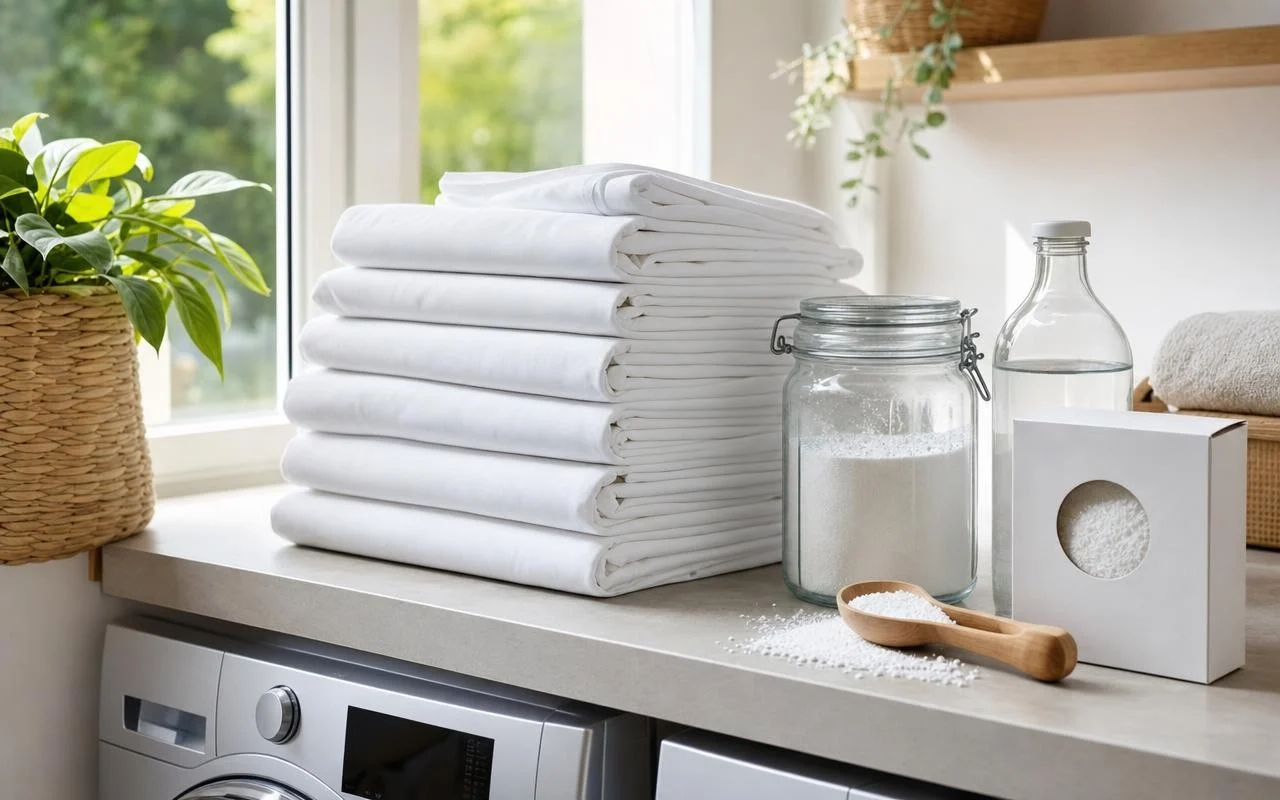
Your sheets come out of the machine clean and scented, with your mix of white vinegar and baking soda… but that bright whiteness from the early days has faded. Slightly gray, a bit rough, they no longer resemble hotel linens. Cleaning experts interviewed by the Argentinian media TN say that this duo remains useful, but that it misses one ingredient to really revive the whiteness.
In an article published on September 28, 2026, these specialists describe how repeated washes end up clogging the fibers: detergent residues, excess fabric softener, sweat, and trapped humidity. White sheets then become yellowish or grayish, lose their softness, and retain odors. To restore sheets to nearly like-new condition without harming the fibers, they rely on an active-oxygen-based whitening agent that truly changes the game.
Why your white sheets look dull despite vinegar and baking soda
Over time, cotton or percale fibers behave a bit like a sponge. With each cycle, a thin layer of detergent and fabric softener remains trapped in the fabric, especially when dosing is excessive or the water is hard. Added to this mix are sebum, sweat, and sometimes humidity if the laundry didn’t dry properly. This cocktail ends up suffocating the fibers and dulling the whiteness.
Result: a whiteness that leans toward gray, typical of sheets saturated with detergent residues; yellowed areas around pillowcases and the panel insert, mainly related to sweat; or that musty odor that quickly returns. The duo white vinegar and baking soda helps a lot to remove odors and some residues, but specialists view it more as a maintenance habit than a shock treatment to re-whiten.
Vinegar, baking soda and sodium percarbonate: what the experts recommend
The popularizer Paula Seitón advises placing about 30 g of baking soda directly in the drum to neutralize odors, then pouring cleaning vinegar into the fabric-softener compartment. The baking soda cleans, the vinegar helps dissolve detergent residues. Meanwhile, Cris, the creator behind Brilla y Cocina, says she always substitutes fabric softener with vinegar to keep sheets soft.
For white sheets that have truly lost their glow, this duo reaches its limit. This is where the sodium percarbonate, also known as sodium percarbonate, comes in. The organization expert Pía Nieto recommends adding it to the wash to boost whitening of white pieces that have grayed. This compound releases oxygen during washing and helps bring the laundry back to nearly-new condition. Laundry guides advise following the dosages and avoiding mixing it directly with vinegar.
The proper percarbonate method for white sheets that look like new
The experts cited by TN describe a simple machine method that combines laundry care with whitening action.
- Spread the sheets out and check for stains, especially on the pillowcases and the panel insert.
- Add the usual amount of detergent to the designated tray and about 30 g of baking soda in the drum.
- Add the amount of sodium percarbonate indicated for white sheets that have dulled.
- Replace the fabric softener with cleaning vinegar in the dedicated compartment.
- Run a cycle of about an hour at 40°C, then air-dry the sheets, ideally in the sun.
For the sodium percarbonate to truly act, temperature matters. Washing guides indicate it becomes effective around 40°C and the whitening effect strengthens toward 60°C, if the label on the sheets permits. Some professionals suggest reserving a cycle without vinegar for percarbonate, then using the vinegar and baking soda duo for maintenance washes.
