
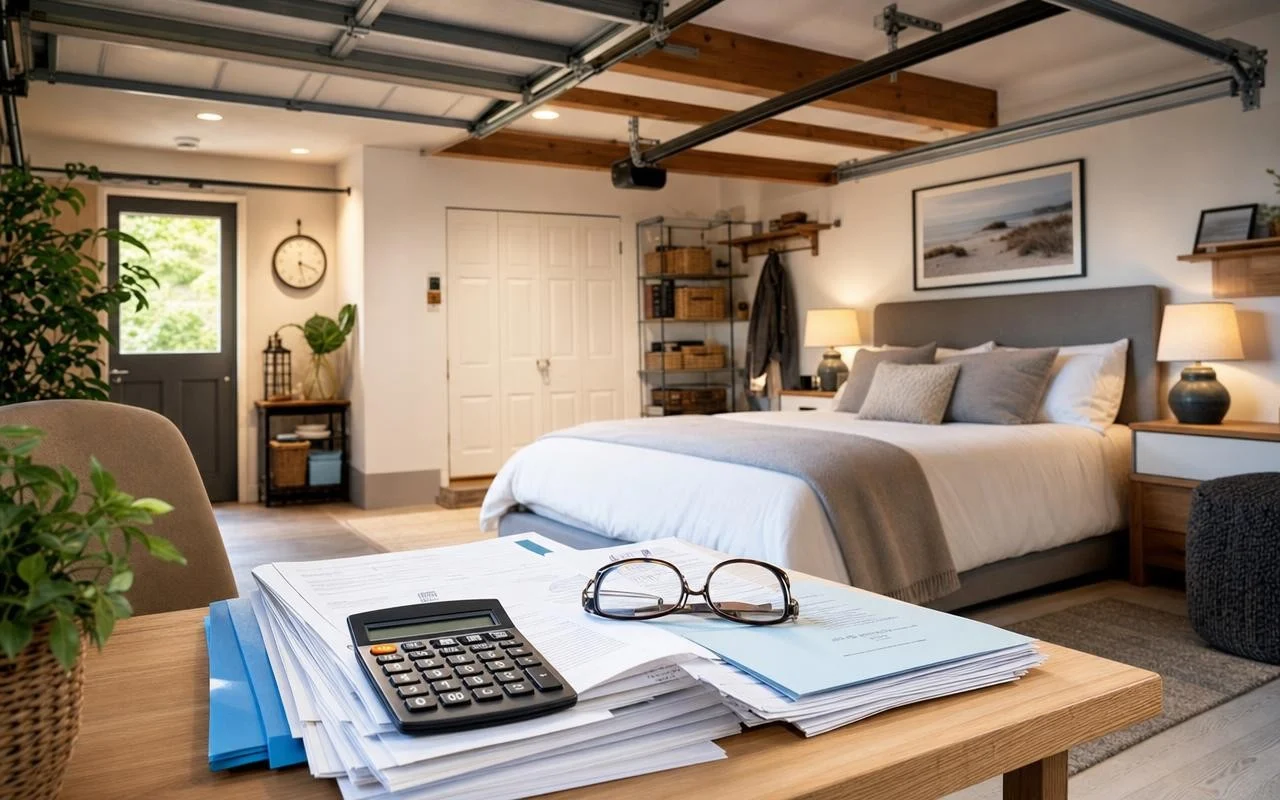
Setting up a bedroom in one’s garage to accommodate one’s parents initially appears to be a purely practical and emotional project. The walls are already in place, the space is single-story, it “only” needs insulation, a heating system, and replacing the garage door with a glass wall to create a cozy cocoon.
The real turning point comes a few months later, at the moment of the first property tax notice after the work. Many homeowners then discover a noticeable increase in the amount due, with no explanation other than a few technical lines tied to the cadastral rental value. It is at that moment that those square meters take on a completely different dimension.
Why a garage converted into a bedroom affects the property tax
In the eyes of the authorities, a garage is a parking annex, thus a non-habitable space. When it becomes a heated, insulated bedroom, accessible from the dwelling and used as living space, it changes category: it is now a habitable surface, as noted by the Directorate General of Public Finances (DGFiP). The property hasn’t moved, but its legal status has changed.
This change triggers an update to the cadastral rental value, i.e., the theoretical rent the dwelling could generate. This value takes into account the area, the number of rooms, and the level of comfort, and then serves as the basis for calculating the property tax. When a few square meters of garage move into the category “bedroom,” the weighted surface increases and the bill follows, without any prior alert letter other than the new assessment notice.
Before the works: checking with the town hall for permission to convert a garage into a bedroom
Long before installing insulation, planning considerations must be addressed. Transforming a closed and covered garage larger than 5 square meters into a living space generally requires a prior declaration to the town hall, especially if the facade is modified (replacing the large door with a window or a glass wall). The planning department relies on the Local Urban Plan (PLU) to approve or refuse the project.
A recurring point is parking. In many PLUs, the house must have a certain number of spaces. If the garage constitutes the sole regulated parking space and it disappears as a parking area, the town hall may require a compensatory space on the plot, or even refuse the amendment. Urban planning authorization thus remains a separate, essential step, distinct from the eventual tax declaration, but just as mandatory.
After the works: the tax declaration that triggers the new assessment
Once the bedroom is completed and usable, the owner has 90 days to report the creation of habitable space to the DGFiP. This can be done via the H1 form for a single-family home, or directly in the “Real Estate” section on impots.gouv.fr. The objective is clear: inform the property tax service of the change in the dwelling’s composition.
This declaration triggers the recalculation of the tax base and the incorporation of the new bedroom into the calculation of the property tax. Doing nothing exposes one to later regularization, along with a fine of up to 150 euros for failure to declare within the deadlines. To avoid a cold shock, some public finance centers may offer an estimate of the project’s impact before or just after the works.
To keep control of the budget, many homeowners rely on a small checklist:
- Consult the planning department to verify the PLU, the parking requirements, and the necessity of a prior declaration.
- Keep quotes, invoices, and a completion certificate to prove the completion date.
- Fill out the H1 form or submit the online declaration within the 90 days.
- Ask the property tax service for an estimate of the possible increase in the property tax.
- Archive copies of the declaration and correspondence with the administration in case of future disputes.
By treating their parents’ bedroom as a genuine real estate project, and not merely a family gesture, homeowners transform an old garage into a living space while knowing from the outset how these extra square meters will affect their next tax assessment.
