
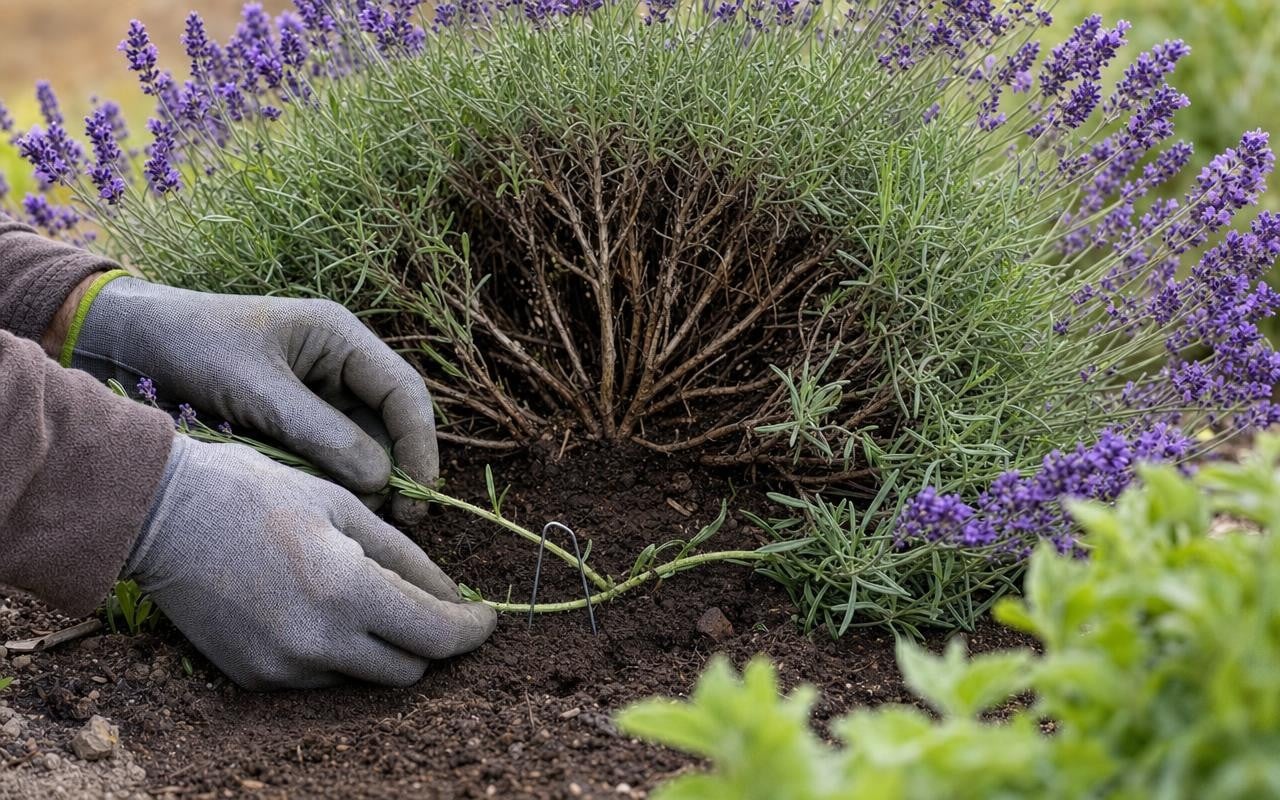
In the garden, many lavender clumps end up looking like a doughnut: well filled around the edge, completely empty in the middle. After three or four summers of flowering, this central hole worries you and gives the impression that the crown is failing, potentially leading to a fresh purchase at the garden center.
This tired appearance does not come from a disease, but from the plant’s normal aging. The good news is that a very simple, ancient, and free gesture done around mid-September allows you to fill this gap by recreating roots at the heart of the bed. The surprise is that this action does not involve cutting, but laying your lavender down.
Why does lavender hollow out in the middle with the years
Lavender is a semi-woody shrub: its base lignifies as it ages, and that hard wood, called woody growth, produces fewer new shoots. The central stems, the oldest, become grayish and brittle, stop flowering, while the outer stems, younger, stay leafy and vigorous. We end up with a bare center surrounded by a still highly fragrant crown.
This phenomenon occurs more quickly if the lavender has never been pruned after flowering or if it has endured several harsh winters. The British gardener Monty Don thus reminds us that “lavender must be pruned every year,” always staying in the green part. The Royal Horticultural Society recommends removing the spent flower clusters by shortening the green leafy zone by about 2.5 cm, without touching the woody heart. This regular pruning delays defoliation, but when the center is already empty, it is no longer enough.
Why mid-September is the right time to act
Experts describe mid-September as an ideal window: the intense heat has eased, the soil is no longer scorching, yet it remains warm enough to encourage the formation of new roots before winter. The plant emerges from its summer dormancy, begins to grow again slowly, while still having several weeks ahead to heal.
Waiting until October or November risks failure, because the new rooting won’t have time to establish before the first frosts. Monty Don also recommends acting as soon as the flowers begin to fade, between mid-summer and the end of August depending on the region. In many gardens, this reference point lines up fairly well with that mid-September period when one can both prune lightly and start the layering.
Layering, step by step, to replenish a lavender “donut”
Faced with a center-cut lavender, severe pruning in the old wood is risky, as that wood hardly regrows. The most reliable method is layering: bend a flexible, still-living stem down onto the soil, partially bury it, and keep it pressed to the ground until it develops its own roots. The newly formed clump will either fill the hollow or become an independent plant.
- Identify a young, flexible outer stem near the thinning area.
- Loosen the soil slightly at the chosen spot, removing stones and debris.
- Gently bend the stem down to the ground without snapping it at the bend.
- Cover the middle portion with 2 to 3 cm of loose soil, leaving the leafy tip exposed to the air.
- Secure with a soft tie, a U-shaped staple, or a small flat stone.
- Water moderately after the operation, then occasionally, without waterlogging.
After a few weeks, the buried part begins to emit roots, like a cutting still attached to the mother plant. You feel a slight resistance when you very gently pull on the stem. It is best to wait until the following spring to check the recovery and, if the rooting is solid, to cut the link with the old stock.
Several mistakes recur: choosing a stem that is already lignified and brittle, watering too much, or brutally cutting back the central old wood in the hope of a new shoot. Experts remind us that old woody parts rarely restart after drastic pruning. A light annual pruning just after flowering, removing about a third of the vegetation without touching the hard wood, coupled with well-drained, sunny, and poor soil, helps keep clumps rounded and dense for many years.
Sources
- Maison & Travaux
“This move with a lavender sprig in a glass of water makes free plants grow that you can no longer ignore” - Mon Jardin Ma Maison
“Lavender that thins out: this Monty Don gesture at the end of summer makes it regrow faster and much more beautiful”
