
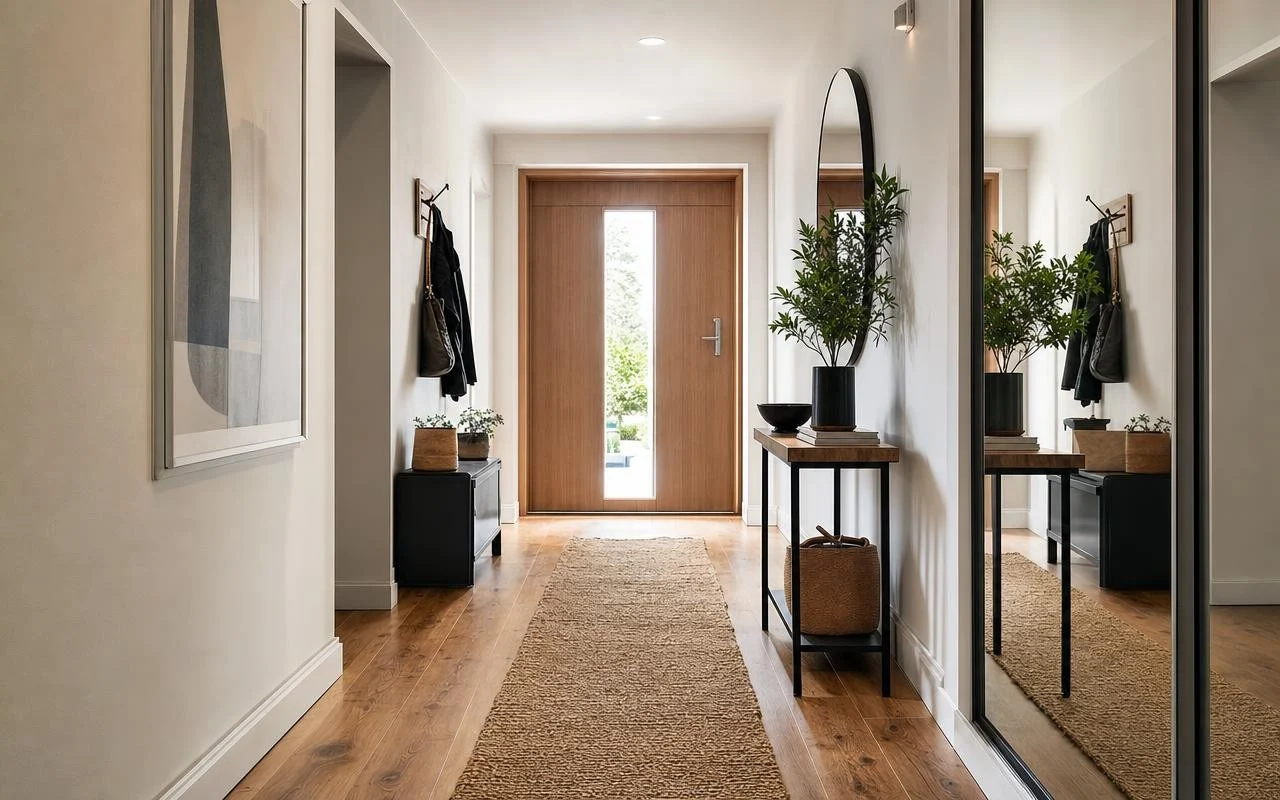
Entering home by walking through a tunnel-like hallway quickly gives the impression of being cramped, even when the space isn’t particularly small. Dim light, dark walls, a ceiling that seems to press down… in just a few seconds, the entry makes the entire apartment feel smaller in the minds of your guests, and in your own as well.
Yet, designers show that three well-thought-out choices are enough to visually enlarge a narrow corridor, without touching a single partition. No heavy renovations, no extravagant budgets: only optical effects that are easy to reproduce for both homeowners and renters. The question is which ones to adopt so that the hallway stops “eating” the entry.
Narrow hallway: how the eye reads space in the blink of an eye
A hallway 90 centimeters wide can feel tiny if it is poorly lit and cluttered, whereas a space of the same width treated with care can seem surprisingly open. The brain does not measure; it interprets. It relies on light, contrasts, vanishing lines, and materials to decide, in a fraction of a second, whether the area breathes or tightens.
In a narrow passage, these cues are often unfavorable: dark walls, a ceiling that visually looks low, a buildup of furniture, the absence of a clear vanishing point. The trick is to flip these cues on their head. Designers rely on three concrete levers for this purpose: a full-height wall mirror, light and continuous walls from floor to ceiling, and a long hallway rug that naturally guides the gaze.
Full-height mirror and light walls: the duo that enlarges the entry
First element, the mirror. Placed on a side wall, a full-length mirror reflects natural light or the glow from fixtures and creates added depth. For the illusion to work really well, experts recommend a minimum height of about 150 centimeters, a very slim frame, and untinted glass. Positioned facing or perpendicular to a window, it bounces light well beyond the actual boundaries of the corridor.
Second pillar, light surfaces. Paint the entry and the hallway in a bright, uniform hue, from off-white to linen beige to a very pale gray, to reflect light and soften angles. Continuity matters as much as color: introducing breaks, friezes, or walls painted in different tones fragments the space. When the ceiling shares the same shade, or a barely lighter one, the edges disappear and the “tunnel” seems to gain height and width. If natural light is lacking, several small light sources (wall lamps, a soft pendant) prevent shadows that press down on everything.
Long hallway rug: the perspective that changes everything in a narrow entry
Third element, often underestimated: the rug. A long and relatively thin runner laid along the circulation axis frames the perspective. Patterns elongated in the direction of movement, such as longitudinal stripes, enhance the depth effect and guide the eye toward the vanishing point at the far end of the hallway. Conversely, a rug that is too short or that is very dark across its surface visually cuts through the passage and reinforces the sense of narrowness.
This textile path also brings everyday comfort: it softens footfalls and protects the floor in this busy passage area. For the trio to work, it must remain legible. The more cluttered a hallway is, the narrower it appears: deep furniture, rows of shoes, or overflowing rails ruin the optical effects created by the mirror, the light walls, and the rug. By combining these three elements, supplemented by well-distributed lighting, a simple hallway transforms into a bright and welcoming entry, without a single hammer stroke.
