
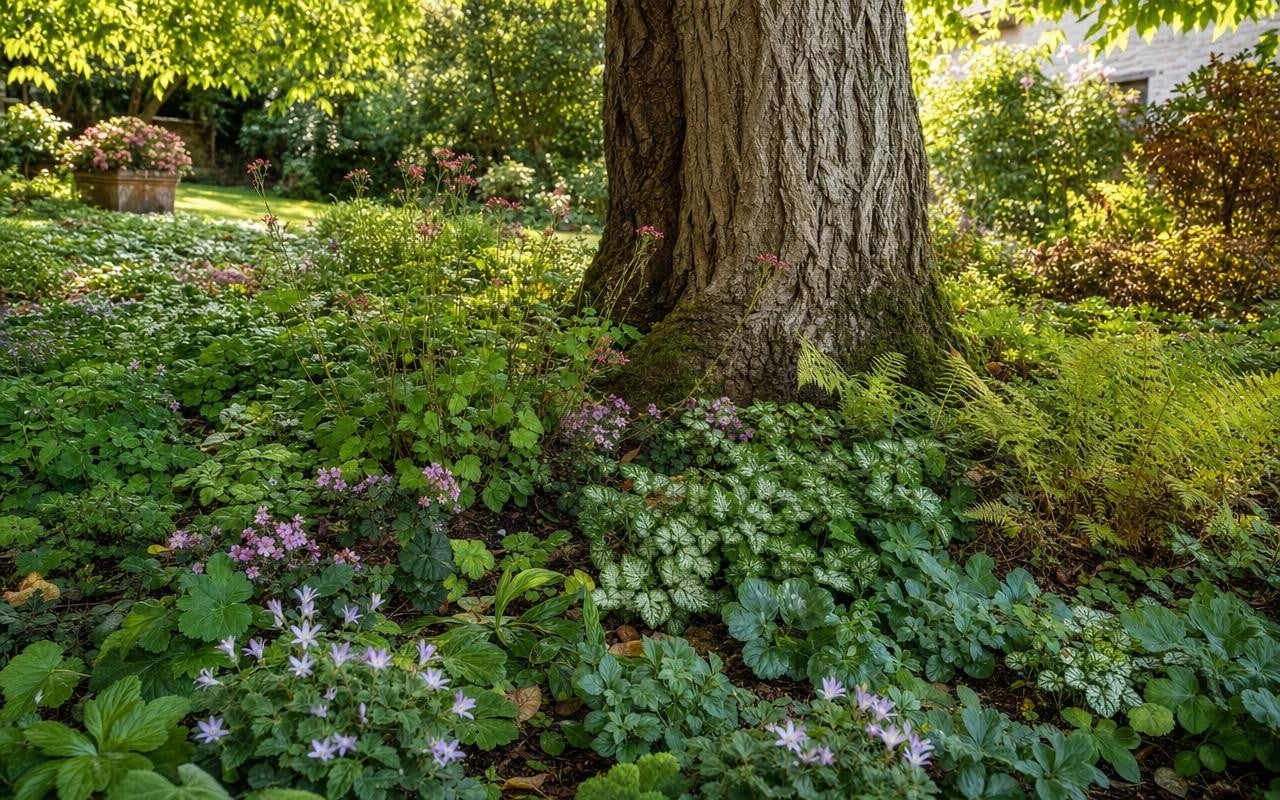
Around the trunk, a ring of dry soil that never greens: many gardens have this unglamorous area at the base of trees. People have tried a few flowers, a bit of lawn, sometimes even a bag of fresh potting soil, without lasting success. In summer, the soil cracks; in winter it compacts, and we end up resigning ourselves.
This space is however not doomed. It signals a zone of dry shade, dominated by the tree’s roots and deprived of light, where only certain perennials can thrive. Planted at the right moment, in early September, these ground-cover plants can completely blanket the soil in two years, with very little watering and maintenance. The secret lies in the late-summer climate, in the choice of a quartet of four species, and in a few planting gestures.
Ombre sèche sous les arbres : comprendre ce qui bloque vos plantations
Under the canopy, the foliage filters light and creates a dense shade where young plants struggle to get started. The large roots seize water and nutrients in the top inches of soil, leaving the ground poor for other vegetation. With repeated foot traffic and a lack of organic inputs, this soil compacts, aerates poorly and dries out very quickly as soon as the heat returns.
In these conditions, conventional border plants or lawn almost always fail. Betting on species that enjoy this context changes everything: some perennials tolerate root competition and drought very well once established. Gardners who succeed transform these surfaces into green carpets thanks to four key plants – Epimedium, Geranium macrorrhizum, Luzula nivea and Polystichum setiferum – capable of colonizing the soil in two growing seasons.
Début septembre : le bon moment pour planter au pied des arbres
The timing of the work plays a decisive role. In September, the heat of the peak summer subsides, but the soil remains warm enough to stimulate new root growth. Rainfalls return more regularly, limiting the irrigation needed and avoiding the heat spikes that spring plantings endure. This period gives the perennials several months to take root before winter, then to resume growth strongly in the following spring.
The method is to open planting pockets between the large roots, without trying to dig a large, uniform hole. Mix into the in-place soil a little well-decomposed compost to compensate for the poverty of the zone. An spacing of 30 to 40 centimeters between each plant offers a good balance: the clumps usually touch after two years, without hindering each other at the start. Planting too tightly creates unnecessary competition, while too wide a spacing leaves bare gaps for too long.
Le quatuor idéal et les bons gestes pour un tapis en deux ans
Each of the four perennials has a role to play. The Epimedium, also known as the elf flower, develops evergreen or semi-evergreen foliage that quickly covers the ground and quietly blooms in spring. The Geranium macrorrhizum, a rhizomatous geranium, spreads rapidly thanks to its creeping roots; its aromatic foliage, sometimes red in autumn, remains dense and is not overly bothered by slugs. The Luzula nivea, snow rush, adds a touch of grass-like texture with its fine stems and pale bloom clusters, well-suited to dry and acidic soils under conifers or tall broadleaved trees. The fern Polystichum setiferum, finally, provides finely cut, evergreen fronds that give structure even in winter.
- Epimedium: covering foliage, spring bloom, very good drought tolerance once established
- Geranium macrorrhizum: rapid growth, aromatic foliage, not very slug-prone
- Luzula nivea: grass-like appearance, suited to dry and acidic soils, decorative year-round
- Polystichum setiferum: elegant evergreen fronds, good dry-resistance with adequate mulching
To speed up their establishment, an organic mulch of 5 to 7 centimeters proves decisive. Shredded leaves or wood chips limit evaporation, suppress weeds and gradually enrich the soil as they decompose. In the first weeks, regular watering helps the roots take hold, then spacing is gradually increased, avoiding any excess that could cause the geranium rhizomes to rot or the fern’s roots to suffer. If the shade remains truly dense, for instance under a large conifer, a light thinning of the crown often suffices to let enough light through for this living carpet to settle in, and, over two years, it will completely erase the bare soil at the foot of the tree.
